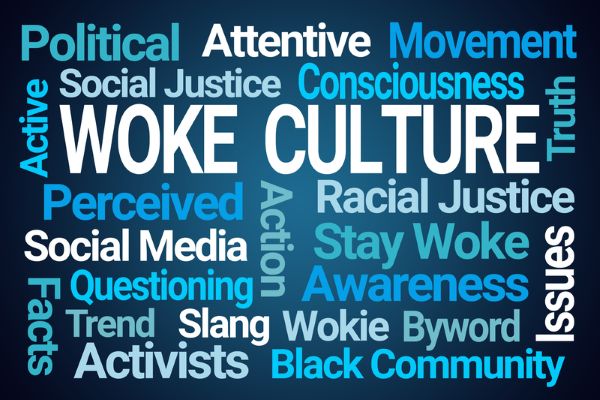
Is the current attempt by the Trump administration to bully American universities as much about its antagonism towards “woke culture” as it is about delegitimizing science?
Woke is street slang for wake up to oppression and fight for civil liberties. The expression “stay woke” was originally associated with the American black community and was first introduced by Marcus Garvey, a Jamaican who urged black people to stay woke in his writings about African national identity.
In the 1960s, “woke” and “wokeness” were popularized by black American songwriters and playwrights from the late 1930s and were words associated with the black power movement.
Today, expressions that include the word “woke” are associated with social, political and systemic inequality and injustice around race, gender, sexual orientation, and culture. To practice “wokefulness” requires awareness of the inequities of modern Western civilization and its history and values, and addresses these systemic faults through actions that come under the banner DEI, referring to diversity, equity and inclusion, programs offered in schools, businesses, and governments.
Associated with left-wing ideologies, “being woke” is seen by right-leaning governments and aligned social groups as harmful to traditional American family values. These groups and governments see American culture as “white” (they don’t overtly state this) and, for the most part, “Christian” (again, no overt admission). In their view, if you are “woke,” you self-identify as LGBTQ+, black, Indigenous, or people who practise Islam or Judaism.
So how has “woke” become associated with science? Likely it started with research in the soft sciences that studied gender, race and health issues. “Woke science” is a term that the right uses to identify DEI practices. The current U.S. administration and supporting conservative groups are anti-DEI and have declared war on perceived woke science as practiced by American universities.
Without acknowledging that American traditional cultural values are as much an imposition on research perspectives as those conforming to DEI, the current Trump administration has used its bully pulpit to issue executive orders that ban DEI policies in businesses receiving government largess and in universities that receive funding and grants from federal departments. The administration has pressured university heads to eliminate DEI references and training, and to fire academic staff associated with DEI teaching. In other words, academic freedom in the U.S. is no longer in practice at schools that comply with the U.S. administration’s DEI policies. The new norm for these schools is self-censorship, deference to the person in the Oval Office, and a voluntary donation to his causes. The risk to universities that do not comply is a loss of billions of dollars in federal research grants, affecting all programs from soft to hard sciences, with subsequent impacts on students and faculty.
Brendan O’Malley, in the November 14, 2025, issue of University World News, describes what he calls the “knock-on impact on international science collaborations, a reorientation of international student flows and a raft of policy changes across other countries to capitalize on the flight of scholars from the U.S.”
The anti-DEI policy of the U.S. administration has caused collaborative research programs with international academic institutions to grind to a halt. O’Malley describes one example, involving Columbia University and the Centre de Recherche du Centre Hospitalier de l’Université de Montréal (CHUM) in Quebec, with the latter receiving a memo notifying it that the project was on hiatus.
The above is just one of many for researchers outside the country who have been collaborating with American universities, receiving grants from the U.S. federal government. The latter has been sending out questionnaires to these foreign researchers asking if there are DEI, climate or environmental elements to their work.
The response from international academia has been universal. Universities outside the U.S. are opening their doors to invite American professors and researchers to join them.
Canada is inviting Americans to cross the border. The latest federal budget earmarks CDN$1.7 billion to attract a thousand U.S. academics. In the last week alone, three academics have announced they were leaving the U.S. to come to the University of Toronto: Sara Seager, an astrophysicist, and Jacquelyn Pless and Mark Duggan, both economists. Toronto’s University Health Network recently launched the Canada Leads 100 Challenge to attract international academics and scientists to relocate to Canada to do advanced medical research, offering two-year funding commitments and other incentives.
There are many other international invitations. Australia’s Academy of Science has created the Global Talent Attraction Program to invite disaffected U.S. researchers and technologists.
The European Research Council is offering €500 million, a seven-year super grant program to attract American academics.
France is aggressively recruiting American scientists and academics with programs like Choose France for Science and the Mission Europe Safe Place for Science initiative, offering up to €15 million over three years, plus support for visas and family accommodation.
Spain has launched ATRAE, a government-sponsored research agency aimed at recruiting American and other international talent.
The Netherlands’ Dutch Tulip Fund was established this summer to attract American researchers to relocate.
The international response to the American administration’s assault on academia and science has not gone unnoticed by students. Those who hoped to enroll in STEM studies in the U.S. are no longer applying. Among them could be the future research leaders in American science. I don’t say this lightly, having written about many American breakthroughs by scientists who have come to the U.S. and achieved their successes in American university research programs and laboratories. Now, international students are aware that America no longer wants them and Studyportals, a site that lists bachelor’s, master’s and PhD programs around the world, confirms a reported 61% decline in international students looking to enroll at U.S. universities.
How can this be happening in the U.S. in this third decade of the 21st century, a period of dynamic and accelerating change covering artificial intelligence (AI), quantum computing, fusion energy, medical discoveries, environmental challenges and climate change on the science and technology agenda?
Governments should be begging to draw science and academic talent. Fortunately for non-American governments, the current U.S. administration is making that much easier.

