
Whenever I engage young people (I’m talking 30 and under, being 76+), I ask them where they went to school and what they hoped to accomplish in life. It seems in a world of continuing crises that finding a purpose is becoming more tenuous. Or was it always this way?
Unlike two of my older brothers, who both pursued medicine, I was a Liberal Arts major studying history in college. When I graduated, I hoped to teach high school history, geography and biology, three of my favourite subjects. But with no teachers being hired and a backlog of teachers’ college graduates looking for work, I didn’t pursue my original plan.
Today, we face rapid technological change, uncertain geopolitics, pandemic threats, climate change and more. Elementary and high schools are increasingly fixated on teaching STEM subjects, the integration of science, technology, engineering and mathematics. Don’t get me wrong. I think STEM has its merits because it focuses on project-based learning and hands-on problem solving, very transferable skills for the working world. But what gets lost with STEM is the arts, communication, and exposure to what we as societies focus on when we remember where we came from and our culture. Without communication and socialization, all the technical learning in the world ends up producing incomplete students.
There is something to be said for encouraging visualization through art to nurture creative problem-solving in engineering and other technology subjects. Courses that teach about literature, philosophy and history reflect how some of the greatest contributors to our technologically advanced world owe their origins to the study of these subjects.

Albert Einstein played the violin and piano, crediting the time he spent on the former as helping him to think through scientific problems. Best known for the telescope, the discovery of the moons of Jupiter and Saturn’s rings, Galileo Galilei was a poet, using his license in literature to help describe his discoveries, and getting him into a lot of hot water with the Catholic church. Sir Isaac Newton used his interest in painting to help solve mathematical and physics problems.
It seems that artistic talent is synergistic with acumen in science. Yet today, liberal education is under fire with an ongoing debate in academia about the purpose of post-secondary education. Should it focus on job preparation, or on creating well-rounded individuals who can contribute to society on multiple levels?
I am a great believer in young people getting well-paying, quality jobs in the gig economy. Today’s world for young people represents a precarious work environment. Those working within and victims of it are called the precariat, characterized by unpredictable employment and psychological vulnerability. Every day, Uber drivers and Skip The Dishes workers show up where I live doing their thing. Their work is called “gigs,” meaning one-off, contract-based, and freelance.
When I played in a jazz-rock band, we would do music gigs about once a week in addition to my regular job selling textbooks. The gigs were something to look forward to. They didn’t cause anxiety like the gigs that young precariat workers are doing today, piece-work jobs that require them to intermittently be on call, that offer no benefits like healthcare and paid sick leave, and no employer-to-employee long-term commitment. The gigs of the precariat world reflect a fragmented working environment for youth and a future of limits.
Today’s employers post job opportunity ads on LinkedIn and other online venues that hundreds will apply to, with few applicants matching the skillset requirements. STEM learning was supposed to help, but it is not. That’s because employers are seeking competencies that are specific to the job requirements, while universities and colleges weren’t designed to provide job-skills training programs and produce micro-credentialed graduates with nanodegrees. And yet, that is what companies seek.
When I graduated with my Islamic Studies and Medieval History B.A., the company I first worked for provided a week-long training program to educate me to do the job. They hired me because of my liberal arts background, thinking I would master the work requirement, which I did.
I often have described the study of history as being a study of everything, including art, music, literature, science, technology, philosophy, and society. This broad exposure challenges the utilitarian education paradigm we see increasingly being taught today. Instead of specialization, exposure to the liberal arts and a generalized curriculum is better suited to solving the problems of the 21st century than vocational and STEM training. Neglecting the arts, history, and the social sciences produces graduates with narrower job prospects and fewer career paths. If employers seek people with nanodegrees and micro-credentials, they should be the ones offering the needed programs, and not academic institutions.
Today’s students need the liberal arts to help them cultivate analytical and communication skills, to allow them to understand the broader consequences of technological innovation on society, such as climate change, or, in the case of artificial intelligence (AI), to the general dumbing down of the population. Communication impacts the ability to write, reason and speak. When a discovery is observed, it would be delightful to read a journal paper that wasn’t written by someone unable to provide clear and reasoned prose. Today, journal articles, of which I have read my fair share to publish the results on this blog site, are often buried in jargon and technical language. The titles can be long and convoluted. Clinical medical research can be cited as an area where the jargon is so dense that the meaning is lost even by medically educated readers.
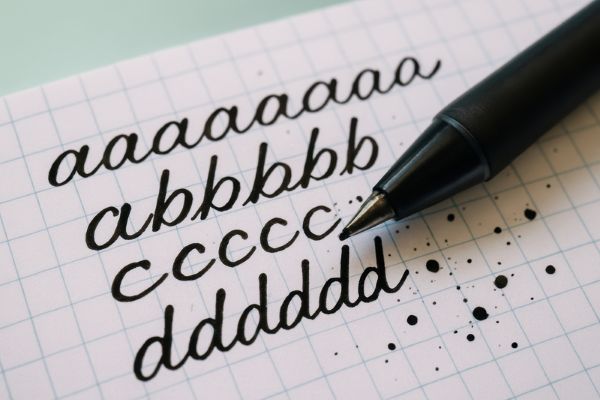
It’s as if the writers of these articles are the same as the doctors we go to, who fill out prescription pads with indecipherable penmanship. There is something to be said for teaching cursive writing skills (see image below), script being a lost art these days.
UNESCO, the United Nations Educational, Scientific and Cultural Organization, describes its mandate as dedicated to the promotion of education, science, culture, and communication. In its efforts to facilitate access to science education, it describes the need for broader skills and perspectives that come from studying the liberal arts. The history of science and technology, and those we esteem as the greatest contributors to these fields, shows us how this UNESCO observation rings true. Taking an artistic approach to solving a complicated engineering or scientific problem works. Just ask Charles Darwin, Benjamin Franklin, Leonardo daVinci, Albert Einstein, Richard Feynman, Carl Sagan, Max Planck, Brian May, the guitarist of Queen and an astrophysicist, and Santiago Ramón y Cajal, the Spanish father of neuroscience.

