
Fifteen hundred workers just let everyone in on a secret while participating in a Stanford Study entitled, “Future of Work with AI Agents.” This study has been described as one of the most comprehensive examinations to date on how artificial intelligence (AI) agents are reshaping the workplace in the United States and elsewhere across a broad range of occupations.
Workers who participated in the study came from 104 different fields. Their answers have created a detailed dataset called WORKBank. Here are some interesting statistics:
- 45% of workers indicated they did not trust AI accuracy.
- 23% feared job loss.
- 46.6% wanted AI for repetitive tasks.
- 69.4% did not want AI to be involved in what they described as high-value work.
Workers divided job tasks into four categories:
- Where AI already existed to help workers do their jobs.
- Where workers didn’t wish to use AI even though the technology existed today.
- Where workers didn’t want AI and where the technology didn’t exist today.
- Where neither workers nor technology developers desired to use AI.
Fifty-two experts were asked to assess worker preferences covering 844 occupational tasks. The results indicated that jobs focused on information processing that were repetitive were likely not safe. Bookkeepers, payroll clerks, data entry specialists, insurance claim processors, tax preparers, and telecom workers were seen as positions where AI automation would replace people.
Worker responses indicated a disconnect between AI developers and those doing jobs. Workers wanted worker-centric AI tools for routine administrative tasks and to support jobs. Respondents, however, felt that developers appeared to be pursuing pure automation wherever it took them with a focus on developing complex business analysis software, a role workers felt was their purview.
Workers saw AI automation as requiring them to change their skillsets. Instead of routine administrative tasks, workers skills would refocus on collaborative teamwork, communication, and the oversight of AI automation. They noted that reskilling would be needed across multiple industries with lifelong learning central to the future of work.
Peter Diamandis describes this AI seachange as “the greatest workplace transformation in human history.”
The graph below summarizes data from WORKBank showing how workers envision AI’s role in the future workplace.
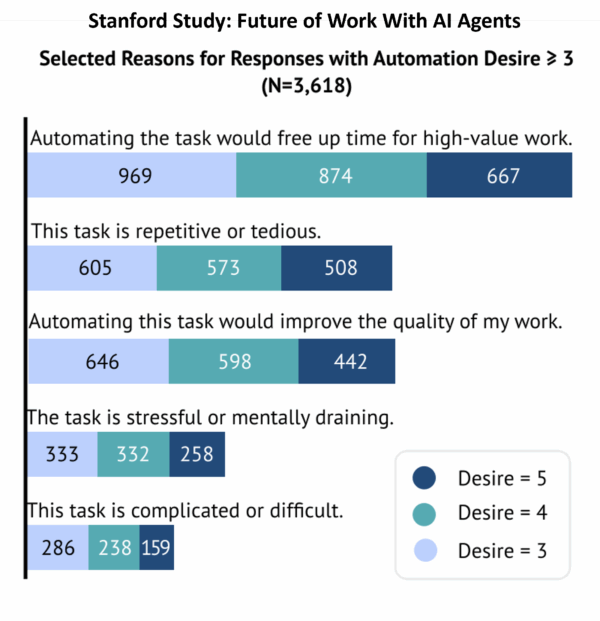
WORKBank Data Shows What Workers Want
It’s not what you think. Workers want AI to do tasks that are prescriptive and repetitive. These roles exist because people have to do them, not because they want to do them. That’s why nearly half of those who participated in the Stanford study wanted AI to take over the repetitive junk in their workday so they could focus on what is meaningful.
If you are facing a work future where AI is being considered, here is an action plan.
The 15-Minute Daily Advantage
The solution isn’t to fear AI, it’s to be curious. Take the time to engage a chatbot and begin a conversation.
To learn and to become a power user, start using AI tools daily to get ahead of the transformation. Take a task you do and ask AI, “How could I do this better?” Every time the AI tells you something you don’t understand, ask it “Why?” or “What does that mean?” or ask it to give you an example, or to slow down an explanation. AI is a patient and personalized tutor when given a chance. Giving AI the raw data can show you how it can transform your work.
The Jobs AI Can’t Touch
WORKBank results indicated that workers resisted AI automation in roles requiring creativity and human judgment. Only 17% wanted AI to handle creative work, and many cited the “absence of human touch” as critical to certain jobs.
This points to a fundamental truth: AI excels at prescriptive, bounded tasks but struggles with work requiring emotional intelligence, creativity, and complex human interaction.
Will AI eventually tackle these areas as well? Probably, but not immediately.
The Winners Versus Those Left Behind
The winners won’t be those who avoid AI or those who get replaced by it. They’ll be the workers who learn to use it to handle routine tasks while they focus on strategy, relationships, and creative problem-solving.
What 1,500 Workers Just Revealed
The Stanford research showed a lack of trust in AI and a fear of job loss. These fears are based on a misunderstanding of what AI does well. It is exceptional at processing information, identifying patterns, and handling repetitive tasks. It’s terrible at uniquely human skills that create real value such as building relationships, making intuitive leaps, and solving novel problems.
Your Next Move (Before It’s Too Late)
Stop treating AI as a threat and start treating it as a tool. The research shows that workers want AI to augment their capabilities, not replace them entirely. Begin experimenting today. Use AI for research, writing assistance, data analysis, or brainstorming. Spend 15 minutes daily exploring how AI can make you more effective at what you already do well.
The gap between AI-savvy professionals and those still operating the old way is widening rapidly. Every day you wait, someone else is building AI-enhanced skills that make them more valuable.
The Bottom Line
WORKBank data confirms what forward-thinking professionals already know: the future belongs to humans who embrace AI as a collaborative partner, and that the transformation is happening whether you participate or not. The only question is whether you’ll be among those who use AI to become more valuable, or among those who get left behind because they refuse to adapt. Your next career move isn’t about finding an “AI-proof” job. It’s about becoming so good at leveraging AI that you become irreplaceable. The data is clear. The choice is yours.

