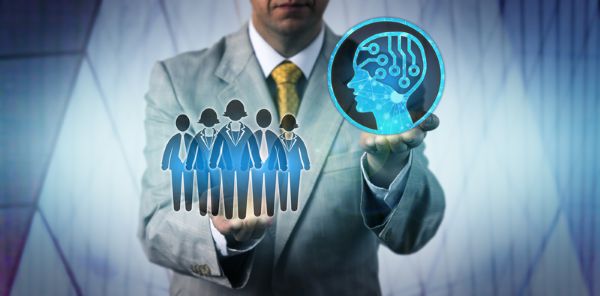
Authors Jim VandeHei and Mike Allen write a column, “Behind the Curtain.” In an article published back in May 2025, they described the unfolding of a coming job apocalypse caused by evolving artificial intelligence (AI) and automation.
When Anthropic’s CEO, Dario Amodei, recently stated that AI will eliminate half of entry-level white-collar workers within five years, causing unemployment rates to jump to between 10 and 20% in that timeframe, his prediction was largely ignored. Amodei noted that at Anthropic, software code was already 90% written by AI, but that the company has yet to lay off its human software developers.
Elsewhere, AI and the future of work are at the front of the minds of academics like those in this recent YouTube discussion held at the City University of New York. The participants describe how humanity is reaching a crossroads where the technology we have created will weigh enormously on us much sooner than anyone a decade ago would have thought.
Over the last week, the concerns about the future of work have shown up in the business pages of newspapers, illustrating a growing threat to human workers. In this instance, the announcement was about Amazon cutting 14,000 jobs, to “seize the opportunity” provided by AI.
Amazon has joined Microsoft, UPS, Target, Meta, Oracle, Dropbox, McKinsey, JPMorgan, Walmart, PwC, Accenture, Nestlé, and Canadian banks, including TD Bank, Scotiabank, and RBC, announcing immediate or planned job cuts in the name of operational efficiency, leveraging shared services, and automating business processes. In other words, big business was favouring AI and outsourcing the jobs of tens of thousands of white-collar workers.
As of the end of July 2025, jobs lost to AI in the United States were already approaching 80,000. Now add Amazon to the tally, and job losses directly attributed to AI in the U.S. are approaching 100,000. This trend isn’t just North American, with the World Economic Forum (WEF) forecasting as many as 80 million global jobs lost to AI and automation by 2027. The range of industries affected includes financial services, information technology, digital communications, logistics and warehousing, legal services, manufacturing, retail, and transportation (autonomous vehicles). Clerical and administrative jobs everywhere are at risk to AIs popping up on mobile phones, pads, laptops and desktops.
This month, Geoffrey Hinton, the “godfather of AI,” is leading a three-day conference in Toronto, with the subject, the positive and negative impacts of AI. Hinton had recently warned that rapid adoption of AI would “increase unemployment while driving higher profits.” He equates this trend less to the technology and more to capitalism as the driver. The current performance of stock prices confirms Hinton’s opinion, with the S&P 500, Dow, Nasdaq, TSE and other exchanges around the world experiencing record highs for a single reason: AI. Businesses have bought into the mantra that AI means more productivity, profit and fewer workers needed. Hinton regularly cautions AI developers and businesses about AI’s long-term risks, advising them to self-impose guardrails, and if not, for governments to impose them.
The questions that need to be asked are:
Are governments paying attention? Some are and others aren’t. Canada has created a cabinet position to oversee policy for AI, digital innovation and automation. The current US administration, with the recent shutdown of the government, appears to be at cross purposes regarding financial assistance, retraining and the future of labour. The recently passed EU AI Act, while recognizing the risks of the technology, remains vague on protecting jobs. Japan recently updated its coverage for workers being laid off by AI and automation, including support for skills development and career transitions.
Are educators paying attention? Universities continue to wrestle with policies and programs aimed at the future of work and the roles AI and automation will play. Some schools are in AI denial, while others are integrating the technology’s use into curricula to establish responsible use. A recent Forbes article written by Samantha Walravens, entitled “Colleges Race to Prepare Students for the AI Workplace,” describes how the goalposts for learning AI keep shifting as employers implement practical uses of the technology to improve performance and profitability. Employers five years ago may have hired students who studied the ethics of AI. Not now! What they want is post-secondary education integrating AI from the first day of class, in other words, future employees who are fluently AI literate, to prepare future hires to synergistically integrate into human-AI teams.
Are workers paying attention? The response varies based on the number of years of employment and the type of work. AI-driven layoffs appear to be closer to reality and not a distant future threat. Recent job cut announcements should not go unnoticed. The new reality is that no type of job will be spared, even those held by scientists, medical researchers, engineers, and lawyers. That’s why current college graduates are facing tougher job prospects everywhere. For the moment, manual jobs, described as non-cognitive, are the least impacted by AI. If a carpenter, plumber, electrician, or another trade, these jobs are currently safe. In time, automation may even catch up with these jobs. For example, 3D printers are now being used to erect homes and buildings. Overall, as AI and automation penetrate every work environment, job growth as a reflection of the health of an economy may become a relic of the past.

