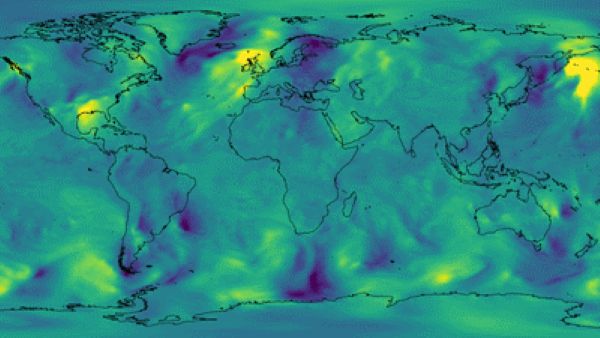
Artificial Intelligence (AI) is being used to sift through volumes of digital data in many fields, from enhanced medical diagnostics to modelling commercial nuclear fusion reactor designs. But can it handle the weather, and in particular, predict the development of tornadoes and their paths, or the strength and track of a hurricane?
Recently, the European Centre for Medium-Range Weather Forecasts (ECMWF), considered to use the most advanced traditional weather forecasting modelling systems, launched its first AI-based forecaster powered by machine learning (ML). The AI forecasting accuracy has proven to be 20% better than existing weather and atmospheric models.
A recent Yale University School of the Environment article published on April 14, 2025, describes the sea change that AI is bringing to the field, stating:
“AI is spurring a revolution in the world of meteorology, allowing forecasts that once required huge teams of experts and massive supercomputers to be made on a laptop.”
What do AI tools see that conventional models and meteorologists do not? It may have something to do with how AI analyzes the physics of weather phenomena that conventional computer climate models do not.
Weather forecasting has seen dramatic improvements in the past few decades because of the existence of more data-gathering instruments here on Earth, satellite observations of our atmosphere, land surfaces and oceans, and more powerful computers.
The Yale article notes that today, “more than 200 billion weather observations” are made daily and fed to supercomputers to churn out daily and longer-range forecasts. Since 2022, however, AI has entered the picture with several competing systems appearing.
- Deep Thunder, from IBM, was a research project started in 1995 to help with forecasts for the upcoming 1996 Olympic Games in Atlanta, Georgia. It became a commercial weather forecasting tool in 2016 and uses a multiscale 3D hierarchical model that provides grid coverage forecasts in 0.32 to 1.93 kilometres (0.2 to 1.2 miles) increments by analyzing data from NOAA, satellites, thousands of personal weather stations and sensors deployed around the world. It owes its origin to IBM’s Deep Blue, the chess-playing AI that made history in the late 1990s. It is still in use today.
- GraphCast was developed using Google DeepMind’s AI weather forecasting model trained using 40 years of historical data, over four weeks, and on 32 computers. It was publicly disclosed in November 2023. The result is an AI weather forecaster capable of predicting the next 10 days using a single desktop computer in under a minute, with results 90% more accurate than current numerical weather prediction models using supercomputers and taking as much as six hours to produce reports four times daily.
- NeuralGCM uses GNNs (graph neural networks) and also comes from Google. It models weather, looking at local vertical atmospheric columns and produces 5-day forecasts 95% more accurate than current supercomputer forecasting systems. It is considered a better medium-range micro-forecasting tool than GraphCast over 5 to 15 days and was first disclosed in July 2024.
- FourCastNet comes from Caltech with contributions from NVIDIA, the Lawrence Berkeley National Laboratory, and several other academic and research institutes. The AI was first described in February 2022. It uses the neural network architecture created to design new-age electrical transformers for the power industry by employing Adaptive Fourier Neural Operators (AFNO) that can also be used to model complex atmospheric dynamics. The results have produced accurate global weather forecasts covering 20 atmospheric variables, including wind, temperature, precipitation and pressure. It is integrated into the NVIDIA Earth-2 large-scale, real-time weather prediction and visualization system.
- Pangu-Weather from China’s telecom giant, Huawei, uses 3D Earth-Specific Transformer (3DEST) architecture trained on 39 years of global historical observations and modern weather models. It generates 24-hour global weather forecasts in 1.4 seconds with greater accuracy than the Integrated Forecast System previously used by ECMWF, and it has been made public on the European site since July 2023.
- Jade AI was developed by Jua, based in Switzerland. Jade uses a large-scale, deep neural network trained on historical global weather data sets that have incorporated observations from satellites, ground stations and other sensing devices to predict future states of the weather. It provides sub-hourly or “nowcasting” forecasts to ones covering multiple days.
The latest Atlantic hurricane, named Melissa, has pummeled Jamaica, Haiti, Cuba and soon the Bahamas. The scientists plotting its trajectory and forecasting have been using the latest version of GraphCast. Google DeepMind has also developed an experimental model for its Weather Lab platform in GraphCast, which is being described by atmospheric scientists in an article published in the journal Nature on October 29, 2025, as being “at the front of the pack” when it comes to modelling the weather.
Stated James Franklin, an atmospheric scientist who served as the chief hurricane specialist in the U.S. National Hurricane Center in Miami, Florida, “I’m not sure I’ve seen such good results from a new model so fast.”
The model being used for Melissa is described as GraphCast plus a cyclone-specific AI version derived from it.
From October 21, 2025, it predicted a 50 to 60% likelihood that Melissa would reach Category 5 on the Saffir-Simpson Hurricane Wind Scale.
A Category 5 storm has wind speeds of 253 kilometres per hour (kph) (157 miles per hour or mph), capable of catastrophic damage, including roof failure, building collapses, flooding from storm surges and rainfall, and long-term power outages.
At landfall in Jamaica, Melissa was a Category 5 hurricane. It has left communities isolated, with 90% of homes and buildings, as well as damaged infrastructure. Severe flooding and landslides have been reported. The confirmed fatality count is currently 4.
Haiti did not experience a direct hit from Melissa at Category 5, but reported heavy rainfall, catastrophic flooding and landslides and between 23 and 25 deaths, damaged homes and disrupted water supplies.
At landfall in Cuba, Melissa was a Category 3 hurricane (wind speeds of 178 to 208 kph (111 to 129 mph). Extensive evacuation efforts involving 735,000 Cubans have largely limited the damage to infrastructure. Category 3 and above are defined as major hurricanes that spawn tornadoes, heavy rain and storm surges in addition to high winds.
At landfall in the Bahamas, Melissa was downgraded to a Category 2 to 3 hurricane. Category 2 hurricanes achieve 154 to 177 kph (96 to 110 mph). As of now, there are no missing persons reported with extensive flooding on some islands. The main tourist centres, Freeport and Nassau, have been spared.
With global warming from climate change, better climate modelling using AI should prove critical for adaptation as the 21st century unfolds.

