Microsoft conducted a recent study, “Working with AI: Measuring the Occupation Implication of Generative AI,” which identified future jobs under threat. Just behind interpreters and translators were historians.
This result is interesting because when people ask various AI chatbots questions, it turns out that 91% of their queries have historical context. That’s because chatbots draw on vast amounts of text generated in the past. Some of these documents are written by historians. Others are primary and secondary sources with a historic context. Historians, in an effort to describe the past, in part, derive their understanding from these and other sources.
Is the Microsoft study right? Does this mean historians in the age of AI will become irrelevant?
I declare a bias on this subject since, as an undergraduate, I pursued a degree in history. If my opinion is worth anything, I see an AI substituting for historians as defined by the sources Microsoft used, as wearing horse blinders. If unfamiliar with blinders, history tells us these were pieces of cloth or leather attached to the reins used with horses to limit their field of vision. Horses were fitted with them to stop them from getting spooked by something in their field of view. Horses’ eyes are on the sides of their head, unlike humans. To keep them focused, the blinders restricted vision to only what lay ahead.
The top 10 list of threatened jobs in the study comes from the O*NET jobs database developed by the U.S. Department of Labor and from 200,000 conversations with engaged users of Microsoft’s Bing Copilot AI. Here are the jobs that made the top 10 threatened list: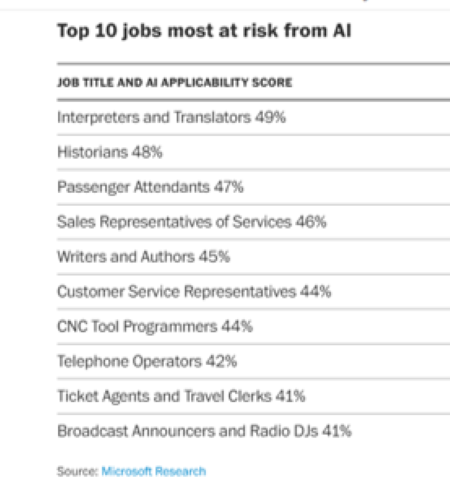
Three of these ten jobs are among the ones I have done, intended to do or am doing now: sales representative, historian and writer. As a writer, I freely admit to using an AI Chatbot, but not to replace me. I ask the Chatbot questions to identify original research and articles for the subjects I write about. I like to read Chatbot summaries, which appear quite formulaic. As a result, I can state categorically that I am a much better writer than any of the ones I test when it comes to punching out lines of prose.
As for sales, I doubt an AI could accomplish the kind of work I did to win lucrative business for my clients through the application of knowledge I gained from one industry to make it relevant to another. That took considerable sleuthing and an ability to identify solutions for my clients’ needs.
And then there is the job I first aspired to do, historian. At the University of Toronto, I studied the history of Islam and European and World Medieval history. I hoped to teach at a high school, but when I graduated with my B.A., there were no teaching job openings. I considered doing a master’s program at a top U.S. university based on the recommendations of my professors, but this was during the height of the Vietnam War, and when several American friends who were drafted ended up dying over there, I put that dream aside. For a few years, I took a job selling educational books aimed at colleges and universities. I found I could talk to professors about curriculum needs and help them select appropriate textbooks for their students.
The technology and science books I sold were among the many I read. Self-education taught me about computers, networks, and software. I learned to document systems and programs. I developed ideas and solutions to market to technology companies to help them achieve business goals.
More than 40 years later, and retired, I decided to write about science and technology because of my collective experiences, plus a childhood fascination with these subjects. My sales experience taught me how to master a complex subject and explain it in lay terms to an audience.
The past gets me back to the present, and whether the history is mine or that of a nation or nations, embracing the past in its entirety is what historians do. Historians look at events, and the sum extent of human achievement in science, technology, literature, sports, music, art, and more. They are the record keepers of humanity, from the first words we carved into monuments and printed on papyrus and parchment to the digital world of today.
As for the Microsoft study, I am convinced that its interpretation of history was the same as that of many of my friends who, in university, opted to go into dentistry, medicine and law. They saw history as dates and names. Some took first-year history survey electives to get a pass and faithfully regurgitated dates and names fed to them. That is not, however, what being a historian is all about.
In an article appearing in The Washington Post, Brendan Gillis, a historian at the American Historical Association, describes historians as “the utility infielders of the workforce baseball team.” I love the baseball reference because I am a huge fan of the sport and have studied its history. In that same article, it draws on data from the New York Federal Reserve Bank, whose data shows that history graduates have lower unemployment rates at 4.6% than recent computer science graduates at 6.1%.
A former Smithsonian Institution historian and head of the American Historical Association, Sarah Weicksel, believes that AI may change the nature of being a historian, not eliminate it. She argues that AI cannot contextualize information the way historians do, and recalled her PhD adviser telling her that remembering event dates isn’t the historian’s raison d’être. Instead, what is important is interpreting the events in the context of the times in which they happened.
What historians do is construct detailed narratives of the past about how societies, cultures and events have evolved. They analyze past events to understand their significance. They study primary and secondary source documents (remember most written history is written by the winners, not the losers and underdogs), archeological artifacts, and engage members of societies where oral rather than written histories exist. A historian’s importance to a society is to help it understand its present by studying and interpreting the past to ensure that future generations learn from the legacy.
I asked an AI Chatbot, “What would be lost if AI replaced historians?” These are its main points:
- A loss of contextual understanding and interpretation of events that shape a society.
- A lack of ethical and philosophical judgment on what sources to trust and how to recognize historical bias.
- The lack of creativity in framing historical problems and connecting disparate ideas and events to gain a deeper insight into past events.
See, even the AI gets the significance of historians.
I leave you with this final thought. It was George Santayana, a Spanish philosopher and writer, who, in 1905, wrote in “The Life of Reason:”
“Those who cannot remember the past are condemned to repeat it.”

