The world’s largest carbon sinks capture anthropogenic and natural carbon emissions. Carbon sinks on land are usually seen as playing a predominant role in the carbon cycle. The oceans, however, play a much bigger role.
What is the carbon cycle? It is the interaction of the carbon contained in all living things with the atmosphere, oceans, and land. There is a natural carbon cycle and a human or anthropogenic cycle.
The natural carbon cycle can be rapid and slow. Photosynthesis in plants absorbs carbon dioxide (CO2). Animals consume plants and other animals, absorbing the carbon and expelling it through respiration, and in death, through decay. The second slower natural carbon cycle is the one created through geoweathering, with carbon mixed with water getting absorbed into the soil and mineralized over time. A good example of the latter is carbonic acid combining with sandstone or shale to become limestone.
The anthropogenic carbon cycle is fuelled by the activities of humans involving fire, from the burning of wood to fossil fuels, and from agriculture, forestry and industry. The amount of anthropogenic carbon produced annually equals 40 to 46 billion tons. This carbon output exceeds the ability of natural carbon sinks to absorb it.
The ocean is the most significant carbon sink on the planet. CO2 can mix with seawater. Our oceans contain 50 times more carbon than Earth’s atmosphere. Before the recent study that I will soon describe, it was estimated that our oceans had absorbed nearly 30% of anthropogenic CO2 emissions since the beginning of the Industrial Revolution.
In addition to our oceans being a carbon sink, they are also home to a vast number of carbon life forms, from phytoplankton to whales. These generate carbon emissions, with phytoplankton alone producing 50 billion tons annually, of which 10 billion get distributed through the water column, eventually migrating downward into the deep ocean.
Although all forms of natural and human terrestrial carbon sinks accumulate more carbon than the ocean, it is the latter which represents the most significant tool that we can use to help mitigate global warming caused by rising atmospheric emissions.
A new study from the Plymouth Marine Laboratory, the GEOMAR Helmholtz Centre, Heidelberg University and Heriot-Watt University suggests we need to rethink the relationship between atmospheric and seawater CO2. It suggests we could enhance ocean uptake of carbon by mimicking those areas of the ocean where turbulent seas interact with the atmosphere.
The ocean is both an absorber and an expeller of CO2, with absorption happening where air and water meet in the presence of wind and waves, and with expulsion happening in calmer areas as carbon life forms outgas CO2 through transpiration and respiration.
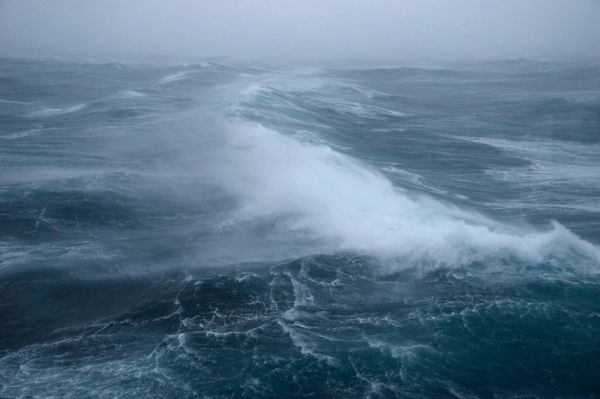
Where ocean waters run unopposed by continents and fed by winds, absorption is significant. The best place to see this is south of the Capes of Good Hope and Cape Horn and north of Antarctica, where Southern Ocean wave action engulfs atmospheric carbon at a more significant rate than anywhere else on the planet. CO2 gets absorbed by “bubble transfer.”
Bubble transfer happens when an air-sea interface is enhanced by wave and wind action in the top metre (3.3 feet) of ocean water. Wave-breaking is a fast way to absorb significant amounts of CO2. Bubble transfer could account for as much as 40% of the ocean’s net carbon intake.
Air bubbles contain much more than CO2. The atmosphere is mostly nitrogen with lesser amounts of oxygen. Wave breaking creates bubbles of air with asymmetric gas solubility. Subsurface hydrostatic pressure compresses the bubbles, driving the nitrogen and oxygen out and absorbing more of the trace gasses of which CO2 is the most common one.
Artificially emulating natural bubble transfer through engineering is likely unfeasible. But the idea of putting ocean water in motion could be a way to increase CO2 drawdown. Pumps could circulate deep ocean water to the surface to increase phytoplankton, which would absorb carbon. The same pumps in reverse mode could funnel the outgassing from phytoplankton through its life and death cycles back to the ocean depths. Could this further increase the ocean carbon sink? Is it a better idea than pumping aerosols into the atmosphere and other proposed solar geoengineering solutions? Maybe.

