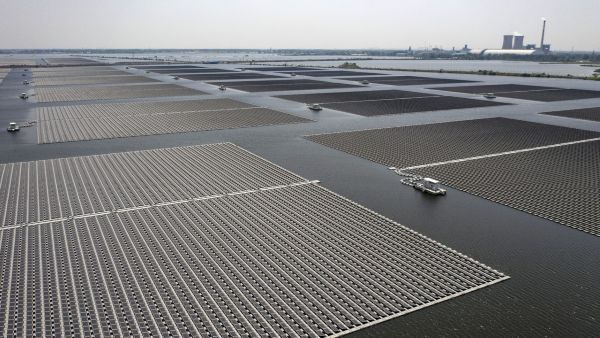
Since the beginning of Donald Trump’s second term, sustainability is no longer a U.S. government priority. Instead, the challenge to mitigate climate change and save the future of humanity appears to lie more in the hands of China, the largest greenhouse gas (GHG) emitter on the planet.
China’s Rush to Modernity
For several decades, the Chinese government has promoted rapid modernization. That demands electricity. To generate electricity, China turned to domestic and imported coal. Today, China burns more coal than the rest of the world combined.
According to the Visual Capitalist, in 2024, China produced and consumed 4.78 billion tons. A distant second was India at 1.08 billion tons, followed by Indonesia at 836 million, the United States at 465 million, Australia at 463 million, Russia at 427 million and South Africa at 235 million.
China’s Climate Change Pivot
In 2026, China will launch new plans to address climate change, reconciling the issue with its continuing economic ambitions as the leading manufacturer on Earth. Part of its manufacturing remit is clean technology, which the country continues to export to Developing World countries in the form of solar panels and wind turbines, to help them make the energy transition from carbon.
At this past international climate meeting in Belém, Brazil, China updated its 2035 NDCs (National Determined Contributions) as follows:
- For the first time, the country pledged to reduce its total greenhouse gas emissions by 7 to 10% from peak levels. Before this, China never announced reduction goals, but rather an easing in the country’s carbon intensity, a measure of GHG emissions per unit of GDP.
- It pledged to continue reforestation and afforestation efforts by 24 billion cubic metres beyond the country’s current 2030 target. Current efforts have increased the country’s forest coverage from 12% in the early 1980s to 24% in 2022, rehabilitating over 500,000 square kilometres (193,000 square miles), and stopping the desertification of its northern provinces in China’s “war on sand.”
- It announced a target of 3,600 GigaWatts (GW) of wind and solar capacity to be added by 2035 to the existing 1,100 GW of solar, and 573 GW of wind. The country has already surpassed the previously announced 2030 goal and is producing six times more wind and solar than existed in 2020.
- It pledged to raise non-fossil fuel energy as a percentage of its total energy capacity by 30%. Currently, renewables, including wind, solar, geothermal and hydro, account for 40% of the total.
- It plans to expand the national carbon emissions trading system (ETS), which currently covers the steel, cement, and aluminum sectors, to include all major industrial emitters by 2027, including chemical, petrochemical, civil aviation and pulp and paper sectors.
As promising as these climate change pledges are, and the country’s efforts to date, the Climate Action Tracker rates the country as “highly insufficient,” largely because of its immense reliance on coal for energy production. But China stands in good company. For example, Canada’s NDC rating was “highly insufficient,” the European Union’s was “insufficient,” and the United States was “critically insufficient.”
In March, China’s National People’s Congress (NPC) reconvenes for its annual meeting. Largely a rubber stamp for the Communist Party’s central leadership, the next five-year plan will be approved. Will the plan enhance the commitments already pledged at COP30? Lili Pike of Bloomberg sees the key number to watch will be China’s target for carbon intensity. Pike notes that the country is “currently off track from its last five-year plan, created in 2020.” Will the plan the NPC rubber stamps include efforts to close the gap?
China, Developing World Countries And Climate Change
As for China’s support for Developing World ambitions to go greener, the country’s Belt and Road Initiative (BRI) has been providing financial support for green energy projects in over 150 countries.
At COP30, its climate finance investments were not disclosed. The previous meeting at COP29, however, stated that since 2016, the nations of the Developing World had received loans and contributions from China in excess of 177 billion Chinese Yuan (CNY), greater than US$24.5 billion.
Chinese solar panels and electric vehicles (EVs) are visible across the globe, except for North America, where imposed Trump tariff barriers have restricted the flow. Akshat Rathi of Bloomberg notes that in countries like Bangladesh, off-grid home solar panels are speeding up rural electrification and have set records.
Elsewhere, solar panels and battery sales to Pakistan are causing that country to accelerate its transition from natural gas as a primary fuel. For Ethiopia, in its move to reduce gas and diesel pollution, the country has been importing Chinese electric vehicles at a record pace. China’s EV exports now span more than 200 countries, with most in the Global South. Total numbers for 2024-2025 reached 5.5 million. These countries see Chinese green imports as a way to reduce their dependence on fossil fuels, improve urban air quality, and electrify transportation. Rathi predicts these Chinese green exports will keep rising in 2026.

