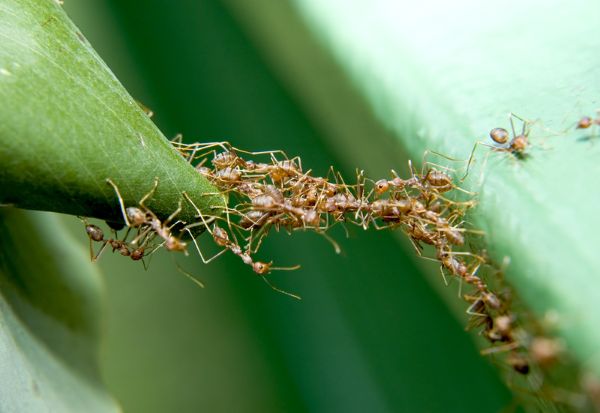
There are more than 8 billion humans on Earth, but there are an estimated 20 quadrillion ants. We humans are down to a single species, and yet we are relative newcomers to the planet, with our ancestry dating back 7 million years. Australopiths, Habilis, Erectus, Neanderthals, Denisovans and Florensis represent our past, and all have become extinct. Compare our limited biodiversity to ants. Ants have been around for 168 million years. They number 30,000 species, with 180 new ones found each year. So, one wonders whether the ants or we have a better shot at surviving into the future.
About Ants and Climate Change
Ants can be found on all continents and islands other than Antarctica. Since they are ectotherms, cold-blooded, they adapt best to warm climates. In colder parts of the planets, ant colonies create thermal-buffered colony environments to ensure their survival.
Global warming, therefore, one would think would be a boon to ant species. Based on a study done by the University of Colorado, Boulder (CU Boulder) and the University one by the University of Colorado, Boulder (CU Boulder) and the University of Michigan, however, climate change could pose an equal threat for them as for us.
Ants can only do so much to stop becoming overheated in increasing heat and drought conditions, as those described in the CU Boulder study of Gregory Canyon over 60 years, turning habitable environments into no-go zones in the future.
Ant Skill Sets
Besides forming communities, ants have another skill that we humans have always thought of as making us distinct from animals. It is the ability to communicate. Where we use language, gesture and physical contact to communicate, ants have perfected, over millions of years, sophisticated ways to connect within their species.
Lots of animals and even plants communicate. Some can do it across species. From bacteria and protozoa to insects, birds, amphibians, reptiles and mammals, communication has proved a skill that is key to survival.
With ants, like termites and bees, socialization represents another critical evolutionary trait that is key to survival. Ant colonies are stratified communities featuring workers, nurses, cultivators, soldiers, drones and queens. Ants communicate in three ways:
- Chemically involving pheromones excreted from exocrine glands.
- Tactilely through stroking and brushing of antennae including lead-ant touching to attract others to form tandem running chains.
- Tapping and rubbing of specific body parts.
Ants can call others to help them, convey when they have discovered a threat, and recruit others to do specific tasks like foraging, digging and colony maintenance. A wide variety of ants detect Earth’s magnetic field and use it for navigation. We use a compass, dead reckoning and GPS.
Ants do many things that we do, but often do them much better. They are conscientious recyclers. When a piece of food drops or we inadvertently squash a bug on a sidewalk, we soon watch ants dissect and carry the find away.
Ants are equal cultivators to us, managing, maintaining and harvesting plants for food, and pollinating and distributing seeds. Ants, in digging and maintaining colonies, are great soil aerators. Although we think of ants in our homes as pests, laying traps for them, outdoors, they serve us well as effective pest controllers.
Ants can even store carbon to help fight anthropogenic climate change.
Ant Studies Describe Future Climate Consequences
The UC Boulder study that has observed ant populations over six decades in Gregory Canyon near Boulder, Colorado, has recorded population species shifts in response to rising temperatures. It shows declining biodiversity and the destabilization of the local ecosystem.
The fear of an insect apocalypse has been on the minds of entomologists and climatologists as global warming alters marginal environments. This study is a case in point.
A previous 2022 study involving the University of Liverpool in the U.K. describes the importance of ants in stabilizing ecosystems, describing them as “key contributors to many ecosystem processes.” It states that global warming will negatively affect tropical ant species that live in the tree canopy and leaf litter environments. Whereas ants living in temperate zones and “those able to thermally buffer their nests in the soil or behaviorally avoid higher temperatures” may benefit from a warming climate.
This earlier study describes the direct effects of climate change on ant populations, looking at rising temperatures, increased levels of carbon dioxide (CO2), precipitation, and ultraviolet radiation. It goes on to describe likely drying scenarios in the rainforests of the Amazon, Central and West Africa, Indonesia and Malaysia by the end of this century and the negative consequences for ant biodiversity. Large-bodied and black ant species will be the most negatively impacted. In addition, ant species with limited foraging behaviours will equally be at higher risk as changes in climate conditions for existing colonies make them uninhabitable. That means species that travel well will prove far more adaptable.
The study also notes that nocturnal ant species will be negatively impacted by global warming as night temperatures continue to rise. Nocturnal ants have lower thermal tolerances than species that are day active. Daytime ants may shift to becoming active at night, putting stress on nocturnal varieties.
Any way you look at it, ants as bellwethers of climate change will see dramatic range shifts, having negative effects on co-dependent plant and animal species within current habitats. The cascading consequences across the wider food web remain unknown.

