The energy industry is undergoing significant changes, with breakthroughs happening in battery technology, solar photovoltaics, hydrogen and nuclear fusion. Enjoy the read.
A Flow Battery Backup That Could Enhance Rooftop Solar

Australia has adopted solar almost as much as China, with innovation driving new battery design. Homes today with rooftop solar panels that use lithium battery packs for backup can see an additional US$10,000 added to their total cost. In a search for a more affordable solution, Monash University researcher Wanqiao Liang, from the Department of Materials Science and Engineering, has led a team developing an aqueous flow battery alternative to replace lithium-ion battery packs for rooftop solar panel installations.
Flow batteries are not a new technology. They have been around for decades, providing large-scale energy storage backup for utilities and industries. They feature two electrolyte solutions stored in separate tanks that feed a cell stack, featuring a semipermeable membrane, allowing free ions to pass through to generate a current while keeping the liquids apart.
Flow batteries are used to back up solar and wind farms. Solutions used vary, but the most common combination is vanadium-redox (like the battery seen above). Other flow battery types include zinc-bromine, iron-chromium, aqueous-organic, metal-air, polysulfide-bromine, sodium-bromide and polysulfides.
The biggest knock against flow batteries has been their exotic chemistry requirements as well as their size and slow recharge times. All these three have made flow batteries impractical for residential rooftop solar deployment, that is, until now.
Liang and her Monash team have been developing an aqueous organic flow battery, featuring a membrane with vastly improved ion exchange performance. She describes the merits of their invention as follows:
“This is the kind of battery you’d want in your garage. It’s non-toxic, non-flammable, and made from abundant materials, all while keeping up with solar power on a sunny day.”
An article appearing in Angewandte Chemie, a journal of the German Chemical Society, in May 2025, notes that the new battery has proven reliable through 600 recharge cycles without any performance loss.
The Monash team has been 3D-printing prototypes for tests with the expectation that a commercial flow battery will be available on the market in a few years.
Perovskite Tandem Solar Cell Hits 33.1% Efficiency

Perovskite is seen as an alternative material for use in solar panels. The best performance from silicon-based solar cells today gets you efficiencies between 20 and 27%. What does that mean? The percentage indicates how much of the sunlight striking a panel gets converted to electricity. Achieving higher efficiencies beyond silicon’s limits has always been a driver for innovation in this industry segment, and tandem solar cells that combine silicon with another material seem the route to go. That’s where perovskite comes in.
Readily available and inexpensive, perovskite photovoltaics have been around for a decade. On their own, perovskite panels aren’t as energy conversion efficient as silicon. But when the two are combined in a tandem cell, the results are very encouraging.
A tandem solar cell involves two layers: perovskite in the upper and silicon in the lower. The work being described here involves the collaboration of researchers from King Abdullah University of Science and Technology, the University of Freiburg, and the Fraunhofer Institute for Solar Energy Systems. The result is a tandem cell with energy conversion efficiencies of up to 33.1%.
The cell has a textured surface to increase the area that sunlight strikes, which enhances energy conversion efficiency. To make the mating work, these tandem solar cells use diaminopropane dihydroiodide added to the perovskite surface. In a press release from the University of Freiburg, Stefan Glunz, Professor of Photovoltaic Energy Conversion, states:
“Surface passivation of solar cells is not just a nice-to-have feature; it is an essential booster for their efficiency and stability. For today’s silicon solar cells, surface passivation was the key for high efficiencies in industrial production, and it is encouraging that the photovoltaic industry will benefit from these positive effects for perovskite silicon tandem solar cells as well.”
Can Hydrogen Eliminate Fossil Fuels?
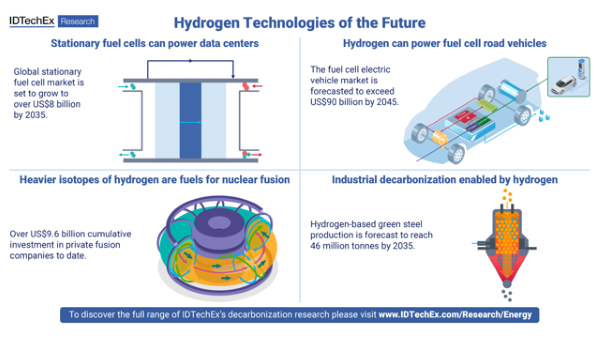
Eve Pope, a Senior Technology Analyst at IDTechEx, recently wrote about the role that hydrogen and helium will play in the energy mix of the future. I have borrowed some of her content for what follows, beginning with hydrogen.
Hydrogen fuel cells convert hydrogen gas into electricity through a chemical reaction with oxygen. Solid oxide fuel cells can last a long time, which makes them suitable for continuous power generation for the growing demands of data centres and AI hubs. Currently, some data centres are already using natural gas plus solid oxide fuel cells. Transitioning to hydrogen to reduce carbon footprints should soon be commercially feasible.
For automobiles, the fuel cell has always been an exotic competitor to lithium-ion battery stacks in the vast majority of today’s electric vehicles (EVs). Toyota is one of the few manufacturers building EVs powered by fuel cells. The impediment to the future growth of this transportation technology alternative to lithium-ion will be the rollout of hydrogen refuelling infrastructure.
Hydrogen for aluminum, steel and cement production is the next evolutionary step for these industries. Hydrogen-based DRI (H2-DRI) processes represent the next logical evolution to green these primary manufacturing industries. IDTechEx has produced a Green Steel 2025-2035: Technologies, Players, Markets, Forecasts report that predicts that by 2035, 46 million tons of steel will be produced annually using hydrogen.
Hydrogen also has a role to play in the future of nuclear energy. Canada’s CANDU fission reactors today use deuterium (heavy water). Deuterium is a hydrogen isotope that is twice as heavy as hydrogen. Future commercial fusion reactors will use deuterium as well as tritium (see the next subheading) as essential fuels.
IDTechEx has produced a report entitled, Fusion Energy Market 2025-2045: Technologies, Players, Timelines, that highlights the race to commercial fusion reactors, describing material opportunities and supply chain challenges.
Among the challenges facing hydrogen is sourcing a green version of the gas. Today, if not naturally sourced, most of the hydrogen produced is a byproduct of fossil fuel production. Hydrogen, however, exists in abundance in water, and that can be the primary green resource using electrolyzers to separate the gas from oxygen. To be perfectly green, electrolyzers need to derive energy from renewable sources.
The electrolyzer sector is still in early growth stages, with the need to create a supply chain containing catalysts, electrodes, porous transport layers, gas diffusion layers, bipolar plates, and gasket sources. Future electrolyzer innovations will need new catalysts with less iridium because the latter adds to the cost. For gas separation membranes, new palladium-alloy metallic membranes need to be developed to unlock ultra-pure hydrogen separation.
The helium challenge may be bigger than the ones faced by hydrogen.
Helium natural reserves exist underground, found along with natural gas deposits. To harvest the helium, the gas needs to be captured as it escapes during initial drilling and exploration. Otherwise, it rapidly escapes into the atmosphere into space.
Helium is used by many industries. It is a coolant for MRIs and for semiconductor manufacturing processes. It is used by companies developing artificial intelligence (AI) Large Language Models (LLMs), and in the creation of autonomous vehicles. Demand for its thermal management properties continues to grow. How much? Read the Helium for Semiconductors and Beyond 2025-2035: Market, Trends, and Forecasts from IDTechEx to get a good idea of how essential helium is for now and the future.
One of the justifications for the Artemis Program to return to the Moon is the existence of abundant amounts of Helium 3 in the lunar regolith.
New Energy Sources to Fuel Future Fusion Reactors
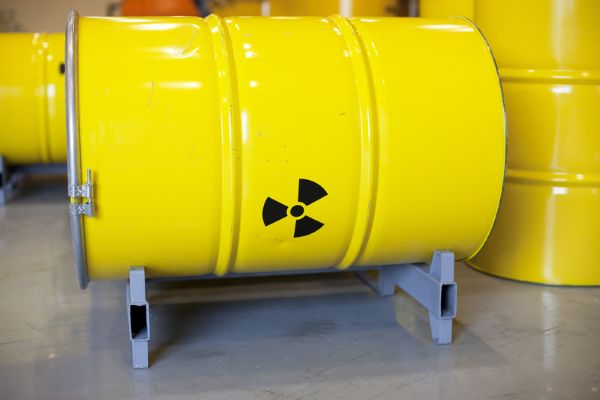
Tritium, like helium, is a scarce material. It exists in trace amounts in the atmosphere with a half-life of 12.3 years. Total natural reserves, therefore, are minuscule. The current source for tritium comes from Canada’s CANDU reactors, which produce a few dozen kilograms annually at a price tag per kilo of US$33 million.
Tritium is the fuel of the future commercial nuclear fusion sector. It combined with deuterium produces vast amounts of energy from very small amounts with minimal waste.
Other fission reactors can be a source of tritium, but it needs to be harvested from the spent fuel they use. That’s where scientists at America’s Los Alamos National Laboratory (LANL) have been looking to create tritium from nuclear waste using a particle accelerator to bombard the spent fuel. The accelerator would switch on and off to avoid the risk of a runaway nuclear reaction.
Terence Tarnowsky is a physicist at LANL who is spearheading the research project. It would require a 1 Gigawatt energy source (roughly equivalent to the annual energy needs of 800,000 homes) to power the particle accelerator with a net yield of about a kilogram of tritium per year.
With no other Earthly source for tritium, very little cosmogenic-sourced tritium to be found beyond Earth, unless lots of new CANDU heavy water reactors are manufactured, tritium will remain a very scarce and valuable material.

