In our battle to mitigate climate change, personal transportation choices are narrowing. Electrification and zero emissions are what we expect to see become predominant by the end of the 2030s. If gasoline and diesel vehicles are still on the road by then, direct air capture and natural carbon sinks will, hopefully, offset the emissions these continue to produce.
What else should we expect to see in personal transportation innovation as we finish the decade of the 20s and head into the 30s and beyond?
IDTechEx has some ideas on what to expect in the cars and the infrastructure to support personal transportation over the next two decades. Its market research reports on Electric Vehicles, Robotics & Autonomy and Fuel Cell Vehicles when combined, provide a showcase of what our driving future will become. So, what’s on the horizon?
Invisible Charging – Building wireless charging infrastructure is likely to become a standard feature for roads and parking, making it possible to keep vehicles moving without having to stop. The current wait to recharge is already getting shorter as new battery technologies from companies like BYD make it into the mainstream. A 5-minute charge will be no different than the 5-minute stop drivers have to make today to refuel with gasoline or diesel.
In parking lots, instead of seeking a plug to recharge your electric vehicle (EV), seamless and invisible charging will become possible from powerful coils fitted underground, ready to provide energy through powerful magnetic resonance or induction. An EV will automatically charge without the driver, eliminating wait times.
On roadways with built-in charging zones, EVs will top up their batteries while on the move. An IDTechEx report, entitled Wireless Charging Market for Electric Vehicles 2023-2033: Technology, Players and Forecasts, describes what it believes will be the future of road-charging infrastructure.
Hydrogen-Powered Transportation – Hydrogen fuel cells have been around for several decades. For personal transportation, they have never gone mainstream. Toyota is one of the few who have tried to launch fuel cell cars with little success.
The challenge has always been how to make hydrogen to power fuel cells sustainably. It may be the most abundant element in The Universe, but on Earth, free hydrogen is a rarity. Only recently, a natural hydrogen deposit was discovered in France, estimated to contain 46 million tons. That’s enough hydrogen to power 100 million fuel-cell-powered vehicles for a year.
Today, we manufacture 70 million tons of hydrogen annually, largely derived from fossil fuels. The alternative source of hydrogen comes from water, H2O (two atoms of hydrogen to one of oxygen), using electrolyzers. Electrolyzers powered by renewable sources yield green hydrogen. Electrolyzers powered by thermal power from natural gas and coal yield gray hydrogen.
Fuel-cell powered cars may become the norm with home electrolyzers in place, making it possible to achieve zero-emission transportation, but only if the electricity to power the electrolyzers comes from renewable, nuclear, hydroelectric or geothermal sources.
The estimated need to make hydrogen the fuel of choice is 500 million tons per year. That will mean a buildout of home electrolyzers combined with a network of hydrogen pipelines and fuelling stations. With the potential range of hydrogen fuel-cell vehicles up to 1,000 kilometres (620 miles), a hydrogen future is not beyond the imagination.
To learn more about hydrogen’s transportation future, access the IDTechEx report, Fuel Cell Electric Vehicles 2025-2045: Markets, Technologies, Forecasts.
Always Connected Cars – The future of software-defined vehicles with onboard AI is rapidly approaching. Whether these vehicles will be driverless or not, those onboard will engage with the technology on a personal level with AI digital assistants.
Vehicles will know their passengers, memorize their favourite seating positions, climate preferences, radio stations, and even dashboard displays. AI assistants will communicate with those onboard, provide maintenance guidance and more. Wireless connectivity will provide continuous updates to the onboard software as well as guidance for routing. Vehicles will communicate with each other to smooth out traffic issues and avoid traffic jams.
To read more, I encourage you to look at the IDTechEx report, entitled, Software-Defined Vehicles, Connected Cars, and AI in Cars 2024-2034: Markets, Trends, and Forecasts.
Service Station Evolution – Internal combustion engine vehicles created the automechanic industry. EVs and hydrogen-fuel cell vehicles appear to be less complex, requiring lower levels of maintenance. Combined with increasing automation, we should soon see robots currently being used on assembly lines leaping to servicing automobiles as well. Whether humanoid or designed specifically for the various types of services needed (think automated car washes today), expect to see robots become a common sight at service depots on highways and urban streets by the 2030s.
Real Autonomy for Cars – Autonomous driving systems (ADS) represent the evolution of current advanced driver assistance systems (ADAS). ADS vehicles will be our call when summoned. They will navigate streets, interconnect with other ADS-equipped vehicles and be situationally aware at all times.
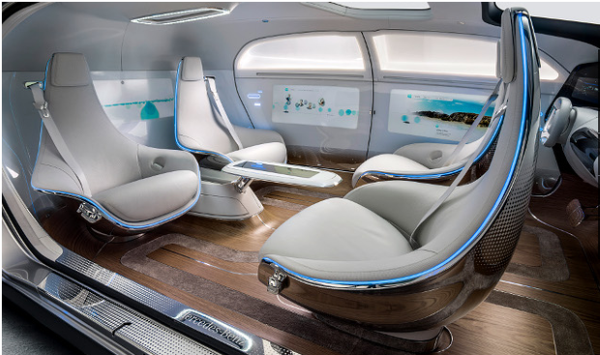
Will there be a need for drivers? Today, yes. Tomorrow, no (see image below). The most advanced ADAS systems being tested today can provide windshield holographic heads-up displays that highlight what’s on the road ahead. These heads-up displays can be used by a passenger opting to sit in the driver’s seat, taking control of the wheel for enjoyment. ADS systems, however, will not need a driver.
Radar, once used almost exclusively by the military and aviation industry, has become a feature of new vehicles being built today. ADS vehicles rely on the technology, with cars being equipped with forward, side, and back view radar systems. Side radars provide blind spot detection and lane change assist. Back-view radar makes autonomous maneuvering in parking lots a breeze. Automatic braking systems found on today’s vehicles make use of radar as well.
Today’s advanced vehicles include monitoring systems (DMS) designed to correct vehicle movements caused by changes in driver behaviour. DMS can detect driver drowsiness and even vital signs. These systems will be required in vehicles for drivers by 2026. In the future, occupant monitoring systems (OMS) will provide passenger monitoring, alerting to situations like a child or pet being left unattended in a vehicle on hot days.
Infrared and thermal sensors may be coming to vehicles in the next decade. Near-infrared systems can work in dark conditions to gauge driver alertness even if he or she is wearing sunglasses. Thermal sensors detect occupant heat signatures to determine the number of occupants in a vehicle, the state of their health and safety, and can initiate and manage climate control, plus feed into other OMS features that can send out alerts in the event of emergencies.
That’s a lot of technological innovation coming to personal transportation over the next two decades. If you want to learn more about what is in development and over the horizon, IDTechEx continues to be a good visionary source covering a wide spectrum of technologies and industries and a place to start what we likely will see as the 21st century unfolds.

