Efforts by the United Nations after three years and six rounds of discussion have failed to come to a comprehensive agreement on curbing plastic use. They have equally failed at coming up with solutions for managing the plastic waste that is highly visible and invisible throughout our global environment.
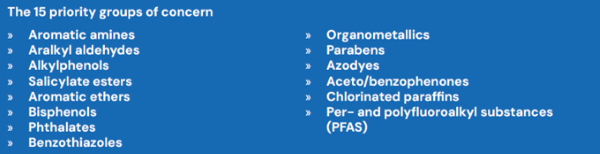
A March 2024 PlastChem report produced by the Norwegian University of Science and Technology listed 16,000 chemicals used in plastic production. It noted that more than 4,200 are “persistent, bioaccumulative, mobile…or toxic.” As many as 66% of these chemicals are found in commonly used plastics, meaning that we are constantly exposed to them during use, and after, if not properly recycled or trashed, they remain a continuing potential hazard. To make matters worse, over 10,000 of the chemicals used in the making of plastic lack information on their potential hazardous nature, with the report calling for policy action. The PlastChem report lists 15 in particular, as seen in the illustration below.
The PlastChem report called for four actions by the international community, including:
- Regulating all chemicals used in plastic production, prioritizing the 15 groups mentioned above.
- Gathering the data on the chemical composition of these types of plastics to create industry accountability.
- Reducing the chemicals used in plastic production by reducing or eliminating those known to be harmful, adopting “essential-use and safe-by-design concepts.”
- Building capacity to create safe and sustainable plastics through the fostering of global knowledge sharing about the chemicals used by the industry.
So, why couldn’t the latest United Nations conference in Geneva, last August, take these recommendations to heart and conclude a global treaty to cover chemical materials and production?
The reason is this. Plastic is convenient and that’s why its production continues to grow. The Organization for Economic Cooperation and Development (OECD), in a 2024 report, estimates that global plastic production in 2024 alone reached 460 million tons. It goes on to state that if nothing is done to stop business as usual, plastic production is expected to grow to 736 million tons annually by 2040.
At the Geneva conference, a draft of a global plastics treaty included limiting or eliminating many of the known hazardous chemicals used in their production. With more than 100 countries in favour of restricting the use of toxic substances in plastic production, it is surprising that no consensus was reached.
-
Disagreement on production limits with countries most affected by plastic waste and pollution advocating for binding limits on production, the banning of most single-use plastics, and the elimination of toxic chemicals.
-
Opposition by major oil and gas producers such as Saudi Arabia, Russia, the UAE, and the United States to production caps, with the treaty to focus on waste management and recycling.
- No agreement on managing the full life cycle of plastic from sourcing and production to post-use safe disposal of hazardous chemicals, environmental cleanup, and workable recycling processes.
- No agreement on how to handle microplastics, seen as an impending environmental hazard, creating a new disease, plastic-induced fibrosis or plasticosis. Plasticosis is increasingly found in seabirds, causing gastrointestinal, urinary, and endometrial scarring.
The geological term for our present age is the Anthropocene, which is characterized by small particles of plastic and microplastics found in mineralized sand deposits. Our love of plastic in the present, therefore, is now a part of Earth’s geological record.
To break the consensus impasse, the next meeting on plastic should end the need for a unanimous consensus to conclude what is increasingly seen as a treaty to address an existential need. Instead, like most UN votes in the General Assembly, a majority should lead to the treaty’s adoption.

