In the 2013 movie Gravity, a runaway cascade of collisions in outer space destroys the International Space Station (ISS), leaving a sole astronaut alive who manages to return to Earth. Collisions between human-made objects in outer space have been few and far between to date. Confirmed collisions include a Chinese antisatellite test that destroyed a weather satellite in 2007, leaving 3,000 pieces of trackable debris. One of those pieces struck Russia’s BLITS satellite in 2013. Then there is the one between the defunct Kosmos 2251 and Iridium 33, a functioning communications satellite, that happened in 2009, destroying both and creating thousands more pieces of space debris.
Today, experts estimate that over 40,000 pieces of debris larger than 10 centimetres (slightly less than 4 inches) remain in Earth’s orbit. Since the launch of the ISS, it has performed more than 40 debris avoidance maneuvers.
Kessler Syndrome remains theoretical to date, but when it was first proposed by NASA scientists, Donald Kessler and Burton Cour-Palais in 1978, it described a point of critical density from objects orbiting in Earth’s space that would trigger a self-sustaining chain reaction, a collision cascade that would produce thousands more fragments until low to mid-Earth orbital space would no longer be safe for satellite deployments.
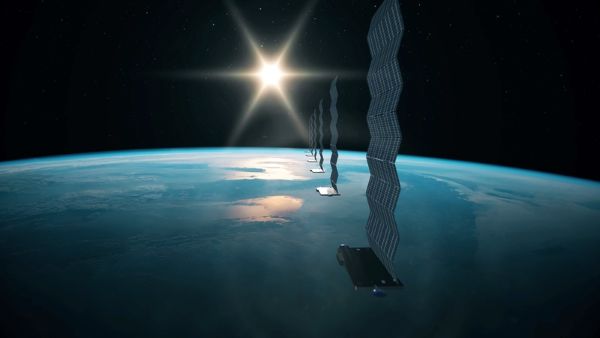
Why is Kessler Syndrome suddenly coming to the forefront in the latest news? The Starlink Communications Network is one reason. The coming constellations of even more space-based telecommunications networks, such as China’s Guwoang, Geespace, and Qinafan projects, Russia’s Rassvet and Sfera projects, India’s ISRO plans, the European Union’s IRIS project, the OneWeb/Eutelsat network, Amazon’s Project Kuiper, and EchoStar/MDA Aurora, suggest a future where tens of thousands of satellites will circle the planet.
We call it outer space because there is a lot of space out there. But usable orbital space is increasingly at a premium. What’s needed, but not yet built, is a global space traffic management system that monitors satellites, incorporates debris mitigation, and includes end-of-life standards and procedures for removing debris and defunct satellites.
Harvard Astrophysicist, Jonathan McDowell, recently told readers of EarthSky, the Chicken Little story, “The sky is falling,” but in this case, he was referring to the between one and two Starlink satellites that de-orbit and burn up in the upper atmosphere daily. McDowell tracks these de-orbits on a website. Seen below, a graph provided by his website tracks the rate of Starlink atmospheric reentries to date.
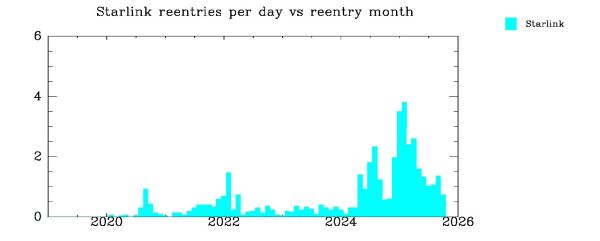
McDowell projects 30,000 telecommunication satellites and 5 de-orbits per day by 2030 based on current ambitions by providers. He acknowledges that collision avoidance maneuvers to date have saved the ISS and Tiangong from large debris impacts, but even so, the ISS shows evidence of several micro-debris hits to date, causing pits and dents to the structure.
Adrift, defunct and de-orbiting satellites pose one level of threat. Even greater, however, would be the impact on satellite constellations from a solar storm that takes out many at once.
McDowell notes:
“If just 1% of Starlink satellites [projected to eventually be a constellation of 30,000] die on station, that’s still 300. Three hundred big satellites could tip low-Earth orbit into Kessler.”
How can the rate of de-orbiting be reduced? The trick to longevity is to fly the satellites at higher altitudes. The higher, the longer they can remain less affected by atmospheric drag. Starlink satellites orbit at lower altitudes (340 to 550 kilometres) to take advantage of atmospheric drag to remove satellites that are no longer operable. It is vastly cheaper than trying to launch a satellite garbage truck.
Project Kuiper, which is already being deployed, plans 3,236 satellites to operate between 590 and 630 kilometres above Earth. This means the satellite network will be less subject to atmospheric drag, meaning a lower rate of satellite de-orbits.
China’s 3 telecommunication constellations will involve tens of thousands of satellites flying at even higher altitudes, between 600 and 1,115 kilometres. That means they will stay aloft longer. As McDowell notes, however, if accidents happen above 1,000 kilometres, “We’re probably screwed.”
For the remainder of the ISS’s stay in space, orbiting at between 350 and 460 kilometres, and for Tiangong, flying 340 to 450 kilometres above the Earth, they will need to be on guard for more near misses. It will be easier to avoid collisions when the orbiting objects are at a similar altitude, but when they come raining down from a higher orbit, the avoidance challenge could become insurmountable.
Another concern McDowell has about Starlink’s current de-orbiting strategy is the long-term consequences to Earth’s upper atmosphere. If other satellite telecommunication providers copy it, dozens of daily de-orbits that use the upper atmosphere as an incinerator will have unknown impacts. With little research being done to date on the stratosphere and ozone layer implications, we are flying in the dark.
Before the Trump budget cuts, the National Oceanic and Atmospheric Administration (NOAA) was monitoring rocket launches and satellite de-orbits. Now, however, there may be no research being done, and we may already be damaging the atmosphere with unforeseen consequences for life on Earth.

