
Despite the claims by Donald Trump that climate change is a hoax, leading climatologists with scientific data conclude that our world is warming faster. The lower Paris Climate Agreement threshold of 1.5°C (2.7°) has consistently been crossed in the last two years. Anthropogenic warming (human-caused) has increased by 0.26°C (0.47°F) per decade, compared to 0.18–0.2°C (0.32-0.36°F) per decade since 1970.
New Findings Show We Are Moving Beyond 1.5°C
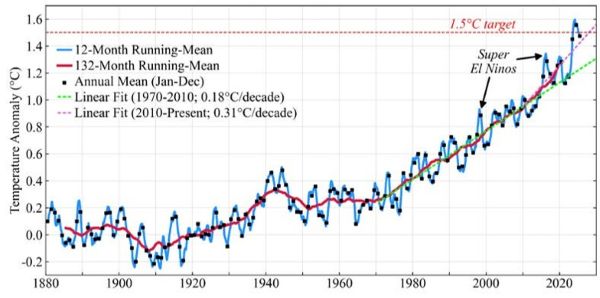
In December 2025, noted climatologist James Hansen, along with Pushker Kharecha, Dyhlan Morgan and Jason Vest, published findings describing how the last El Niño, which ended last year, had pushed global warming beyond 1.5°C, forecasting a new global mean rise by 2027 to 1.7°C above historic records from 1880 to 1920.
The following chart maps how Earth’s atmosphere has warmed over the last 140+ years.
 The report shows that, since surpassing 1.5°C, the world entered a post-El Niño cooling and the next La Niña oscillation, leading to a decline of 0.1°C (0.18°F). It notes that this drop was unusually small compared to past post-El Niño periods. It goes on to predict temperatures to ease to a 1.4°C rise for the early part of 2026 before climbing again and reaching 1.7°C in 2027. See the same chart as above with projected El Niño peaks and La Niña minimums.
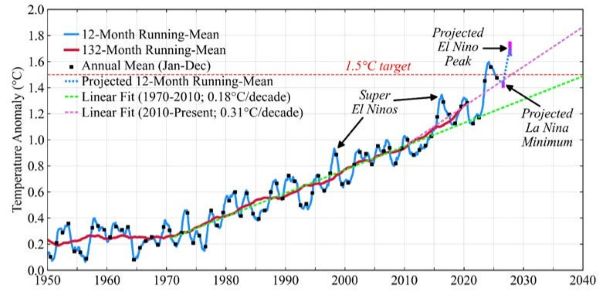
Why pay attention to these climate predictions? These same researchers, in March 2024, projected that global warming during the ongoing El Niño would be higher than during any prior warming event, raising the global temperature by at least 1.6°C, with a subsequent fall to +1.4°C.
The report linked the cooling effect to an increase in atmospheric aerosols in the Northern Hemisphere from wildfires. Sun-blocking particulate matter suspended in the atmosphere has a known negative impact on warming. That is why proponents of geoengineering have pushed for large-scale aerosol dumping in the stratosphere as a countermeasure to offset the warming effect of increased carbon dioxide (CO2) and methane (CH4) from human activities.
Collecting Data That Tracks Climate Change
So where does the planet go from here? Climatologists assert that it is no longer a question of reaching 1.5°C, but rather how long we will stay above it and how high the next peak will be. The variability of oscillating El Niños and La Niñas, plus recurrent wildfire season aerosol contributions, will not stop the obvious upward trajectory in atmospheric temperatures as depicted in the above two graphs. Atmospheric mean temperatures, therefore, are expected to rise between 0.24–0.3°C (0.43–0.54°F) per decade through 2050.
The other human threat climatologists and humanity face is coming from Donald Trump. Cuts and changes to the mandates of America’s Environmental Protection Agency (EPA) and the National Oceanic and Atmospheric Administration (NOAA) appear to be undermining the collection, maintenance, and public accessibility to climate data. Historical records remain, but no one knows for how long. Budget cuts have targeted the Office of Oceanic and Atmospheric Research (OAR) and the climate modelling done by the Geophysical Fluid Dynamics Laboratory (GFDL) at Princeton University. In addition, U.S. datasets used by weather forecasters and climatologists have been retired. Currently, there is no evidence of existing climate dataset tampering.
The American withdrawal from the Paris Climate Agreement, Trump’s executive declarations of a national energy emergency, and the subsequent rollback of climate-mitigating U.S. energy policies will contribute 0.1°C (0.18°F) to global temperature rise.
Meanwhile, delayed international progress to reduce carbon emissions, based on COP30-announced Nationally Determined Contributions (NDC) pledges, points to a world in 2100 where temperatures will be 2.5°C (4.5°F) higher than those recorded between 1880 and 1920.
So, where do world climatologists go to find reliable data upon which to build long-term climate forecasts? Fortunately, there are non-American governments, space agencies, and private institutions and companies collecting climate data. The following is a summary list of the ones I have found.
Climate Datasets From Other Than U.S. Government Agencies
-
Berkeley Earth is an independent climate science research organization in Berkeley, California, that uses raw station data worldwide to issue annual climate change reports.
-
Carbon Brief is a UK-based website providing the latest climate science, climate policy and energy policy information.
- China National Space Administration (CNSA) has the Fengyun geostationary meteorological satellites that share datasets with the WMO through the country’s National Satellite Meteorological Center.
-
Climate Central is an independent science communication and research organization that reports facts about climate change that affect people’s lives.
- Climate X is a London, UK private climate risk analytics firm backed by Google that integrates international research with in-house modelling.
- European Centre for Medium-Range Weather Forecasts (ECMWF) with the Copernicus Climate Change Service (C3S), and the European Space Agency’s Sentinel satellites that provide global climate monitoring, vegetation health, land cover changes, sea ice, soil moisture and other data to produce near-real-time bulletins.
- European Union and Climate ADAPT provide interactive access to the Climate Data Store and Copernicus, and reflect the priorities of the European Environment Agency (EEA), which publishes annual indicators on temperatures and tipping points.
- Indian Space Research Organisation (ISRO) has launched multiple satellites for climate monitoring and provides extensive datasets to the public, researchers and companies through an open platform.
- Japan Aerospace Exploration Agency (JAXA) has launched a series of GOSAT satellites to map and track emission sources, aerosols, clouds, water cycle, sea ice and essential climate variables with the country’s Ministry of Environment and National Institute for Environmental Studies distributing the data through the GOSAT User Interface Gateway, which is integrated into the World Meteorological Organization (WMO).
-
Met Office Hadley Centre in the UK is the country’s primary source of climate information and maintains the HadCRUT5 and HadSST4 global dataset of surface land and sea temperatures, cross-verified with Europe’s Copernicus climate datasets.
-
Mitiga Solutions is a Barcelona, Spain-based climate risk intelligence company with EarthScan, an artificial-intelligence climate risk modelling tool.
-
Morningstar Sustainalytics has offices in Europe, Asia, Australia, Canada and the U.S. It is the creator of the Physical Climate Risk Metrics, a climate dataset and risk analysis tool to help assess adverse impacts from extreme weather, wildfires, floods and other physical hazards.
-
Pathzero is a Sydney, Australia company, which has developed a carbon accounting and risk management platform that provides trusted climate intelligence.
- Roscosmos, the Russian space agency, has the Meteor-M2 constellation of orbiting satellites to provide global data on clouds, atmosphere, ocean, and solar phenomena, with the datasets produced shared with the WMO.
-
S&P Global is a New York-based company with climate and environmental datasets to pinpoint risk exposure to sea level rise, flooding, water stress, heatwaves, coldwaves, hurricanes and wildfires.
- The World Meteorological Organization (WMO) is the United Nations’ authority that maintains eight global surface temperature datasets, integrated observation systems, and a full archive of datasets from its members, ensuring interoperability.
It is heartening to know that despite Donald Trump’s actions to deny the reality of global warming, the rest of the nations of the planet are taking notice and making up for America’s withdrawal from the fight to mitigate and adapt to the changes happening around us here in the 21st century.

