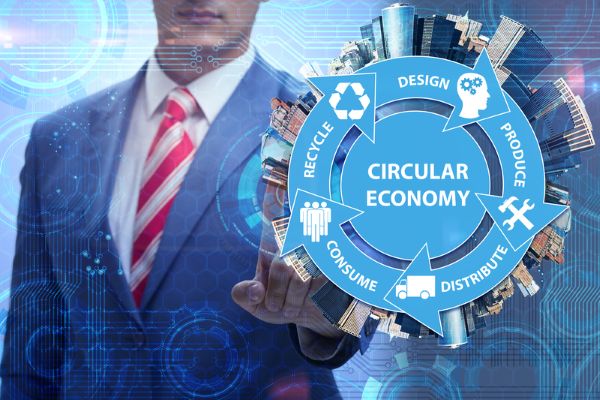
Is circularity a universal cure to what ails our modern business world this century? Circular economies are built to be sustainable. They emphasize eliminating waste throughout a product or service lifecycle. Recycling, reusing, remanufacturing, sharing, and repairing are cornerstones in practice.
When we look at the full range of 21st-century industry, it is only extractive industries like coal, oil, and gas that are more difficult to fit into circular economic practices. They can even go beyond removing the resource to find ways to become more circular.
For other industries, however, based on the list provided below, going circular in the 21st century seems feasible and appropriate in the face of global warming and the need to address environmental sustainability.
Adopting Industry Sector Circular Economic Principles
- For agriculture, minimizing harvest waste, optimizing soil regeneration and water use, and implementing no-till practices.
-
For the building sector, recovering and reusing materials, and using prefab and modular designs.
-
For electronic devices and components, recycling of materials deemed hazardous, and repurposing, upgrading or reusing devices to extend their lives.
- For food distribution, eliminating food and packaging waste, and rethinking best-before and use-by dates, where products can remain safe to consume.
- For healthcare, designing medical devices and products for longevity and repairability, and safely reusing or recycling used plastic materials that represent a significant portion of hospital and medical waste.
- For manufacturers of consumer goods, designing products for durability with an end-of-life program that focuses on repurposing, recycling, and reuse.
- For mining and resource extraction, improving resource efficiency, recovering useful materials from waste, and mining and resource extraction site rehabilitation.
- For pharmaceuticals, adopting the 9R framework (refuse, rethink, reduce, reuse, repair, refurbish, remanufacture, repurpose, recycle, recovery) to target the massive waste footprint, using green chemistry to minimize hazardous substances, and taking perceived waste such as solvents, which can be reused for multiple projects.
- For service industries, implementing resource sharing and waste minimization through the adoption of digital forms and processes, and creating products-as-a-service models for clients, to foster similar outcomes.
- For transportation, adopting electrification, extending vehicle lifecycles, recovering and refurbishing components, adopting predictive maintenance, leasing over ownership, and optimizing route navigation.
- For utilities, shifting from use-and-dispose models to waste minimization, energy regeneration, sustainable water and waste systems, repurposing and hardening materials to extend the lifecycle of systems and components like pipes and cables, and adopting more modular components and predictive maintenance to allow for easy upgrades and repairs.
What’s Holding Businesses Back From Going Circular?
Probably, the most common reasons for businesses not adopting circular economic principles are:
- Entrenched practices that have served a business well for years, and a conservative mindset, create resistance to change.
- A lack of knowledge about the available technologies and practices makes switching a significant learning curve.
- The time requirements are perceived as too long to make the switch, with concerns for the short and long-term impacts on the bottom line.
- The concern about the impact of circularity on supply chain partners.
- The overall costs and upfront investments needed for the redesign of products and processes.
Free Circular Economy Tools
It is surprising to find several free tools and model playbooks, as well as several online applications for companies to begin the process of going circular. Here are some of them:
Circulab Toolbox – providing a value chain analysis, the rethinking of business models, the redesign of products, and a map to follow for the adoption of circular economic principles.
Circular Economy Action Plan – designed for collaboration, innovation, and investment backed by the government of Canada to adopt a national circular economy roadmap and best practices for industry.
CircularX – a 6.5-year project developing tools for circular service business models, funded by the European Research Council, providing gaming, model pilot plans, a regenerative business case database, sustainable by design tools, an experimentation workbench and more.
Circulytics – an assessment created by the Ellen MacArthur Foundation in 2020 that produces a circular economic scorecard to provide insights into how to improve processes.
Nordic Circular Economy Playbook – a series of tools first developed in 2018 and available for transitioning to a circular business model. There is the Playbook, the Playbook 2.0, and the Nordic Data Sharing Playbook, the latter, currently in development.
Quickscan Circular Business Model (CBM) – a questionnaire developed by Saxion University of Applied Sciences, from the Netherlands, to gain insight into adopting circular business models for a business.

