
Three stories that recently appeared in the news include:
- Astrobee, the flying robot, navigates the International Space Station (ISS).
- A robot arm with AI shows it can build furniture.
- A six-legged robot has started restoring forests.
Astrobee Robots Get Their Wings
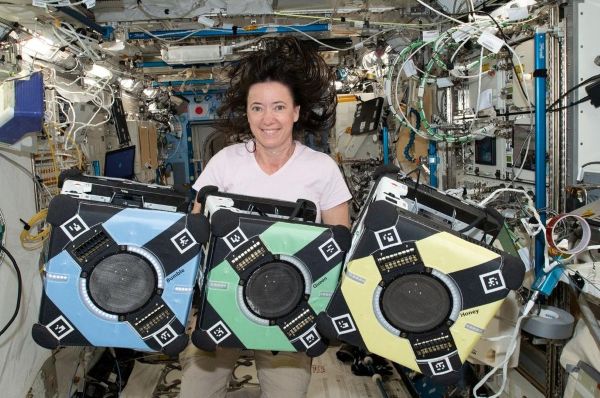
In 2019, Bumble and Honey, two Astrobee robots, first arrived at the ISS. Queen, the third Astrobee, was sent up the same year in a separate supply mission. These three were designed to be free flyers in microgravity. Cube-shaped 32 centimetres (12.5 inches) square, they come with a docking station to recharge onboard batteries that power fans that expel air through nozzles to provide steering. Onboard are navigation and science cameras, a video recorder, LIDAR sensors, an Inertial Measurement Unit (IMU) containing accelerometers and gyroscopes, vision-based software, three payload bays for experiments, and a robotic arm for grasping.
Bumble, Honey and Queen were designed for autonomous flight aboard the ISS, but until Stanford University’s latest test, the three Astrobees needed the astronauts on board to provide guidance. Stanford researchers developed sequential route-planning software using a machine-learning (ML) model trained to navigate obstacles in the crowded onboard environment of the ISS.
They call the foundational knowledge gained through the training a “warm start,” akin to route planning for road trips. The Stanford team used a testbed at NASA Ames Research Center to perfect the ML software. Once proven, the software was transmitted to the ISS and loaded into an Astrobee. This involved minimal preparation by the onboard crew, who stepped aside to allow a NASA team to relay commands to the Astrobee.
States, Somrita Banerjee, Stanford’s Lead Researcher, “This is the first time AI has been used to help control a robot on the ISS. It shows that robots can move faster and more efficiently without sacrificing safety, which is essential for future missions where humans won’t always be able to guide them.”
Eighteen different trajectories were tested with the Astrobee, each around a minute in length, demonstrating that it could fly up to 60% faster through the cluttered, tight corridors of the ISS. After the test, NASA declared a Level 5 status for the technology, meaning it was ready for real operational deployment.
For future missions to Mars, or robots servicing satellites or building structures in Deep Space, robot autonomy to perform numerous tasks will be necessary. This Stanford demonstration is the first step to fulfill that future capability.
Robot Uses A “Speech-to-Reality” AI System to Build Furniture
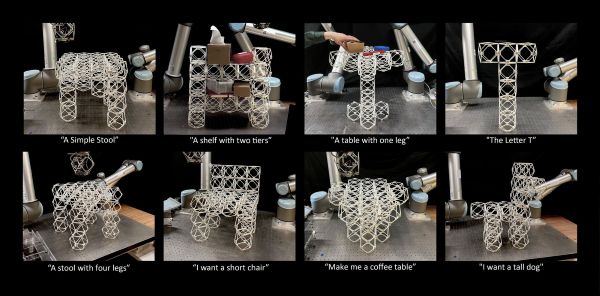
At the Massachusetts Institute of Technology (MIT), researchers are using generative AI to instruct a robot arm to build pieces of furniture in five minutes. Simple voice commands enable the robot arm, which converts spoken prompts such as “make me a chair” into actions.
The robot arm receives spoken input and then constructs the requested object using modular components. So far it has created stools, shelves, chairs, tables and even decorative statues.
Alexander Htet Kyaw, an MIT graduate student, describes the process as “connecting natural language processing, 3D generative AI and robotic assembly.” Working with Neil Gershenfeld, Director of the MIT Center for Bits and Atoms, Kyaw used speech recognition tools with a large language model (LLM) and 3D modelling to create digital mesh representations of objects as seen in the image above. The AI processed the different geometric shapes and the number of components needed to make each of the assembled items, and then created an automated path plan and sequence for the robotic arm to execute each build. What Kyaw ended up delivering was an AI robot capable of materializing a finished object within minutes.
Using modular mesh components was like building with Lego blocks. There was no waste. Objects could be assembled and disassembled. For Kyaw, the next step is to get the AI to respond through gesture recognition to tackle new fabrications. His vision is “for people to make physical objects in a fast, accessible and sustainable manner,” akin to the Star Trek replicator.
Six-Legged Robot May Revolutionize Reforestation Projects
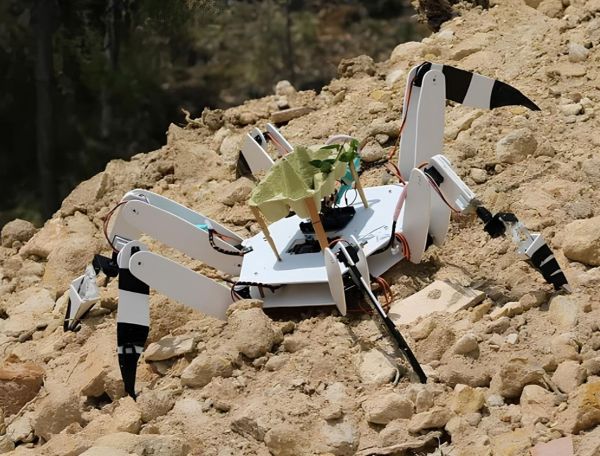
A robot named Trovador has been invented by two Portuguese college students, Marta Bernardino and Sebastião Mendonça, to help restore Portugal’s wildfire-damaged forests. Portugal is one of Europe’s most wildfire-affected countries, losing almost 5 million hectares (over 12.3 million acres), or approximately half of its total area, between 1980 and 2023.
The initial design chosen, a hexapod (six-legged), was to create stability and flexibility for navigating steep (slopes up to 45 degrees) and hazardous and burned-out terrain. The design allows for the load distribution of baby saplings while avoiding soil compaction.
The six legs move in coordinated fashion, creating a gait that ensures balance even across rough, uneven and burned ground, where wheeled machines and humans would find difficulty.
An onboard depth camera enables real-time obstacle detection to avoid hazards, while Trovador’s sensors and AI algorithms collect and analyze data on soil conditions, pH, moisture, and health in real time. An onboard drill creates the holes for the saplings while Trovador’s built-in GPS provides for cloud-based route optimization and precise positioning.
Trovador plants at a rate of up to 200 saplings per hour. It is six times cheaper and significantly faster than tree-planting human crews.
Bernardino and Mendonça recently won the National Geographic Slingshot Challenge, a $10,000 prize, and received Europe’s Robotics for Sustainability Award for their invention. Large-scale deployment is planned for 2026.

