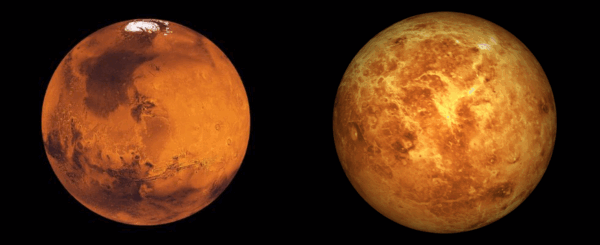
Studying Mars weather will be critical for any future human mission to the Red Planet. The atmosphere of Mars is far more influenced by what’s happening in the near vacuum of space than Earth’s. Mars has planetwide dust storms. One of these ended the life of the Opportunity rover in 2018, blocking sunlight from reaching its solar panels and recharging the onboard batteries and thermal control systems. The rover’s final communication on June 10, 2018, showed a black sky before its systems went into hibernation and eventually froze. Repeated attempts to wake it failed, and by February 2019, NASA declared Opportunity dead.
M-MATISSE is a mission that may help us understand Martian weather once and for all. The name is an acronym for the Mars Magnetospheric Atmospheric Ionosphere and Space Weather Science mission. The European Space Agency (ESA) is preparing two orbiters to send to Mars. On the University of Leicester site, the mission description states that its goal is to understand the complex and dynamic relationships involving the Martian magnetosphere, ionosphere and thermosphere with the solar wind and the lower atmosphere. The coupled satellites will make simultaneous observations of the Martian system, providing a global picture of the planet’s weather at all altitudes. Named Henri and Marguerite, derived from the artist Henri Matisse and his daughter, a final decision to go ahead with the mission will be made by mid-2026.
The mission should reveal how the solar wind influences Martian weather, which will be key to understanding future habitability of the planet.
Venus is Earth’s twin in size, but that’s where the similarities end. Its atmosphere is 96.5% carbon dioxide (CO2) and 3.5% nitrogen. There are also traces of argon, water vapour, sulphur dioxide and other gases. The thick clouds of Venus contain sulphuric acid rain that never reaches the surface. The planet’s surface temperature is 462 Celsius (864 Fahrenheit), hot enough to melt lead. It is the hottest planet in the Solar System. The thick atmosphere produces surface pressures 90 times that of Earth at sea level, equivalent to being 1 kilometre (0.62 miles) below the ocean surface. The clouds reflect 90% of sunlight back into space. The planet is best described as a runaway greenhouse that is a living hell, except nothing can live on its surface.
Some scientists have speculated that although life as we know it could never survive on the surface of Venus, the atmosphere is another story. In 2020, researchers studying Venus discovered phosphine gas in the planet’s clouds, described as being in the habitable region of its atmosphere.
What is the significance of phosphine? On Earth, phosphine is linked to anaerobic bacteria. These are extremophiles that live and metabolize in environments lacking oxygen. It also is present in the gut, in marshes, and in places where there is organic decomposition.
So, what could be causing phosphine on Venus? Clara Sousa-Silva, a researcher at MIT in the Department of Earth, Atmospheric and Planetary Sciences, expressed her amazement at this discovery, trying along with other astronomers to come up with an exotic chemistry that could produce phosphine in the absence of life.
In a September 2020 paper published in Nature Astronomy, it stated there is “no currently known abiotic production routes” to create phosphine gas in observable amounts in Venus’ atmosphere. The researchers looked at different scenarios such as sunlight, surface minerals, volcanic activity, meteor strikes and lightning and modelled them, but none produced phosphine in the amounts observed. Janus Petkowski, who was one of the researchers working with Sousa-Silva, noted, “If this is not life, then our understanding of rocky planets is severely lacking.”
Since the 2020 discovery, astronomers have detected the presence of ammonia in addition to phosphine. Ammonia, like phosphine, is a byproduct of living organisms (as well as industrial processes, which we can rule out as being a source on Venus). The ammonia has been found in the clouds, which increasingly are being considered as potential areas where we may find alien life.
How is this even possible? Although the temperatures on the surface of Venus can melt lead, 50 kilometres (31 miles) above the planet’s surface, temperatures range from 30 to 70 Celsius (86 to 158 Fahrenheit). Atmospheric pressures at that elevation are equivalent to what we experience here on Earth at sea level.
To study what is causing these gases to exist in the atmosphere of Venus, British scientists are proposing a space mission to the planet which could be launched as early as 2031 and propose building a CubeSat-sized probe that would accompany EnVision, an ESA-planned mission to be launched that same year.
Will we discover life on Venus before we find it on Mars? Although M-MATISSE isn’t looking for evidence of current or past life, current NASA rovers are busily doing that task with Perseverance having gathered samples for a future return mission to Earth scheduled for sometime during the 2030s. Meanwhile, the EnVision CubeSat could beat Martian efforts to discover life elsewhere early in the 2030s well before any Martian samples are returned or humans land on Mars.

