When I first noticed my hands trembling, I was in my early 60s. I remember seeing my father afflicted with the same condition. The tremors make my hands shake when holding items like a coffee mug. My wife constantly asks me if I need help taking a mug from the kitchen to our dining table or couch.
These tremors have worsened as I get older. I often wondered if they were an early sign of Multiple Sclerosis (MS) or Parkinson’s Disease (PD). Fortunately, symptoms associated with those debilitating diseases beyond my tremors have not happened. What I have been experiencing doesn’t compare to anything I have seen in friends who have developed MS or PD.
In this posting, I first look at what are called essential tremors (what I suffer from) and a potential therapy to ease the condition. In the second half, I discuss PD and the latest search to mitigate and even a potential personalized medical therapy to treat this debilitating disease.
1. Essential Tremors, Symptoms, Causes, And Cures?
The Symptoms
Essential tremors (ETs) are a physiological condition that affects the hands, arms and head. In me, it is largely my hands, arms and face. My lips shake, and only when I look in the mirror do I notice. My hands and arms are another matter. Even as I type this posting, if I pause, my hands tremble.
The Causes
ETs worsen with age, fatigue and exposure to stress. Half of ETs are hereditary. Other ETs are linked to metabolic and neurological conditions, medications, toxic pollutants, too much caffeine and alcohol withdrawal. If you have asthma and use a puffer, ETs are a common reaction.
Hyperthyroidism (an overactive thyroid), hypoglycemia (low blood sugar), and diabetic conditions with high levels of blood sugar, liver and kidney failure are nerve-signalling causes. Add to the list Multiple Sclerosis (MS), strokes, cerebellar damage, and brain tumours, Restless Leg Syndrome (RLS), mercury and lead poisoning, and over-exposure to some pesticides.
The Cure?
Hadi Mohammadi is a doctor and engineering professor at the University of British Columbia-Okanagan (UBCO). He leads a team focused on developing non-invasive wearable devices to control ETs. In a January 2026 UBCO press release, Dr. Mohammadi states,
“Hand tremors are among the most prevalent neurodegenerative movement disorders, causing involuntary upper-limb fluctuations that significantly impair a person’s quality of life.”
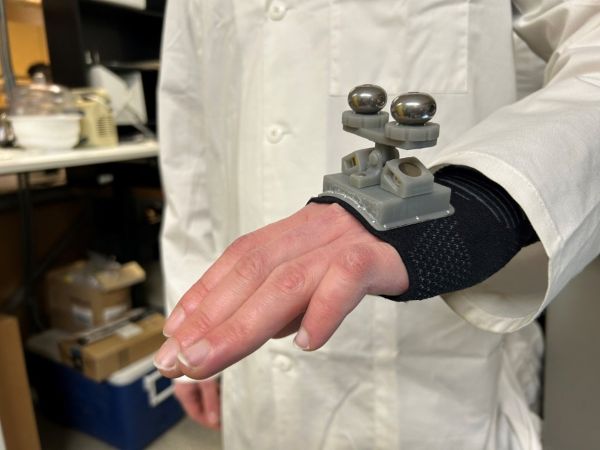
The UBCO research focused on developing wearable devices to reduce hand tremors. Their latest invention was recently described in a paper published in the Journal of Medical Engineering & Technology. It describes a wearable, the prototype seen in the image above, that can deliver tremor suppression without motors, restrictive bracing, or a power source. How does it work? Mohammadi describes how the non-invasive, passive technology works:
“Rather than actively driving motion, the device uses a passive omnidirectional vibration-absorbing mechanism tuned to the frequency range of the uncontrolled tremors. When worn on the hand, the system dampens involuntary fluctuations while allowing voluntary movement to continue largely unhindered.”
Results show a 79% reduction in unidirectional tremors and a 73% reduction in omnidirectional tremors. Clinical trials are in the offing.
2. Parkinson’s Disease, Symptoms, Causes and Cures?
Parkinson’s Disease (PD) is a neurodegenerative disease that progresses slowly. Associated PD symptoms, not the disease itself, can be fatal. These shorten life spans by as much as ten years for those diagnosed at age 55, 6.7 years at 65, 3.5 years at 75, and 1.2 years at 85. Early-onset PD, before age 50, progresses more slowly and is more treatable.
The Symptoms
A common PD symptom is tremors. Another is muscle rigidity and slowness in movement. PD can cause postural instability, leading to falls. PD can cause dyskinesia, abnormal and involuntary muscle movements. It can cause loss of sense of smell, depression, fatigue, sleep disturbances, gastrointestinal issues, and cognitive decline. Clinicians define PD in five physical stages beginning with ETs, then changes to walking gate, loss of balance, mobility loss, and finally full-time need for wheelchair or bed confinement.
The Causes
PD occurs when dopamine-producing neurons in the brain begin to die. Dopamine controls coordinated muscle movement in our body. All of us lose dopamine as we age, but with PD, the loss is rapid. A dopamine-producing cell loss of 50 to 60% triggers PD.
PD occurrence is 10 to 15% genetics caused. Other agents that induce PD include exposure to toxins in pesticides and traumatic head injury. There is no known cure at present, just a range of treatments to delay its onset. Included among these are:
- Physiotherapy, yoga, and a regular regimen of mobility, balance, strength and endurance exercises can slow down PD symptoms. Swimming and boxing appear on the list of approved activities.
- Medicines like Levodopa (a dopamine replacement drug), dopamine agonists like Ropinirole and Pramipexole, and MAO-B inhibitors like Selegiline and Rasagiline that reduce stiffening, ETs, and extend mobility.
- Deep Brain Stimulation (DBS) and Adaptive DBS using surgically-implanted electrodes to reduce loss of motor skills.
The Cure?
It is still early on in a PD Phase 1 clinical trial, but there appears to be a degree of confidence in a new treatment to cure PD. Brian Lee, a neurosurgeon at Keck Medicine, University of Southern California (USC), is heading an early-stage patient trial that has been fast-tracked by the U.S. Food and Drug Administration. This is personalized patient therapy that has been given the name RNDP-001.
From the laboratories at USC to clinical trial, the therapy is a product of Kenai Therapeutics, a biotechnology company founded in 2022 and located in San Diego, California.
The Phase 1 trial goes by the name REPLACE™. Its first patient was enrolled in December 2025, with 11 more to follow at three different sites. Each enrollee donates some adult blood or skin cells to produce induced pluripotent stem cells (iPSCs). These are then reprogrammed to become dopamine-producing brain cells.
The therapy involves making a small incision in the skull for surgeons, using directed MRI, to implant these dopamine-producing cells in the brain’s basal ganglia, the region responsible for controlling movement. States, Xenos Mason, a Keck neurologist in the clinical trial,
“We believe that these iPSCs can reliably mature into dopamine-producing brain cells, and offer the best chance of jump-starting the brain’s dopamine production.”
Dr. Lee hopes to see this personalized patient therapy treatment for PD become a way to repair and restore lost motor function. No one is calling it a cure as of yet. It will take five years as the 12 enrollees get monitored closely to see if PD symptoms have mitigated. Only then will we know if PD can be reversed.

