Jeff Bezos envisions a future where terrestrial-based heavy industries no longer exist on Earth and sees his rocket company, Blue Origin, as a first step in making this a reality. He has repeatedly stated that he started the company to make what he calls the Great Inversion a reality. The inversion Bezos speaks of envisions moving heavy industry off planet into Earth orbit; maximizing resource extraction and utilization from space, asteroids and the Moon; and drawing on continuous solar energy to power our off-world infrastructure.
Based on comments from Dave Limp, the CEO of Blue Origin, this week, he predicted that data centres will be moving off-world as well. Limp predicts this will happen within the next decade, with limitless solar energy being the big draw. High-speed communications to and from data centres will use lasers to retrieve and send information to satellites as well as the ground.
One of the companies attempting to turn this vision into a reality is Starcloud, a recent startup that is building and testing prototypes for future space-based data centres. Its first satellite, Starcloud-1, was launched into orbit on November 2, 2025. It is refrigerator-sized and contains an Nvidia H100 GPU, a data-centre-grade piece of hardware designed, as well as a closed-loop cooling system designed to absorb and radiate the heat generated by the processor into space. Starcloud-1 will stay in orbit for 11 months. It will be followed by Starcloud-2 late in 2026, which will feature a more powerful Nvidia GPU, called Blackwell. Starcloud-2 will include optical communication terminals to test the laser communications capability of the technology. The result, if all goes well, will be the first of its type secure data storage and cloud computing centre that will be out of this world.
Starcloud and Blue Origin share a common vision. They see future space-based data centres resembling constellations of individual data storage satellites, not too dissimilar from space-based telecommunication networks like Starlink. There would no longer be the need to build hectare-sized ground-based data centres requiring energy from restored nuclear power plants for operations. Limp sees in Starcloud-1 and 2 the proof of concept that space-based data centres can replace current ground-based operations and eventually eliminate the need to build more like them in the coming decades.
Of course, the only way this vision becomes a reality depends on lowering the cost and increasing the frequency of getting from Earth to orbit. The trend for both of these data points is in the right direction. In 2023, 223 rockets were launched successfully. In 2024, the number reached was 259. This year, we will see 300 or more.
Meanwhile, the feasibility of large payload deliveries to Earth orbit using partially reusable launchers has been adequately demonstrated by SpaceX with its Falcon 9, Rocket Lab’s Electron, and most recently, Blue Origin’s New Glenn. The SpaceX Starship may soon join this trio to continue lowering the launch costs.
Data centres in space may happen before manufacturing industries make the same move, despite outer space’s unique advantages, which include microgravity and unlimited solar energy. Large-scale resource extraction with the deployment of commercial, sustainable space mining and creating a space labour force remain the missing pieces to finish this puzzle.
How close are we to realizing this Bezos vision of the future? The tools to make the Great Inversion a reality are already in the process of being developed by NASA and its partners, with much of the prototyping happening on the International Space Station (ISS). These include:
- In-situ Resource Utilization (ISRU), which NASA is currently developing with projects like MMPACT (Moon to Mars Planetary Autonomous Construction Technology). ISRU is focused on providing sources of water, oxygen, and hydrogen from space, the Moon, Mars, and asteroids, and developing the needed technologies to make this a reality. The Lunar Surface Innovation Consortium (LSIC) at Johns Hopkins University in Baltimore, Maryland, through its Applied Physics Laboratory, is heading up an alliance of academics, industry and government in support of meeting ISRU objectives for the Artemis Program.
- In-space manufacturing initiatives and advances to date include:
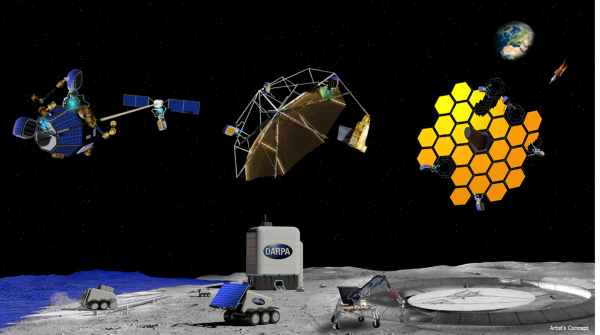
- The U.S. Defence Advanced Research Projects Agency (DARPA) has created the NOM4D (Novel Orbital and Moon Manufacturing, Materials and Mass-Efficient Design) program to stimulate commercial development of space manufacturing.
- Since 2016, NASA has been operating a 3D printer in its Additive Manufacturing Facility (AMF) on the ISS. It has produced over 200 replacement parts for the station to date.
- An Airbus-developed 3D metal printer was installed on the ISS in 2024 and is also producing components for the station.
- Japan’s Mitsubishi Electric and NASA are developing robotics and autonomous assembly agents, and robots to build habitats, solar arrays, antennae and other space infrastructure. The NASA Assemblers are programmable to grip, lift, weld and join materials. They are reconfigurable and imbued with machine learning and other artificial intelligence (AI) capacities. NASA is seeking commercial partners to license its Assemblers.
- Radiation Shielding and Habitat Designs capable of supporting long-term human presence in space, the Moon and Mars are of primary interest to NASA in support of the Artemis Program. On the ISS, the agency is testing a number of modular habitat structures that could become future space stations or lunar and Martian bases. The Artemis Lunar Gateway is one of these projects. Meanwhile, ongoing ISS experiments are focused on radiation shielding, material durability, and environmental control and life support systems (ECLSS).
As an effective way to preserve Earth’s environment and address climate change, the move to off-world primary manufacturing would cause conditions on the planet to revert to pre-Industrial Revolution times, states Bezos. Bezos believes this will be a multi-generational project and will create a new Eden on our planet, giving a whole new meaning to the era of humans, known as the Anthropocene.
Bezos’ vision dramatically differs from that of his commercial space billionaire rival, Elon Musk. Musk’s purpose for launching SpaceX has been to ensure that humans become a multi-planetary species to avoid an extinction-level event like the one that wiped out the dinosaurs 65 million years ago. That’s why he is focused on colonizing Mars. Bezos’ answer to this is to build cities in space that become self-sufficient manufacturing centres that serve Earth populations’ needs as well as provide a foundation for a space-based human civilization.

