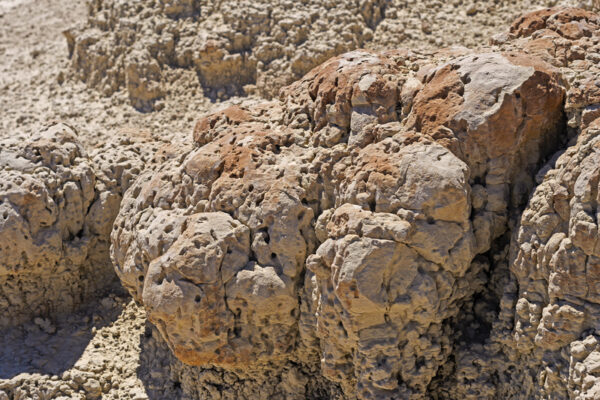
Mudstone occurs on Earth. It is also found on Mars. Mudstone is a sedimentary rock. In other words, it exists because older igneous rocks erode, producing sediment that gets laid down over time. To create mudstone, you need the presence of a lot of water lasting a long time. The sediments compress. The water gets driven out, and what is left is solid rock containing minerals, salts and silica.
On Earh, mudstone formations have been a good source for finding evidence of previous life. It clay-rich content seals organic remains to limit microbial decay. The organic remains mineralize producing fine details. In Earth’s Precambrian, mudstone deposits have been a key source of microfossils. The famous Burgess Shale fossils of the Cambrian explosion were laid down 500 million years ago and permanently preserved in both shale and mudstone. The two have similar qualities when it comes to preserving the fossil record.
Why? Both mudstone and shale are fine-grained. Both are laid down in water. Their clay-rich content buries and seals organic remains, limiting oxygen and microbial decay while promoting mineralization to preserve microscopic details.
Mudstone On Mars
Curiosity’s Discoveries
At Gale Crater on Mars, the NASA rover Curiosity, in 2013, discovered mudstone, confirming the theory that the crater once contained an ancient lake that lasted for millions of years. Curiosity continues to find mudstone deposits. Gale Crater apparently has lots.
In fact, the amounts of organic material seen in the rocks the rover has sampled far exceed deposits on Earth laid down by chemical non-inorganic processes. In March last year, the Curiosity team announced the discovery of quantities of decane, undecane, and dodecane molecules in rock samples analyzed by the rover. These three are the largest organic hydrocarbons identified on Mars to date. They appear to be fragments of fatty acids preserved in mudstone.
What do fatty acid remains on Mars tell us? Here on Earth, living cells contain cell membranes formed from fatty acids. Although similar molecules can be formed without life present here on Earth, these conditions are rarer.
At Jezero Crater, the Perseverance rover has been making similar discoveries, almost from the moment it touched down on the Martian surface in 2021. The mudstone it has found contains carbon and organic molecules with features and textures resembling leopard spots. These spots, when analyzed by Perseverance’s onboard instrumentation, indicate the presence of carbon, silica, aluminum and iron.
The majority of scientists who have assessed the Perseverance data to date opine that these carbon organics, with their associated minerals, indicate microbial processes in sediments similar to those found here on Earth.
The astrobiological potential for these leopard spots is considered high. NASA, however, as it did with the two Viking lander experiments in 1976, continues to err on the side of caution, suggesting that without the samples back here on Earth to test, abiotic processes cannot be ruled out.
Reconstructing Mars In The Past
When did these mudstones form?
Gale’s mudstones date back approximately 4.2 billion years. The surface features of the crater indicate the existence of rivers and a lake. The climate conditions for this area would have been similar to Iceland today, supporting surface and groundwater deposits. A prolonged wet phase created the preconditions for mudstone formation which occurred when the area dried out.
Jezero’s mudstones date back to approximately 3.8 billion years. Conditions here supported water with riverine deposits forming a large delta. It appears that persistent rainfall-like conditions leached minerals to form the clay deposits. The climate conditions at Jezero, although not as warm as Earth’s rainforests, produced similar soil conditions. The arid phase that followed produced the mudstone deposits.
The absence of a strong magnetic field would mean Martian microbial life had to weather the impact of cosmic and solar radiation. One would think this would degrade organic molecules to make them undetectable. However, a superabundance of fossilized organic molecules indicating life on Mars billions of years ago would explain why the rovers have successfully detected their remains.

