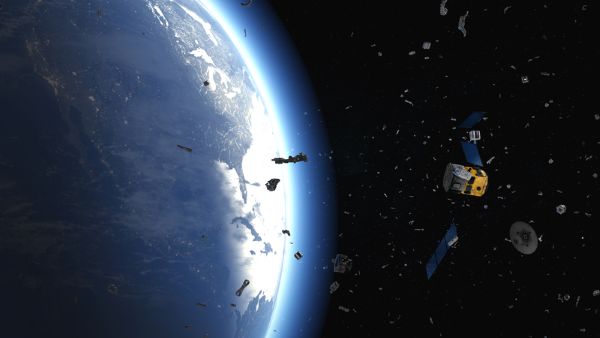
With the many private and government space programs announcing or launching vast constellations of satellites, we are polluting near-Earth space with a disaster waiting to happen. A recent SpaceX Falcon 9 rocket that burned up over Europe produced a measurable plume of toxic lithium pollutants in the upper atmosphere. It was the first time humans measured upper atmosphere pollution from space debris, and it was about time.
The lithium pollution occurred because the SpaceX upper stage experienced a leak, which sent it into an erratic orbit and eventual atmospheric re-entry, raining debris into the mesosphere and thermosphere layers. Besides the plume of gasified lithium, a number of pieces from the second stage didn’t completely burn up and eventually landed in farm fields in Poland.
How much lithium could have been released into the upper atmosphere? Each Falcon 9 upper stage uses approximately 30 kilograms (66 pounds) of lithium alloy to line fuel tanks. That’s considerably more than the 80 grams (2.8 ounces) of lithium contained in cosmic dust and meteoroids that fall to Earth daily.
How The Atmosphere Contributes To Satellite Lifecycle Strategies
A recently published paper appearing in the open-access journal, Communications Earth & Environment, questions the strategy of using Earth’s upper atmosphere as an incinerator. It describes, as well, how lithium was detected from the SpaceX Falcon 9 upper stage at 96 kilometres, 20 hours after its uncontrolled re-entry.
When your launch strategy is like that being used by SpaceX’s Starlink, deploying thousands of telecommunications satellites into Low-Earth Orbit (LEO), you need an end-of-operation strategy as well. The de-orbiting Starlink strategy involves burning up spent satellites in the atmosphere’s mesosphere and thermosphere layers. If the burning up were complete, leaving nothing behind, it wouldn’t be an issue. Burning up, however, doesn’t come without consequences. Besides occasional lithium plumes caused by out-of-control rocket stages, there is orbital debris that can linger in orbit in the upper atmosphere for years.
Then, some impacts could turn lethal. Consider the pieces of debris that recently struck a Chinese spacecraft, temporarily stranding three taikonauts on the Taingong Space Station.
Space Trash Equals A Bag A Day
According to Zili Shen of Astrobites, a graduate-student-run organization associated with the American Astronomical Society, the trash from space launches equals a trash bag a day. This trash has been accumulating since the 1960s and is now crowding out LEO. It includes:
- Rocket upper stages like the above-mentioned Falcon 9, plus 18 others with surplus propellant on board, resulting in explosive disintegration.
- Dead satellites that re-enter the atmosphere as their orbits decay.
- Lost stuff from spacewalks during the building of the International Space Station and other human space missions.
- Satellite collisions, including:
- The 2007 intentional destruction of a Chinese satellite contributing 41% of the debris.
- The 2009 accidental collision between Cosmos 2251 and Iridium 33 adding 20%.
Recently, I wrote about the Kessler Syndrome, first theorized by NASA scientists, Donald Kessler and Burton Cour-Palais, in 1978. It suggested there would be a point in time when the critical density of objects circling in NEO would lead to a collision cascade, producing more fragments until low to mid-Earth orbital space would no longer be safe for satellite deployments.
What Kessler Syndrome didn’t consider was the fallout from those fragments as they entered the upper atmosphere. At the time, when the theory was first proposed, deployed satellites and orbital debris particles amounted to a few thousand. Today, detectable pieces of space hardware now number more than 40,000.
End-of-Life Satellite Strategies Contribute To Climate Change
We are, therefore, turning LEO into a potential giant landfill. What happens in LEO will also have consequences for climate change. Space debris that persists will eventually reenter the atmosphere, rendering the design-for-demise strategy that relies on atmospheric burn-up ineffective.
Metal aerosols and aerosol-polluting nanoparticles will reach the stratosphere and influence climate change. These aerosols will persist for years, altering radiative forcing, causing Jet Stream and other wind shifts, and depleting atmospheric ozone.

