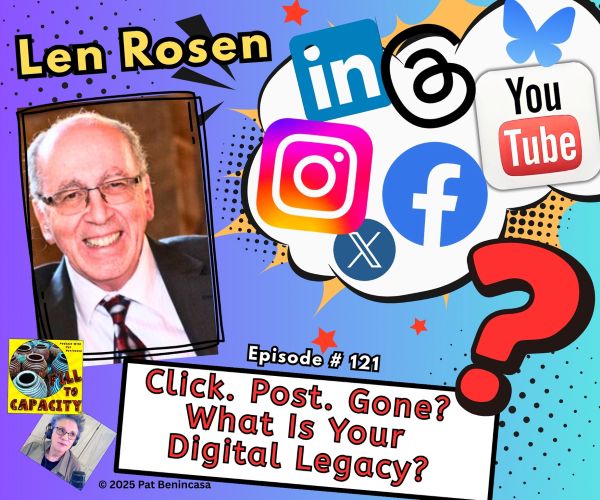
A week ago, I was a guest on Pat Benincasa’s podcast. For me, this was my first experience, and Pat was a very engaging host. Pat has worn several hats in her life. She has been an educator, is an artist and now, a podcaster who has created “Fill to Capacity,” for what she calls “people too stubborn to quit and too creative not to make a difference!”
When she found some of my postings on the subject of managing digital legacies, Pat reached out to me to ask if I would join her on a podcast, which I agreed to with a small sense of apprehension, having never done this before. But she made the conversation easy, and I hope you can get a chance to listen to “Click. Post. Gone? What is Your Digital Legacy?” For additional information, type “digital assets and death” in the Search window on the menu bar of the 21st Century Tech Blog to find more postings on this subject.
Digital History Explained
When you join Facebook, Instagram, LinkedIn, X, Threads, Bluesky, Tumblr, Mastodon, Reddit and other online social media, you do a lot of information sharing.
This is a subject you probably haven’t considered when writing emails and texts, setting up a PayPal or Stripe account, or engaging in online banking activities, let alone if you are a blogger like me.
What happens to all those points collected from credit card offers or subscription rewards like AirMiles, AAA (CAA) rewards, and others?
The digital contrail we leave behind with every keystroke needs our attention before we die because that trail of activity persists.
I became aware of just how much of our digital presence remains when Facebook suggested that I consider “friending” my dead aunt. I quickly let my cousin know that his mother was still very much alive on Facebook.
That’s what got me started looking at my digital legacy and writing about it. I began by asking if the problem of digital death was unique or if it was no different from dealing with the physical legacy you leave behind.
As I explored the subject, I found out that dealing with your presence in the ether is pretty complex and needs to be addressed separately when drafting a will.
Inventory Your Digital Identity
To begin organizing a digital presence means taking inventory. Inventory includes blogs, online e-commerce and banking, email, social media presence, online subscriptions, loyalty reward programs and more.
Then there are sites you no longer consider active, like old blogs and social media long abandoned. Does your digital presence still exist on sites you no longer visit?
Compiling this list for me took time. When finished, I included all this information and entered it into a password-protected document, which included URLs, user names, passwords, PINs, phone numbers and contact information, and more. I copied the document to my Google Drive and put it, as well, as accessible from all my digital devices. A hard copy was put in the filing cabinet containing my will. And because my wife and daughter are named as executors in my will, I shared the information with them.
But that wasn’t enough. My wife is not savvy around computers and the latest technology. So, I needed to find someone who was trustworthy whom I could name as the digital executor or trustee for handling my digital presence after death.
What does “properly handled” mean?
Should everything you have done online be shut down after you die?
Is there a continuing digital presence worth preserving either in remembrance or because it serves a cause? This latter issue came up during my inventory of my digital presence. I have an account with kiva.org, where the money I earn from the blog site and other Internet work I do gets used to fund microloans to small businesses and entrepreneurs in the Developing World. The loan repayments wouldn’t stop after my death and, as a result, could become a self-perpetuating activity.
That wouldn’t be the case for finite financial transactions that could be handled through proof of death notifications.
Governments and Digital Legacy
When a person dies, a death certificate is produced, a proof of death government-issued document that you need to send to insurers, banks, lawyers and more. But how do governments deal with digital death?
The United States, several years ago, passed the Revised Fiduciary Access to Digital Assets Act, requiring explicit consent to be included in a will when dealing with all digital property.
Canada has studied the U.S. legislation but has yet to pass a similar law. Instead, digital versus physical assets get treated within a will without specifying their very different natures.
The European Union has yet to pass a common regulation for digital legacy. Estonia leads the way, being the first country to create e-citizens and the management of digital legacies. Its inheritance laws incorporate digital assets with a transparent transferring of online presence, accounts and content to heirs unless otherwise stated in a will. Estonian law provides for death protection of personal data, allowing for limited heir rights to digital assets if prior arrangements have not been described or documented in a will.
Tools For Managing Common Digital Identities
Today, many online applications and services include a process to manage your posthumous digital identity. Examples include:
- Google’s Inactive Account Manager covers YouTube and other Google applications like Drive.
- Apple’s Legacy Contact allows the digital executor to access your Apple ID and iCloud.
- Facebook, Instagram and Threads offer a method for the digital executor to delete or memorialize.
- LinkedIn, X and Tumblr have death certificate requirements
Sites like Bluesky and Mastodon (the latter is decentralized and therefore a little more complicated) require a digital executor to email or log in as the user to remove the accounts while sharing proof of death. Bluesky allows the export of legacy content.
For TikTok, only a family member can request account deactivation. There is currently no recognition of a digital executor. Nor can a TikTok account be memorialized.
A Final but not the Last Note on this Subject
Before the podcast, Pat had asked me to comment on the Internet Archive and Wayback Machine. I intend to do that in a future posting, which will also look at handling financial and business account matters as part of a digital legacy, including some dedicated digital estate planning software tools. So stay tuned.

