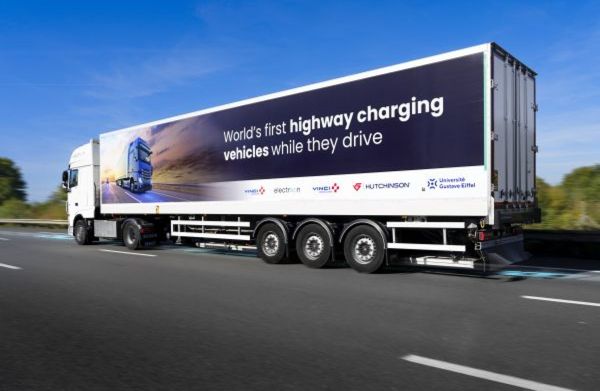
Can a road be converted into an energy source for the vehicles travelling on it? In October 2025, France launched the “Charge as You Drive” project, a 40-kilometre (25-mile) section of the A10 motorway just southwest of Paris. The project has been called the world’s first dynamic induction roadway charging system. It uses road-embedded inductive coils and vehicle-receiver coils. Power transfers from the roadway to vehicles averaged 200 kW with peaks of 300 kW in pilot tests of specially outfitted trucks, buses, vans and cars.
Electreon, an Israel-based developer of wireless electric road systems, is the technology provider. The use of an electrified inductive track buried beneath the roadway means electric vehicles (EVs) can use smaller battery packs and be lighter in weight. Lighter means less road wear and lower maintenance costs for both vehicle operators and infrastructure providers.
Electreon states that its mission is to support “100% global electrification” for the transportation sector, and induction is its chosen methodology for the electrified section of this highly travelled A10 highway. For the initial test, EV heavy-duty trucks, like the ones seen in the image above, were outfitted with receivers to recharge as they drove. The data indicate excellent results.
If France proceeds with its Electric Road System (ERS), it will cover 9,000 kilometres (approximately 5,600 miles) by 2035.
Power From Roadways Is Not Something New
France isn’t the first to consider electrified road systems. Back in 2021, I described a Swedish pilot project, an ERS that used a conductive metal rail near the side of the road to send electricity to EVs with receivers. The test area was a small section of highway outside of Stockholm.
Older still are catenary systems that use overhead wires to power electrified transportation. We are talking about electric trains, trams and streetcars, the primary means for mass transit in the 20th century. Overhead attachments make contact with power lines to drive the vehicles with these catenary systems found in cities around the world. They work because of the unrestricted overhead space that makes the technology relatively inexpensive to build, operate, and maintain. Third-rail systems have also been around throughout the 20th century, running in subways and on elevated rapid transit, like the Chicago L.
In the future, we may see kinetic energy roadway systems that derive power from piezoelectric devices embedded in roadways. At the Rutgers Center for Advanced Infrastructure and Transportation, implanted devices capture energy from the vibrations and weight of traffic on roads. Harvesting this mechanical energy from highly-travelled roadways may not equal the power derived from inductive or conductive electric road systems, but it should be more than enough to power roadway lighting, traffic signage and signals, and melt ice and snow.
Solar Roadways, an Idaho-based company, has been experimenting with integrating solar energy into road infrastructure. Its system uses harvested energy to provide charging, illumination, and road heating powered by sunlight.
All of these roadway-based energy-generating systems represent alternatives to powering EVs with rechargeable battery packs and rechargers.
Comparing Electrified Roadways And Recharge Networks
Does the cost of electrifying a road network come out at more or less than the buildout of a public high-speed recharge network?
Electrifying a roadway can be expensive. For example, the estimated cost of inductive or conductive systems per kilometre comes to between US$1 and $7 million ($1.7 and $11 million per mile).
That’s a low ball when you consider this case example.
A 1.2-kilometre (0.75-mile) section of electrified roadway in the State of Florida ended up costing $500 million when all the power upgrades, cabling, and other supporting infrastructure costs got added in.
Now, compare the above to the cost of recharger units. How many public recharge units would be needed to support the growing number of EVs on the roads? Here are some basic recharger facts:
- A Level 1 charger can be powered by plugging it into a home outlet. A recharge can take up to 24 hours. Most EVs come with a Level 1 charger. If you need an extra, the cost runs between US$200 and $500. That’s okay if you only drive occasionally.
- A Level 2 public charger costs about $10,000 per unit. It takes 4 to 8 hours for a full recharge. For highway deployments with multiple daily destinations, using a Level 2 may suffice within an urban environment. Level 2 chargers can be installed in homes, garages or at workplace parking lots.
- One more grade takes you to Level 3. These can recharge an EV to 80% in 20 to 60 minutes. Per unit cost, including upgraded power infrastructure, comes to between $50,000 and $150,000 per unit. For long commutes, this type of charger may or may not be suitable. If you are a trucker overnighting at a truck stop or taking a long break, the time needed may be acceptable.
- Then there are ultrafast chargers, which recharge to 80% in 15 to 30 minutes. That’s 250% more time than you would take to pump gas. The unit cost per charger comes in at between $100,000 and $350,000, including the added infrastructure support. For long commutes with a stop for lunch or dinner, this type of charger fits the bill.
- Then there is BYD’s Super e-Platform, a flash charging system that can recharge to 80% in 5 to 6 minutes, about the time it takes to pump gas. Currently, these chargers support a few Chinese-built EV models, and the unit cost estimate for each is between $500,000 and $1 million, all in. That’s an ouch!
A Case Study For Road Vs. Charger Electrification
Consider the U.S. Interstate Highway System. Here are some interesting statistics:
- The Interstate covers 78,680 kilometres (48,890 miles) and supports traffic volumes of between 1 to 1.5 billion vehicles daily.
- More than 80% of the traffic commutes between 40 and 80 kilometres (26 and 52 miles) daily. A Level 2 charge system at home or work would meet the EV requirements of this type of travel.
- Longer hauls with travel between 65 and 80 kilometres (40 to 50 miles) and involve between 25,000 and 193,000 vehicles daily. Even for these commutes with current EV ranges, a Level 2 at-home charger should be sufficient.
- For the rest of the vehicles using the Interstate system, between 12 and 20% of total volume, Level 3, ultrafast, and Super e-Platform chargers would be needed.
Could a dedicated electrified lane for Interstate long-haul trucks on high-travelled routes be cost and environmentally sustainable? Would it be more cost-effective than building out a network of Level 3, ultrafast and Super e-Platform chargers? The accountants and policymakers in the 21st century have their work cut out for them as they consider the infrastructure needs to support future EV volumes and the economics of electrified roadways versus charge stations, or a combination of the two.

