
An update to NASA’s DART mission and a new dark matter theory caught my eye in recent space news. I share these with you and hope you find them equally intriguing.
NASA’s Asteroid Redirect Experiment Works
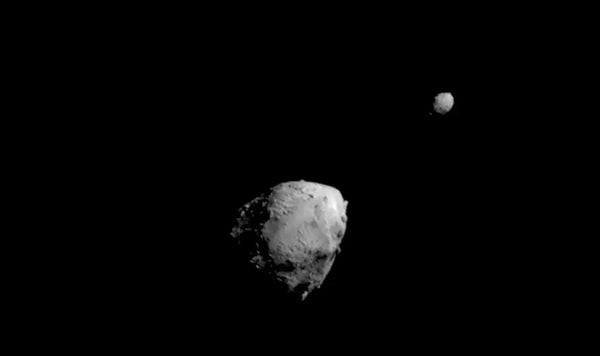
When NASA sent DART (Double Asteroid Redirection Test) to rendezvous with Didymos and Dimorphos and collide with the latter in 2022, the agency hoped it would measure changes to the latter’s orbital period around the former. It did, from 11:55 to 11:23, a change of 32 minutes. NASA measured success if the orbital period changed by a mere 73 seconds. What NASA didn’t expect, as reported in the astronomy journal Science Advances, was that the impact on Dimorphos would alter Didymos’ orbit around the Sun.
Instead of just changing the orbital relationship between the two asteroids, NASA’s experiment demonstrated that we could defend Earth from a future impactor that could cause an extinction event like the one that killed the dinosaurs 65 million years ago.
Measuring the latest double asteroid orbit shows that its orbit has slowed by 370 metres (more than 1,220 feet), altering its trajectory. Although the Didymos-Dimorphos binary asteroid retains the same angular momentum, the velocity reduction means the elliptical path around the Sun will be a little bit closer than before.
Jay McMahon, an Associate Professor of Aerospace Engineering Sciences at the University of Colorado Boulder, told Scientific American that the results of the DART test are “very cool. Like any experiment [referring to the potential to redirect], you can make a prediction about what will happen, but then you take the measurements to prove it. And so, this proves it.”
What about the residual effect of the impactor when striking Dimorphos, a mass of material ejected into the surrounding space? Will that material in time exert an additional tug to further alter the double asteroid’s journey around the Sun? Although NASA doesn’t believe the ejecta will play a significant part in the future orbital path, the European Space Agency (ESA) has sent its own follow-up probe, Hera, launched in 2024, to further study the dynamic changes resulting from the test. Hera is accompanied by two cubesats, Milani and Juventus.
All three will rendezvous and go into orbit around the double asteroid in November 2026. Hera cameras, thermal sensors and radiometer will study changes in structure and mass at the site of the Dimorphos impact crater. The cubesats will attempt landings on Dimorphos. Juventas’ instrumentation will study the asteroid’s subsurface composition. Milani will use a visible-light camera, an infrared spectrometer and an accelerometer to study its landing site.
Our Galaxy Centre: A Black Hole Or Dark Matter Blob
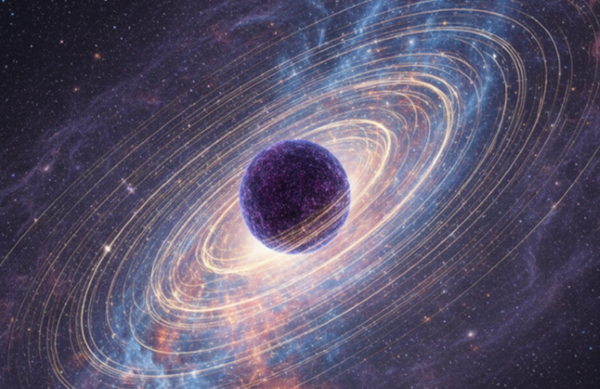
At the centre of our galaxy, the Milky Way, lies a dark mass equivalent to 4.3 million Earth Suns. Astronomers have named it Sagittarius A* (*Sgr A*), lying between 26,000 and 27,000 light-years from Earth. It’s equivalent in size to the Solar System. Observations using telescopes here on Earth reveal a shadow at the centre of the galaxy surrounded by fast-moving S-Stars.
Astronomers have theorized that Sgr A* formed billions of years ago from the merger of several black holes within the galaxy. Now, however, a new hypothesis is gathering academic support that brings dark matter into the picture. Could Sgr A* actually be a “supermassive compact object composed of self-gravitating fermionic dark matter,” a description found in a February 2026 paper published in Monthly Notices of the Royal Astronomical Society?
This isn’t just dark matter. It is a specific type of dark matter called fermions. Fermions are light subatomic particles. Fermionic dark matter and matter-based fermions share common quantum attributes. Where ordinary fermions like quarks and leptons are strongly charged particles that emit light, dark matter fermions are invisible and only detectable by gravity. Those who propose that Sgr A* is composed of fermionic dark matter point to the diffuse halo seen at the centre of the Milky Way.
The behaviour of the S-stars orbiting the galactic centre is behind the fermionic dark matter blob theory. These S-stars are young. They circle the galactic centre rapidly with orbits measuring teen Earth years, not centuries, millennia or longer.
Differences between a black hole and a dark matter blob are subtle. With a black hole, there would be an event horizon, a circle of light surrounding a dark centre as matter gets sucked into the hole’s core. With a dark matter blob, there would be a diluted halo of light.
Astrophysicist Carlos Argüelles of the Institute of Astrophysics La Plata in Argentina describes the current state of thinking in light of the fermion dark matter alternative to a central black hole, stating:
“We are not just replacing the black hole with a dark object; we are proposing that the supermassive central object and the galaxy’s dark matter halo are two manifestations of the same, continuous substance.”
So, which theory is right? The problem we face here on Earth is the lack of a good view of what lies at the centre of the Milky Way. Ours is significantly obscured by interstellar dust that lies between Earth and the galactic centre, and the current Event Horizon Telescope (EHT) technology is just not cutting it.
What’s needed is a next-generation EHT that cuts through galactic dust and definitively shows what is at the centre of our galaxy. The problems with the current EHT, a network of Earth-based radio telescopes spanning the planet from the South Pole to Greenland, are many.
The current EHT is incapable of producing the extreme precision needed to get accurate readings. Atmospheric interference limits observations. Data aggregation needs are massive and more than what the current network can handle.
At best, today, we can produce static images of the galactic centre. Movies, however, are what’s needed to show the S-stars in motion around an event horizon or fermion halo.
The next generation EHT requires double the number of radio telescopes with more located at higher altitudes, well above atmospheric interference. As well, the EHT needs wider bandwidth recordings and better and faster software with artificial intelligence (AI) added to the mix. These improvements remain years away from reality, which means Sgr A* will continue to be a mystery.

