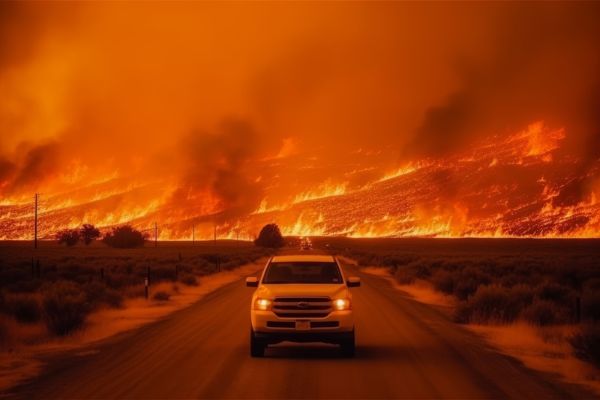
Michael Greenstone is an economics professor at the University of Chicago and the co-creator of the Air Quality Life Index (AQLI). In describing the record-breaking wildfires that enveloped Canada this summer and the smoke pollution they caused, he recently told CBS News:
“We’re now stuck living with air pollution concentrations that are the dangerous ghost of the fossil fuels burned since the Industrial Revolution. Even countries that have earnestly spent decades cleaning up their air can’t escape these ghosts and the shorter and sicker lives that they deliver.”
The smoky skies stretched across North America, dipping deep into the United States. Where I live by Lake Ontario, smoke appeared as a fog bank over the water, obscuring the far shore and lake freighters plying its waters.
My allergies, not usually severe, spiked. I couldn’t shake off a nagging cough that worsened as the day progressed. At night, I was constantly clearing my throat. I had never experienced anything like it, even in previous fire season summers when you could smell and taste the smoke in the air.
Environment and Climate Change Canada, in a July news release, described how climate scientists had started using an extreme weather event attribution system to differentiate extreme weather events. Here are four 2025 examples from collected Canadian data:
- The Yukon Territory, from June 20 to 23, 2025, saw peak daily highs of 22.0 °C (71.6 °F), 6.5 Celsius (11.7 Fahrenheit) above normal. The event was three times more likely because of human activity.
- The province of Alberta, from May 28 to 31, 2025, experienced daily highs of 28.8 °C (83.8 °F), 11.3 Celsius (20.3 Fahrenheit) degrees above normal. This event was also deemed to have been three times more likely because of human contributions.
- From February 12 to 19, 2025, the province of Saskatchewan experienced its coldest daily temperatures of -34.5 °C (-30.1 °F), 17.2 Celsius (31 Fahrenheit) colder than normal. Unlike the heat events, the cold was less likely to be attributed to human activity.
- From January 20 to 21, 2025, Western Ontario experienced its coldest daily temperatures of -34 °C (-29 °F), 12 Celsius (21.6 Fahrenheit) colder than normal. This event was also considered to be much less likely to be caused by climate forcing from human activity.
The Canadian site stated that extreme climate-related weather events were becoming more frequent, severe, and costly in 2020, 2021, 2022, and 2023, ranking in the top 10 years based on insurance claims, surpassed only by the 2016 Fort McMurray fires, the 2013 flooding in Calgary and Toronto, and the 1998 Quebec ice storm.
In another study from World Weather Attribution, Climate Central and the Red Cross Red Crescent Climate Center, human-causes were attributed to an increasing number of global heatwaves in the period from May 1, 2024, to May 1, 2025. The report’s key findings include:
-
Four billion people representing almost half the world’s population saw at least 30 days of extreme heat, hotter than 90% of temperatures observed in their locations when compared to the period from 1991 to 2020.
-
195 countries or territories reported double the number of extreme heat days when compared to the previous period described in the previous point.
-
All of the 67 extreme heat events described that included record-breaking temperatures were attributed to human-caused climate change.
- These heat waves in the U.S. were seen as the leading cause of weather-related events, causing 1,300 fatalities.
- The U.S. National Weather Service Climate Prediction Center, according to the Sanibel-Captiva Conservation Foundation, noted that Florida had experienced 50% more extreme heat days than normal, affecting not just humans but plants and wildlife.
But it is the wildfires that stand out even more, attributed largely to the drying out of the North American continent and rising atmospheric temperatures. While wildfires have always been with us, those we experienced this summer have been growing in size, ferocity and spread.
Where 2020 was the worst year for wildfires in California, the Palisades and Eaton Fires in January 2025 brought back vivid memories of what happened in Paradise five years earlier. The 2025 fires happened within the perimeter of Greater Los Angeles, leading to the evacuation of more than 200,000, 440 excess deaths, and 18,0000 structures consumed by the flames. These were historically high numbers in every respect. California in 2025 wasn’t alone. Wildfires burned vast areas of Oregon, Washington and Colorado as well.
The extreme heat events felt in Canada didn’t quite compare to what parts of California experienced, with the entire state experiencing temperatures 1.66 °C (3 °F) higher than the average for the past century and Death Valley, the nation’s hot spot, reaching highs of 54°C (130 °F).
In Texas, Austin saw a heatwave lasting several days with temperatures of 37.8 °C (100 °F). Houston added an extra month to its calendar with temperatures exceeding 35°C (95 °F).
The Union of Concerned Scientists (UCS), the keepers of the Doomsday Clock, predicted a significant increase in heat waves and excessive heat events throughout the rest of the century. In a recent comment, UCS scientists stated that “This summer could very well be the coolest of the rest of our lives,” noting that global average temperatures based on current human-caused heating will raise atmospheric temperatures from 2 to over 3 °C (3.6 to 5.4 °F) by 2100.
Although 2 and 3 sound like small incremental changes, across the planet, the implications of these types of temperature increases will disrupt the natural world, causing:
- Tropical coral reefs, seagrass and kelp forest degradation in the oceans, affecting 25% of fish species.
- Near extinction-level events affecting marine and terrestrial biodiversity, with a decline in insect, plant, and mammal and bird species.
- Sea and continental ice sheet melt, with the Arctic Ocean becoming ice-free for much of the year.
- Alpine glacier melts, impacting water sources that feed many of the world’s most important rivers and their downstream populations dependent on them for freshwater for agriculture and human consumption.
- 2.3 million deaths above average annually by 2100 in Europe alone, attributed to lethal heat and humidity conditions and tens of millions worldwide each year.
The ghosts of Christmas future lie ahead if we cannot address the human causes of climate change in the present. It matters little that the Trump administration is lifting the requirements for the Environmental Protection Agency (EPA) to collect emissions data from carbon polluters. Putting on environmental blinders won’t change the outcome.

