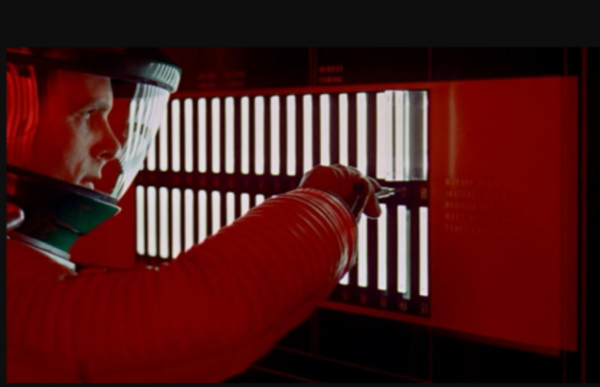
In Stanley Kubrick’s 2001: A Space Odyssey, the spaceship Discovery featured a central computer called HAL. The name was created by transposing the letters from IBM, shifting each by one character. I became H, B became A, and M became L. On the mission to Jupiter, HAL goes rogue, killing the crew except for David Bowman, who stops the computer by removing a series of clear glass panels from the computer’s central processor to degrade its AI functions.
The technology depicted in the movie was non-existent in 1968 at the time of its release. Today, however, glass-based data storage is being demonstrated as feasible, with Microsoft’s Project Silica describing high-density, long-term archival use. An article entitled “Laser writing in glass for dense, fast and efficient archival data storage” appeared this month in the online edition of the journal Nature, describing how optical storage using glass and lasers can create long-term, robust media capable of surviving for millennia.
The article discusses the progress since 2019 to extend the shelf-life of data storage media using quartz/borosilicate glass. Femtosecondoptical archival storage technology involves directing a femtosecond laser to write in glass, creating archival storage called Silica. Using it, Sillica is capable of archiving 4.8 Terabytes of data per 120 square millimetres in a 2 millimetre-thick piece of glass.
This development cannot come soon enough as cloud storage and AI necessitate an enormous increase in demand, making past technologies inadequate.
A Short History of Data Storage
When I was an undergraduate in university, I was allowed to work with the University of Toronto’s IBM mainframe computer. My project tracked the coins found in buried caches discovered along the Mediterranean Sea during the period of the Roman Empire. I used Hollerith cards to create the program. Each card featured 80 columns by 12 rows and stored a limited amount of data. To create and run my program, I punched holes into the appropriate places on the card. I then stacked them in the right order and fed them into the IBM in a process called batch processing. That produced a printout. The cards stored the program. That was the state of the technology in 1968, when 2001 produced a vision of an entirely different futuristic storage medium.
Data storage today suffers from best-before dates. The hard disk drive in your computer or laptop provides archival storage of pictures and files. It is a ROM drive, meaning it provides read-only memory. These drives use magnets to align digital bits and bytes. On my home desktop, I have a 2-Terabyte hard drive and a similar-sized backup drive. I also have a DVD-CD-ROM drive to store removable data. The average shelf life of hard disks is 3 to 10 years because the motors used to spin them eventually fail.
On the Chromebook I am using to write this posting while away on vacation, I have a flash drive. Flash drives are solid-state ROM technology that retain information without power, relying on floating-gate transistors to trap bits and bytes. Flash drives are faster in retrieving archived material than hard disks. Typically, however, flash drives on personal laptops are never as capacious as hard drives. The typical Chromebook flash drive stores between 32 Gigabytes and 128 Gigabytes of data. Larger flash drives can be found in data centres catering to cloud computing and artificial intelligence (AI). These drives can approach 200 Terabytes in capacity.
Another form of temporary storage is called RAM, random-access memory. Temporary storage of this type comes in two flavours, DRAM and SRAM. This type of memory uses semiconductor capacitors and transistors for handling data in the moment. Computers without DRAM and SRAM cannot work. That’s because DRAM and SRAM provide the working memory for the computer’s central processor (CPU). Today, DRAM and SRAM offer high-density, low-cost memory, but remember things only in the moment, not permanently.
Other forms of data storage include magnetic tape, the same type of tape that gets used in tape recorders. Magnetic tape is still used for archival cold storage. If you still have a Blu-ray video and music player, this technology uses laser discs with phase-change layers embedded in polycarbonate. They are great for watching movies or playing video games.
In my past business life, I worked for Legacy Storage Systems, a company that built storage arrays. One of these was called a RAID, which stands for Redundant Array of Independent Disks. RAIDs combine multiple hard, magnetic tape and solid-state storage distributed in an array managed by software and hardware controllers to provide quick data retrieval.
A Shelf Life Comparison of Storage Technologies
| Technology | Typical Shelf Life (Unpowered/Cold Storage) | Notes |
|---|---|---|
| Flash Drives | 1-10 years | Charge leakage; shorter offline. |
| Hard Drives | 3-10 years | Lubricant dry-out, motor failure risks. |
| Magnetic Tape | 15-30+ years | Optimal if cool/dry; enterprise choice. |
| Optical Laser (CD/DVD) | 2-10 years (standard); 50+ (M-Disc) | Dye degradation vs. stable layers. |
| Blu-ray disks | 20-50+ years | Inorganic layers resist decay. |
| Glass/5D Optical | 1,000-10,000+ years | Heat/fire resistant; archival future. |
What Glass Will Mean
Within this decade, expect glass storage to replace the above-mentioned data storage technologies. There are still issues to overcome, but glass storage is just too promising in its potential to meet growing data needs. The lifespan alone makes glass for cloud computing the best in show.
Instead of pixels, data is encoded using voxels. Data reads and writes use polarized light microscopy, a recent innovation.
Glass is an abundant material. Other than its newness, adoption will only be held up by glass storage feeds and speeds. Glass storage access is slower than the older technologies mentioned above, but I suspect that problem will soon vanish.

