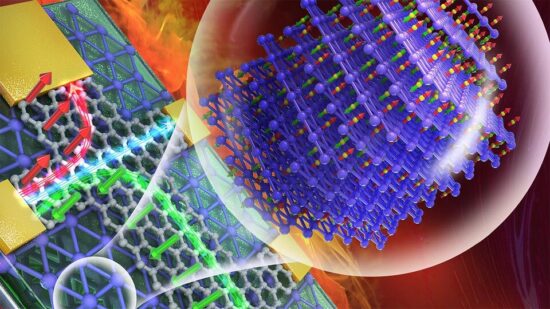
This image illustrates the material composition of a new transistor that uses graphene (seen in gray) and chromium oxide (in blue). The red and green arrows represent spin properties of electrons that convert to 0s and 1s used in binary code. (Image credit: University of Buffalo, Advanced Materials)
Does 5% energy reduction sound like a lot to you? But when you consider how transistors are ubiquitous to almost every piece of technology we use today, reducing the power requirements by that amount in an energy-hungry world could be a gamechanger.
Physicists at the University of Nebraska and the University of Buffalo are credited with discovering the first magneto-electric transistor. They have described this new iteration of the transistor in a paper entitled “Graphene on Chromia: A System for Beyond-Room-Temperature Spintronics” and published in the January 2022 edition of the engineering journal, Advanced Materials.
Today, our electronic devices largely depend on metal–oxides and silicon as the principal semiconducting materials in integrated circuits and chips containing millions of transistors. Each transistor serves as an on-and-off switch for reading binary-coded instructions which are the basis of computing. Newer iterations of chips pack more transistors into a smaller space. There is little room left now for decreasing the size of transistors and the number that can be placed on a single chip.
These chips serve to provide digital memory for computers, smart devices, automobiles, satellites, and the network plumbing that underlies the Internet, telecommunication networks, and power grids.
Peter Dowben, a University of Nebraska physicist, in an article appearing in Nebraska Today, tells author Scott Schrage, “The traditional integrated circuit is facing some serious problems. There is a limit to how much smaller it can get. We’re basically down to the range where we’re talking about 25 or fewer silicon atoms wide. And you generate heat with every device…so you can’t any longer carry away enough heat to make everything work.”
It’s not like our world will need less computing technology in this decade and beyond. As we further automate manufacturing, transition to electric vehicles, and digitized almost every aspect of our existence, chip demand and the energy needed to run them will continue to rise. Professor Dowben notes, “We’re getting to the point where we’re going to approach the previous energy consumption of the United States just for memory. And it doesn’t stop. So you need something that you can shrink smaller, if possible. But above all, you need something that works differently than a silicon transistor, so that you can drop the power consumption, a lot.”
Graphene combined with chromium oxide appears to be a good alternative to silicon. Experimenting with these materials using spintronic-based rather than conventional transistors appears to provide a solution that uses less energy and allows the device to get even smaller. Professor Dowben describes the advantages as “huge fidelity at very little energy cost.”
So what differentiates a spintronic transistor from the current crop?
Spintronics is also known as spin electronics. A transistor that uses spintronics is taking advantage of the inherent properties of electrons that spin around the nucleus in atoms. Conventional transistors rely on the linear transport of an electronic charge. Spintronics is different. The electron exhibits one of two spin states: it is either up or down which translates to “0s” and “1s” or “ons” and “offs” used in binary code and switches.
The use of magnets and semiconductor materials with ferromagnetic properties allows spintronic transistor electrons to be manipulated to rotate clockwise or counterclockwise in constant frequency. The magnetic properties of the material substrate control the spin creating spin waves or magnons which create spin without heat. Less heat means more transistors packed closer together. Less power means more computing capacity for a smaller amount of space without the need to increase energy production.
The University of Nebraska and University of Buffalo teams who have worked collaboratively, in one-atom-thick graphene and chromium oxide have demonstrated that their new transistor not only uses 5% less energy to operate but also allows manufacturers to reduce the number of transistors per chip for data storage by as much as 75%. That should mean a future of even smaller devices.
Cookie Consent
We use cookies to improve your experience on our site. By using our site, you consent to cookies.
ID used to identify users for 24 hours after last activity
24 hours
_gat
Used to monitor number of Google Analytics server requests when using Google Tag Manager
1 minute
_ga
ID used to identify users
2 years
_gali
Used by Google Analytics to determine which links on a page are being clicked
30 seconds
_ga_
ID used to identify users
2 years
__utmv
Contains custom information set by the web developer via the _setCustomVar method in Google Analytics. This cookie is updated every time new data is sent to the Google Analytics server.
2 years after last activity
__utmx
Used to determine whether a user is included in an A / B or Multivariate test.
18 months
__utmc
Used only with old Urchin versions of Google Analytics and not with GA.js. Was used to distinguish between new sessions and visits at the end of a session.
End of session (browser)
__utmz
Contains information about the traffic source or campaign that directed user to the website. The cookie is set when the GA.js javascript is loaded and updated when data is sent to the Google Anaytics server
6 months after last activity
__utmt
Used to monitor number of Google Analytics server requests
10 minutes
__utmb
Used to distinguish new sessions and visits. This cookie is set when the GA.js javascript library is loaded and there is no existing __utmb cookie. The cookie is updated every time data is sent to the Google Analytics server.
30 minutes after last activity
_gac_
Contains information related to marketing campaigns of the user. These are shared with Google AdWords / Google Ads when the Google Ads and Google Analytics accounts are linked together.