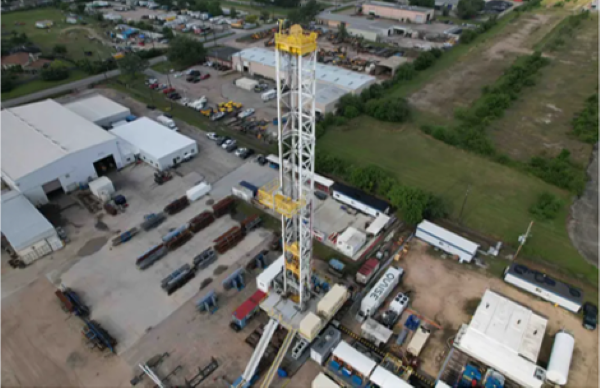
Forget about drilling for oil and natural gas. Drilling to unlock Earth’s internal heat, called geothermal energy, represents our 21st-century future. Geothermal energy can provide baseline power along with renewable energy sources to eliminate the need to burn fossil fuels for electricity. With demand for fossil fuels confined to transportation and the manufacturing of advanced materials, the world could be rapidly transformed.
How can this come about? A Houston-based company, Quaise Energy, founded in 2018, has been developing a gyrotron-powered drilling platform that bores through rock to access heat deep inside the Earth. It can use the existing fossil fuel infrastructure and conventional rotary drills of the fossil fuel industry, combined with its high-power millimetre wave drilling technology, to reach Earth’s internal heat as deep as 20 kilometres (12 miles) underground, where temperatures reach 500 degrees Celsius (932 degrees Fahrenheit). The ability to instantly create a workforce already skilled in drilling for oil and gas is a bonus that gives geothermal energy projects primacy going forward.
CEO of Quaise, Carlos Araque, told reporters at the first demonstration site of its hybrid drill technology, “Geothermal energy is available everywhere on massive scales. If you take all fossil, all nuclear, and all other forms of renewable energy combined, they’re not even a millionth of a millionth of the thermal stores of energy. It’s mind-boggling, and to get it, we only have to go down two to twelve miles. That’s how close we are to infinite clean energy, no matter where you are in the world.”
Not only can geothermal use the existing expertise and infrastructure from the fossil fuel industry, but it also provides an energy source with a tiny footprint. Unlike wind and solar energy farms, a geothermal site would be no bigger than a few hectares.
The technology has come from 15 years of research done at the Massachusetts Institute of Technology (MIT). I wrote about the research being done at MIT into millimetre wave drilling technology three years ago, a technology that has existed for 70 years, coming from research into nuclear fusion. Gyrotrons are similar to lasers but use an entirely different range of frequencies.
The initial tests at MIT and later at Quaise bored holes 5 centimetres wide and 5 centimetres deep. Since then, the bore holes have been getting wider and deeper. In May, at the demo for press and investors, the millimetre-wave demonstration bored a 3 metre (10-foot) hole. The following week, Quaise drilled three times deeper, and then a week later, four times deeper using no more than 100 kilowatts of power, equivalent to the energy required to drive a single car.
Next month, Quaise plans to drill multiple 130-metre (425-foot) holes in a granite outcrop at Marble Falls, Texas. By 2026, the plan is for Quaise to complete its design and build of the world’s first superhot geothermal power plant, and have it operational, generating 100 Megawatts of thermal energy harvested from a small group of drilled wells. By 2028, the company’s goal is to convert its first fossil-fuel thermal power plant into one repowered using geothermal heat. The likely first site will be in Oregon, with its known geothermal properties having been a test site for others doing research into this energy source.
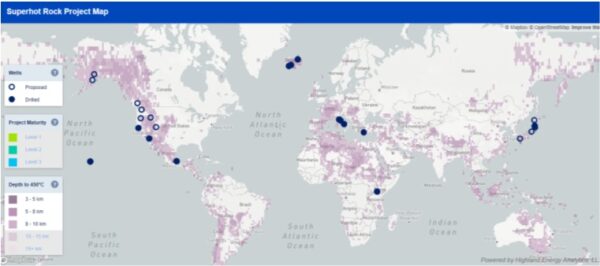
In a paper presented at a conference at Stanford University in 2024, Trenton T. Cladouhos, a goethermal scientist, stated that “just 2% of the thermal energy stored in hot rock 3 to 10 km [2 to 12 miles] below the continental U.S.” would be “equivalent to 2,000 times the primary U.S. energy consumption. By developing these resources, clean, firm, renewable geothermal power becomes possible virtually anywhere.”
Where can you find hot rock sources? In the paper that Cladouhos co-authored, an accompanying map reproduced below shows the current mapping of superhot geothermal potential sites.
The advantages that geothermal brings to the energy demand equation are many:
- Superhot and hot rock can be tapped almost anywhere around the world. If it doesn’t appear on the above map, trust me, it still lies underfoot.
- The method to access hot rocks uses conventional fossil fuel drilling technology, which means no fracking is required.
- Only the very deep superhot rocks require the technology Quaise is perfecting.
- Superhot and hot geothermal are renewable energy sources that are reliable and continuous to provide baseline energy demand requirements for the grid, unlike their intermittent energy cousins, wind and solar.
- Geothermal produces zero emissions and uses less than 1% of the land and material requirements of wind and solar energy.
- Finally, converting existing thermal power plants using coal, oil and gas can be converted to operate using superhot geothermal, meaning no new build-outs required.

