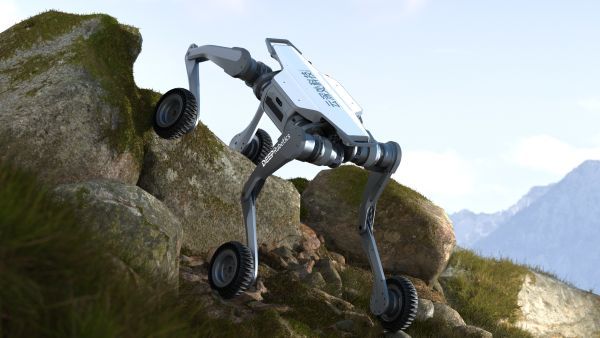
DeepRobotics is a Chinese developer of quadruped and humanoid robots founded in 2017 with its headquarters in Hangzhou. When you visit the website, its quadruped robot models bear a remarkable resemblance to an American competitor, Boston Dynamics, considered one of the leading engineering and robotics design companies in the world. Hyundai Motors in Korea purchased an 80% stake in Boston in 2021. Hyundai plans to use Boston’s four-legged and humanoid robots in the production and assembly of its automobiles and trucks, and is funding research into both Spot and Atlas, the latter, a two-legged advanced humanoid robot first introduced in 2013 and previously featured in articles on this blog site.
Boston introduced the first commercial quadruped robot called Spot, a pretty generic name for a pet dog. Spot, upon its introduction, resembled our four-legged friends but has since become more sophisticated, autonomous, intelligent and athletic.
DeepRobotics is challenging Boston with its latest robot, called Lynx, a quadruped that combines wheels and walking. Lynx’s wheeled-leg combination design allows it to switch between walking and rolling. This makes it possible to use wheels and move quickly on flat terrain while still being able to climb stairs and tackle 45-degree slopes. Lynx also has a bipedal mode where it can stand on its two back legs, as shown in the picture below, making it possible to see over tall objects in its path.
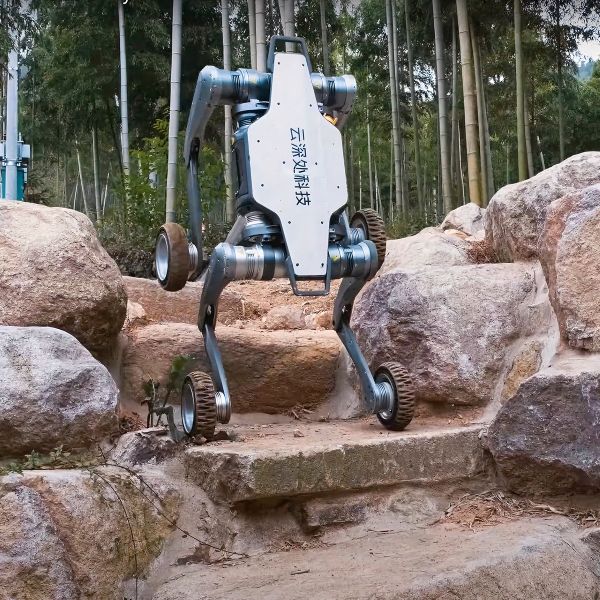
Lynx has onboard AI that features autonomous navigation with both cameras and Lidar and reinforcement learning. Like other DeepRobotics quadruped robots, Lynx has been built to work in factories, warehouses and hazardous environments. Targeted applications are in construction, utilities, logistics, scientific exploration, emergency rescue, the military and security.
What has Lynx standing out is its strikingly low price point at US$ 18,000. When compared to the price Boston Dynamics is selling the basic starting package for Spot, Lynx is four times cheaper. That is one of the reasons that has garnered Lynx media attention since it was first announced, that and four-wheel and walking mobility.
Lynx weighs 33 kilograms (72 pounds), making it reasonably easy to carry. It can carry payloads between 15 and 50 kilograms (33 to 110 pounds). It can navigate in tight spaces and climb obstacles 80 centimetres (over 2 1/2 feet) tall. Its travel range is 12 kilometres (nearly 7 1/2 miles). It travels on a single battery charge up to 2 1/2 hours and features hot-swappable batteries to minimize downtime. Its temperature tolerance range is from -20 to 55 Celsius (-4 to 131 Fahrenheit).
I asked Perplexity.ai to compare Boston’s Spot and DeepRobotics Lynx, and the table it created is an eye-opener:
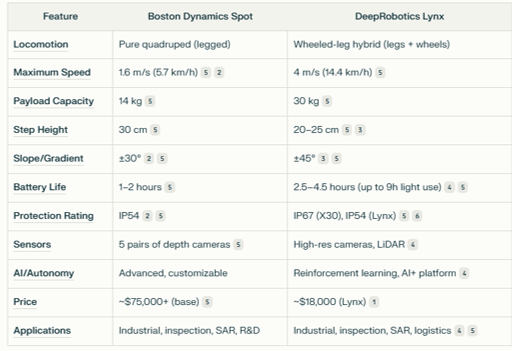
If I were an executive at Boston Dynamics, I would be a bit wary of the competition from China. A tariff wall may be the only impediment to seeing Lynx and other DeepRobotics quadruped robots taking a good chunk of the market.

