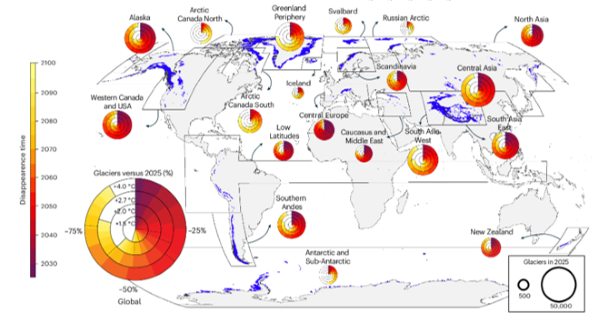
The reality of global warming is best observed by watching changes to alpine glaciers. A paper entitled “Peak Glacier Extinction in the Mid-Twenty-First-Century” was published this month in the journal Nature. The title says it all.
What is a glacier? It is an ice mass that persists for a long period of time. The common guideline is a mass that exceeds 0.1 km2 (0.0039 m2). Below this size, accumulations of snow and ice are called snow fields or patches.
The Meaning of Peak Glacier Extinction
The aforementioned paper introduces the phrase “peak glacier extinction,” classifying glaciers as disappeared or extinct when projected areas fall below 0.01 km2 (0.0039 m2) or ice volume declines to less than 1% from current levels.
Alpine glaciers are small when compared to those in Greenland and Antarctica. They persist for tens of thousands of years and can be found at various levels of elevation. Today, however, they are vanishing as atmospheric temperatures rise 1.5 °C (2.7°F) above pre-Industrial Revolution levels.
Today, 215,543 alpine glaciers cover 705,253 km2 (272,278.6 m2) of the planet. Using four global warming scenarios, including the two previously mentioned, plus mean temperature rises of 2.0 and 4.0°C (3.6 and 7.2°F), results indicate that almost all will shrink. Only 20% expected to survive, even if warming attains the worst scenario.
The peak glacier extinction event will happen around 2041, with approximately 2,000 alpine glaciers disappearing. The European Alps may see the highest rate of glacier loss between 2033 and 2041. The rest of the world’s alpine glaciers will shrink significantly or disappear by 2050, based on current rates of atmospheric warming that by 2100 will see a mean increase of 2.7 °C (4.9°F).
The research comes from scientists at:
- Vrije Universiteit Brussel (Belgium),
- University of Fribourg (Switzerland),
- Carnegie Mellon University (USA),
- Universität Innsbruck (Austria),
- University of Bristol (UK),
- The Swiss Federal Institute for Forest, Snow and Landscape Research
- The Laboratory of Hydraulics, Hydrology and Glaciology at ETH Zürich, Zurich (Switzerland).
Lead author, Lander Van Tricht, from ETH Zürich, states:
“For the first time, we’ve put years on when every single glacier on Earth will disappear.”
How Do We Measure Alpine Glacier Mass?
What methods help make projections like these possible? How do we measure a glacier’s ice volume?
Climatologists and glaciologists use in-field observations and measurements by drilling into glaciers, calculating winter snow accumulations, and tracking data from remote, automated weather stations. Satellite sensors provide elevation surveys of ice surfaces as well as gravimetric readings that show the shifting of ice masses over time as they shrink or grow.
Vanishing Alpine Glaciers
As temperatures warm, what areas are most vulnerable? The European Alps, Caucasus, the Canadian and U.S. Rocky Mountains, the near-tropical Andes in South America, and Africa’s Mount Kilimanjaro, Mount Kenya, and the Rwenzori Mountains will see the biggest ice losses. A good example is Kilimanjaro, which has seen its alpine glacier shrink from 4.8 km2 (1.85 m2) in 1984 to where it is today, which is practically non-existent.
Himalayan glaciers, the largest source of alpine ice, today, provide river water for the populations of China and South Asia. The glaciers feed the Indus, Ganges, Brahmaputra and Yangtze River basins, providing freshwater, agriculture, a fishery, hydroelectricity and more to more than 1.65 billion people. For Bhutan, Nepal, India, China, Laos, Vietnam, and Cambodia, alpine glacier loss means dire consequences.
A website, Goodbye Glaciers!? projects the rate of alpine glacier decline for selected sites around the world. Watching its video clips should be a wake-up call for politicians and policymakers who currently ignore climate change and global warming.
Glacier Extinction Consequences
What to expect as alpine glaciers vanish? Here is a list:
- Growing freshwater insecurity for 2 billion people as glacier-fed rivers become unpredictable in terms of flow volumes.
- Rising sea levels from meltwater contribute more than either the Antarctic continent or Greenland glaciers.
- Degraded and unstable alpine habitats with increasing floods, landslides and avalanches, creating new risk hotspots, causing disruptions to biodiversity, agriculture, forestry, and riverine fisheries.
- Increased global warming as formerly sequestered pollutants and greenhouse gasses get released from the melting ice.

