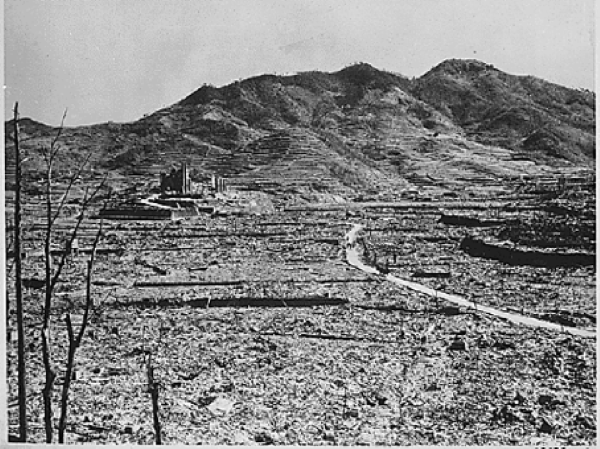
On August 9, 1945, the U.S. dropped an atomic bomb on the city of Nagasaki. It was the secondary target, alongside the primary target, the city of Kokura. Cloud cover saved the latter from the devastation of the bomb.
When the U.S. chose the targets for its first two atom bombs, the order of choice started with Hiroshima, then Kokura, Niigata and Nagasaki. Niigata would have been the Hiroshima bomb’s secondary target.
The bombing of Nagasaki, a city with a population of just under 200,000, was a last-minute decision, made during the B-29 bomber’s flight from Tinian, the Pacific island that the American marines captured in the summer of 1944 and turned into a base for bombing operations over Japan’s home islands.
The Nagasaki bomb exploded 500 metres (1,650 feet) above the city and immediately killed an estimated 40,000. By the end of 1945, another 30,000 died from injuries sustained at the time and from radiation poisoning. An additional 4,000 died later from longer-term radiation-associated illnesses.
No atomic bomb has been unleashed on a civilian population since the two August 1945 bombings. Only the Americans possessed this weapon at the end of World War II. Today, however, eight more have joined the nuclear club. Collectively, there are now more than 12,300 nuclear warheads in military arsenals around the world despite a United Nations Non-Proliferation Treaty that came into force in 1970. These warheads are far more potent and lethal than the bombs used at Hiroshima and Nagasaki.
Today’s leading nuclear powers, the U.S., Russia and China, are enhancing their nuclear capabilities through modernization programs. The only constraint on the U.S. and Russia is a treaty called New START that will expire next year. Meanwhile, China, the third-largest nuclear power, continues to expand its arsenal.
In 2025, The Bulletin of the Atomic Scientists set its Doomsday Clock at 89 seconds to midnight, the closest measure of concern, suggesting the potential for a future nuclear war. The Clock is a metaphor representing how human-engineered technologies and actions are leading to an extinction-level event. The Clock recognizes that other existential threats could lead to our demise. These include biological weapons, artificial intelligence (AI), and climate change. The Bulletin continues to cite concerns about the ongoing Russian-Ukraine and Israel-Gaza-Iran wars as potential tipping points that could lead to a nuclear war.
Combining nuclear weapons and rapidly advancing AI represents a heightened threat. AI is great at processing vast amounts of data and seeing patterns often missed by humans. As such, an AI fed with bad data could influence political and military decision-makers about threat levels posed by antagonists. An AI that is vulnerable to cyberattacks could provide misinformation fed to it by a perceived enemy. AI-generated disinformation (the AI engines do hallucinate from time to time) could lead to a human ordering a nuclear launch.
The Lessons Learned From World War One
The decision-making steps that led to past world wars should never be forgotten. The best example of how out-of-control things can get comes from the steps that led to World War One. It began with the assassination of the heir to the Austrian-Hungarian dual monarchy in June 1914.
This bullet, fired by a Bosnian-Serb, sparked a series of calamitous events beginning with Austria’s ultimatum to Serbia, Serbia’s agreement to almost all the demands, and yet not good enough for the Austrians, leading to a declaration of war. Then Russia came to Serbia’s defence. Germany joined to defend Austria-Hungary. Then France and Great Britain joined with Russia, and so on with Italy, Japan and the British Dominions soon following. Three years later, the U.S. entered the war in alignment with France and Great Britain.
Germany’s war plans had baked-in mobilizations with the bulk of the army moving against France, not Russia. France had its mobilization plans. So did Great Britain with the British Expeditionary Force crossing the channel to support France.
This step-by-step descent to madness was a product of each country’s military planners, and voila, the first 20th-century global war began. When the armistice came over four years later, the war dead amounted to over 11 million soldiers and 13 million civilians.
Not only did this “war-to-end-all-wars” not do the trick, with World War Two more a continuation of the first, it also led to an immediate global 20th-century pandemic, the Spanish flu. It spread from soldiers on the battlefield to home countries and then across the globe, with estimated deaths amounting to between 50 and 100 million.
Some Lessons From World War Two Remain Unlearned
The second global 20th-century war spawned many of the technologies we use today. The war led to the development of advanced rocketry, jet aircraft, computers and the atomic bomb.
The latter two, combined in the 21st century, may prove our undoing. Nuclear weapons have been a devastating threat to us and the rest of life on Earth since 1945. AI, the ultimate offspring of modern computing software and hardware, poses an equal existential risk if used in conjunction with nuclear weapons. The nuclear-capable countries are increasingly modernizing and in many cases, expanding their arsenals. The pairing of destructive bombs and advanced AI represents a risk that The Bulletin believes has never been higher.
With AI, faster, more automated command and control systems without human oversight will lead to accelerated decision-making. The pressure on leaders will involve assessing and responding to crises much faster. That means mistakes are likely to happen. What fail-safe strategies will we need to stop the use of nuclear weapons on the battlefield?
Russia has been threatening to use nuclear battlefield weapons since it invaded Ukraine in February 2022, and as the offensive has bogged down. What was first conceived as a quick surgical strike to overthrow Ukraine’s elected government has become the longest European war since World War Two.
Along with the fighting, European Union countries, the U.S. and many other Western democracies have aligned with Ukraine. China and a few other countries are supporting Russia.
Russia’s nuclear blackmail threats may be real or a bluff. The sabre-rattling has produced a response from the Western NATO alliance, with its members sending surplus weapons to Ukraine and upping military spending. They are staying out of the war directly, but are invested in a positive Ukrainian outcome.
Now, we can only hope that no misteps follow with an errant AI or human miscalculation turning the Russia-Ukraine conflict into a war where nuclear weapons get used by one side and then the other in response, aided and abetted by AI.

