Tarina Hawkins is a regular contributor to the 21st Century Tech Blog. She enjoys researching and writing on many different subjects, trying to make technology understandable to a wider audience.
In this posting, she writes about Airbus, the aerospace rival to Boeing, and its use of 3D printing, material reuse and other circular economic principles to manufacture its aircraft. Take it away, Tarina.
The How and Why of Airbus’ New Thinking
Airbus is the largest aeronautics and space company in Europe. With more than 180 sites worldwide and boasting over five decades of aerospace expertise, it is utilizing a new 3D printing technology to set sustainability standards. Airbus is embracing circular processes to optimize its resource use and minimize waste when it comes to metals, many of which are infinitely recyclable and retain their quality throughout their lifespan.
To achieve Airbus’ sustainability goals, it has focused on two critical metals, aluminum and titanium, working with raw material suppliers, component manufacturers, recycling specialists, and others within the aeronautical industry. It is also applying circular economic principles to its manufacturing processes. These efforts represent a strong commitment to battling global warming and waste.
Aluminum and titanium are used widely in the manufacturing of aircraft.
Titanium, on average, makes up 14% of the material found in every Airbus aircraft. Various grades of the metal are used for a wide variety of components. The most common is Grade 5 titanium alloy, which provides high strength, light weight, good corrosion resistance, and weldability. Lower grades, such as 2, 3, and 4, are also used for their strength and anti-corrosive qualities. Other alloy grades, such as 9, are used for tubing, hydraulics, and landing gear components.
Aluminum alloys account for even more in aircraft production, comprising 20% of the total. Alloys are grouped in the following categories: 2xxx, 6xxx, and 7xxx.
- The 2xxx series, including grades like 2024, 2091, and 2014, is commonly chosen for fuselage and wing skins because of high fatigue resistance and excellent fracture toughness characteristics.
- The 6xxx series of alloys, such as 6013, 6061, and 6063, is primarily used for interior components and secondary structures.
- For parts requiring the highest stress resistance, like wings, fuselage frame structures and landing gear, the 7xxx series (with grades such as 7050, 7075, 7175, and 7475) is preferred.
Reduce, Reuse, Recycle
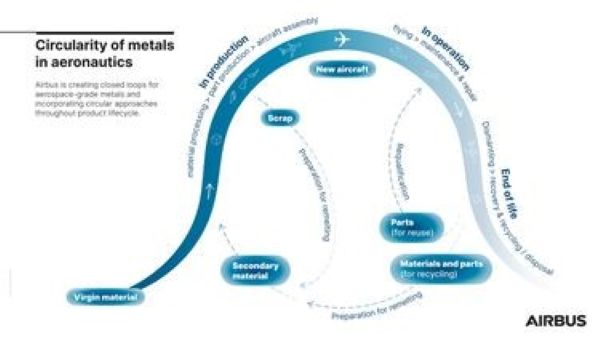
The high use of titanium and aluminum in Airbus aircraft has been the focus of the company as it seeks innovative ways to reduce these metals’ carbon footprint. Airbus has crafted a goal embracing “Ten Rs,” which expands on the idea of the reuse, reduce, and recycle philosophy.
The Ten Rs include:
- Refuse (using unnecessary materials),
- Reduce (the amount of materials used),
- Rethink (innovate and redesign products and processes to increase sustainability),
- Reuse (extend product life by using components again),
- Repair (fix components so they can be used for longer),
- Refurbish (restore parts or products to a like‑new condition),
- Repurpose (use materials or components for a different function),
- Remanufacture (rebuild products to original specifications),
- Recycle (process materials into new raw materials),
- and Recover (salvage residual value at the end of a product’s life).
Adopting Cutting-Edge Circular Manufacturing Processes
Titanium and 3D Printing
3D printing is not new to manufacturers. Airbus is using two specific types of 3D printing technologies called Additive Layer Manufacturing (ALM) to build aircraft parts out of titanium, with minimal waste. Instead of creating parts using larger amounts of material and milling them down, producing excess scrap, ALM provides precision manufacturing using only the precise amount of material needed.
The first of these 3D technologies is Powder Bed Fusion (PBF) uses laser beams to melt powdered titanium into a desired shape. This technology can be used to create layers as thin as 0.1 millimetres. A good example of how PBF gets used is in the creation of the 32 door latch shafts required for each A350 aircraft. Before PBF, latch shafts were made from ten different parts that then had to be assembled. The PBF replacement is a single integrated part that weighs 45% less than its predecessor. Considering weight is critical in any aircraft, this one change saves up to 126,000 kilograms of CO2 emissions from less fuel being used over a 20-year average aircraft lifespan.
The second 3D printing technology is Directed-Energy Deposition (DED), which involves creating large parts by using a laser to melt titanium wire and then depositing it in place to create a semi-finished “near net shape” part that needs further machining before installation. With DED, teams can forge parts faster and relieve pressure on titanium supply chains.
Aluminum Reuse, Recycling and Repurposing
Why is reusing and repurposing aluminum used in airframe manufacturing so important? Recycled aluminum requires only 5% of the energy needed for primary production.
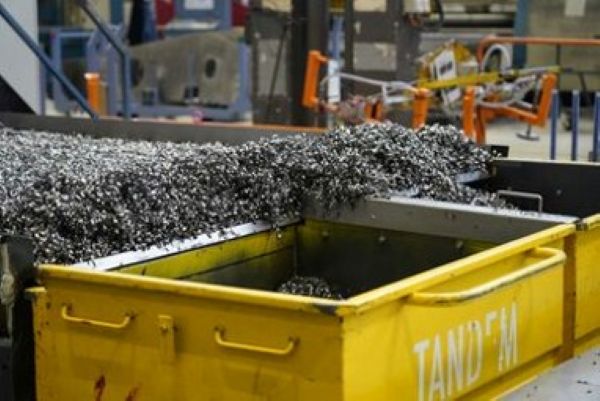
That’s why Airbus is working with two aluminum suppliers, Constellium and Novelis, to create a closed-loop recycling process for aluminum scrap. The project has involved onboarding machinists who produce aluminum scrap, as well as scrap dealers and melters.
A subsidiary of Airbus called Tarmac Aerosave is partnering with Constellium to recycle fuselages into new aluminum alloys that can be used in future aerospace applications.
The Importance of a New Manufacturing Mindset
In an industry often defined by precision, speed, and scale, it’s refreshing to see a company like Airbus slowing down to ask the bigger questions, about how things are made, where materials come from, and what happens to them when their job is done.
By weaving sustainability into the very fabric of its design and production processes, Airbus is showing that cutting-edge technology doesn’t have to come at the planet’s expense. Whether it’s reimagining aircraft parts through 3D printing or giving aluminum scrap a second life, the truth is, airplanes are better, but what’s even more powerful is the mindset that is creating them, one that embraces circular thinking with the potential to spark change far beyond the aviation industry.