
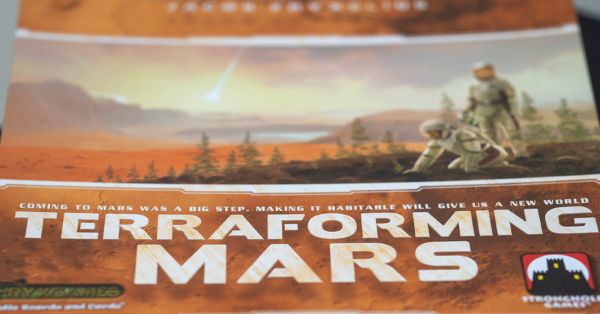
Terraforming, the greening of Mars, will begin with microbes engineered for Mars, states Erika DeBenedictis, the CEO of Pioneer Labs, a nonprofit research organization that is creating bioengineered bugs. The goal is to engineer biology to make Mars more Earth-like.
In a recent interview published in Scientific American, Erika told the magazine that Pioneer Labs has already engineered the first of five made-for-Mars microbes, “a really cool milestone.” She envisions turning Mars into a “habitable, beautiful place” with it and the four microbes to follow
Introducing a Microbe Called sPL.001
sPL.001 is engineered from the Earth bacterium, Cupriavidus necator. On Earth, the unmodified bacterium can convert carbon into bioplastic. When modified for Mars, the microbe will draw on atmospheric CO2 to do the same. States Erika,
“The idea is that you can go to Mars, and you can feed it dirt, water and air, and use it to build bioplastic houses for astronauts.”
sPL.001 is the first of five Pioneer Labs microbes designed to begin terraforming the Red Planet. The company focuses on pioneer species, defined as living things that can thrive in hostile environments.
Here on Earth, we have extremophiles, life capable of surviving deep in the ocean around hydrothermal vents, under polar ice caps, in Arctic permafrost, atop the highest mountains, and in super-hot springs. As extreme as these environments are here on Earth, none match the extremes of Mars.
What About Real Martians?
In sPL.001, the engineered microbe is designed to keep “forward contamination risk demonstrably low.”
What does that mean?
sPL.001’s developers have focused on derisking the potential of contaminating existing Martian life.
One of NASA and other space agencies’ goals in sending robotic spacecraft and landers to Mars has been to search for past conditions suitable for life. Note that these expeditions are currently not designed to find living Martians.
Why is that?
Some believe that NASA decided on this course after controversial results from two life-seeking experiments placed on board the Viking landers that arrived on the surface of Mars in 1976.
The experiments created two conclusions: On one side, there were those who argued the results proved Martians exist; on the other side, the results could be explained as produced by non-terrestrial inorganics.
The kerfuffle within NASA influenced subsequent missions. No longer would NASA test for the existence of Martians, but instead, seek evidence for conditions in the past that could support life as we know it.
Seeking evidence of life-favouring environments is less controversial than seeking Martians. Considering the small sample set to date, it is difficult to conclude in favour of or against existing Martian life.
Complicating things even more is the Perseverance rover, which has been collecting life-favouring samples with no way to send them back to Earth since the Martian Sample Return mission was indefinitely postponed by NASA.
So, Martians may very well be out there: ones that we could easily recognize as living, or ones with unique chemistry that current rovers and surveyors weren’t designed to recognize as being potentially alive.
The Good and Bad of Terraforming
Beyond the confines of hermetically sealed greenhouse-grown crops, greening Mars seems next to impossible. If you think Antarctica is extreme, Mars makes the former seem hospitable. The Martian magnetic field is next to invisible. Without a magnetic field, the planet’s surface is subject to continuous cosmic and solar bombardment. That’s why most of the Martian atmosphere has vanished into space. Today, its thickness is 1% of Earth’s. Then there are the temperature swings from day to night of 100 degrees Celsius (180 Fahrenheit). If that is not inconducive to life, consider the almost zero presence of nitrogen, which on Earth is critical for plants.
Developing Earthlike bioengineered life and parachuting into this frozen hellscape to suit our terraforming aspirations comes with another caveat. If we change Martian conditions and Martians already exist, what will happen to them?
In her Scientific American interview, Erika states that they developed sPL.001 to grow in a contained Martian environment and begin producing bioplastic materials to construct domes. A climate-controlled sealed environment will be home to the microbe as it begins churning out bioplastic using the in situ raw materials available to it. In producing bioplastic within confines, it is unlikely to come into contact with and contaminate Martians.
sPL.001 will thrive under controlled conditions. The four other microbes Pioneer is creating will make the transparent window material for the bioplastic domes sPL.001 produces. They will extract oxygen, remove toxic perchlorate, harvest water and turn Martian regolith into arable soil for growing Earth-adapted crops.
For those who first drafted the United Nations Outer Space Treaty, with its defining principle to explore space and do no harm, what Pioneer Labs aspires to achieve on Mars doesn’t precisely fit. Is it exploration if our Martian adventure wipes out native Martian life? It certainly doesn’t meet the treaty’s do-no-harm obligations.