
Have you ever watched a hummingbird in flight? The speed of each wing beat is so fast that their physical presence becomes a blur. It is only when alit that you see it’s a bird. If only someone could invent a technology that can do what hummingbirds do, almost making a portion of their bodies invisible.
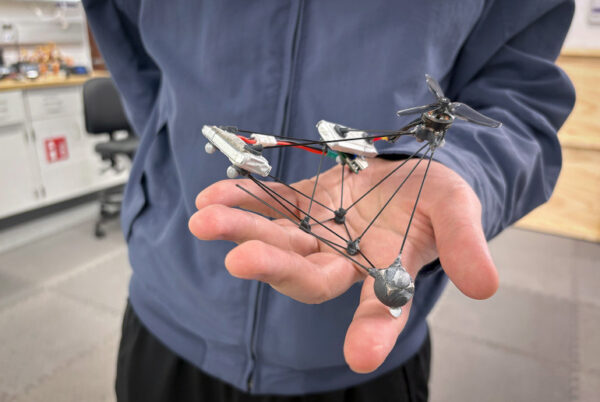
Hummingbirds, not whirling dervishes, appear to be the inspiration behind the Phantom Twist, a drone whose rotor and motor spin so fast the device can physically hide in plain sight?
Engineers from Northwestern University have built this tiny drone to spin in two directions at a rate of 25 times per second. That’s not hummingbird speeds, but the two-direction innovation has one thing hummingbirds don’t.
Hummingbird species reach wingbeat frequencies between 50 and 60 per second on average. The tiniest present even higher wingbeat frequencies and during courtship can achieve up to 200 beats per second in short bursts involving high-performance manoeuvres. But a hummingbird’s body doesn’t spin. That’s why it looks suspended in space when you observe one sipping nectar from flowers in a garden.
The Phantom Twist design to make a tiny drone invisible uses the concept of motion blur, the same thing our eyes observe when hummingbirds take flight. When flying the Phantom Twist, Amanda Morris of Northwestern Now describes how it “morphs into a ghostly smudge that seamlessly blends into the background.”
Phantom Twist, unlike hummingbirds, spins in its entirety. With one motor and one propeller, the two spin in opposite directions. So unlike the hummingbird whose body doesn’t beat or spin, and thus remains visible, the Phantom Twist combines two spinning objects going in opposite directions to turn nearly invisible.
Stated Michael Rubenstein, Associate Professor of Computer Science and Mechanical Engineering, and lead on the project:
“Most efforts to hide drones focus on making them look like their surroundings. Instead, we asked whether we could design the drone itself around the way humans perceive motion.”
The design team created 20,000 drone configurations and then used the help of artificial intelligence to test these different designs to deliver a result that minimizes visibility during stable flight. You can stare at where the Phantom Twist is flying from all angles, and all you see is a blur or haze.
States Northwestern’s Emma Alexander, Assistant Professor of Computer Science and Electrical and Computer Engineering:
“The human eye takes time to accumulate signals, roughly analogous to the exposure time of a camera. When an object spins quickly, we perceive it as blurring out and losing distinct features.”
She continues:
“Because this new drone is almost entirely transparent, its few opaque components are visually averaged with the background for an overall appearance of a slight haze.”
Northwestern published about its invention in May 2026 on the curated research-sharing platform arXiv. Then, on July 16, 2026, Phantom Twist made its international debut at Robotics Science and Systems, a conference in Sydney, Australia.
Phantom Twist still has some flaws. Its motor and rotor make noise. It also has wires that can be seen when in flight if you look very closely. The Northwestern team is planning design upgrades to include a quieter motor and use more transparent materials to make what already appears as a semi-transparent cloud become a tiny version of H.G. Wells’ Invisible Man.
Invisibility attributes for drones are also being pursued in other universities. China’s Zhejiang University in 2024 took a different approach in designing a drone that demonstrated “intelligent aero-amphibious invisibility.” The design team’s work appeared in an article in Advanced Photonics describing a drone made of meta materials that used transformation optics to create an invisibility cloak.