The Space Launch System (SLS) represents an unnecessary expenditure that many in NASA must secretly regret. The cost overruns and delays the agency has experienced in its goal to return to the Moon are significant.
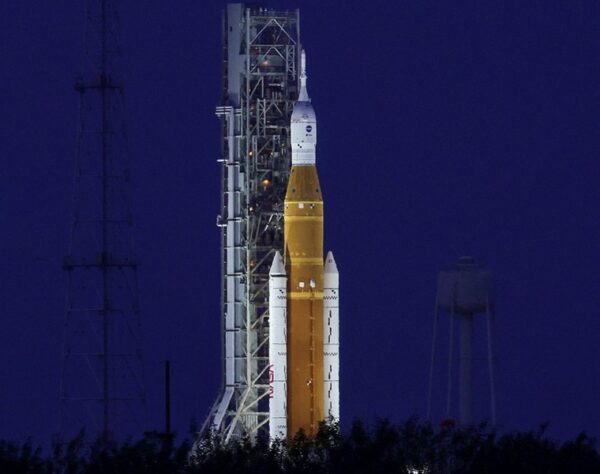
NASA developed SLS and the Orion space capsule to succeed the Saturn V and Apollo Command Module. The resemblance between the two systems aimed at the Moon is uncanny. SLS is a one-way launcher that resembles the Saturn V rocket. The rocket and spaceship structure almost looks like a retread of the 1960s Apollo. The biggest difference lies in the solid rocket boosters, resurrected from the Space Shuttle era, that are strapped to the SLS first stage to increase thrust.
The Orion space capsule lies atop, eerily similar to the Apollo Command Module but bigger to handle a larger crew. Orion’s service module comes from the European Space Agency. This heat shield is supposed to be better than the one used for Apollo, with improvements designed to handle accelerated re-entry speeds. Tested for the first time during the uncrewed Artemis I mission, it proved wanting, prompting NASA to do a rethink and redesign.
To me, these elements in the Artemis Program represent a series of compounding mistakes. This week was the latest example of how American pork-barrel politics have compromised NASA’s ability to innovate, leaving it with an Apollo retread. The launch of Artemis II, the mission to send a crew of four beyond the Moon and back, had to be postponed until March. The reason given, the SLS sprang a hydrogen leak during fueling.
Artemis I was originally scheduled to launch in 2017. SLS development delays and technology glitches pushed that timeline back five years. NASA blamed funding cuts and COVID-19 for the delay. The truth, however, is that the SLS had numerous rocket engine, battery, and, guess what, hydrogen leak problems. Artemis I finally launched on November 16, 2022.
NASA Reinvents Itself After Apollo
After Apollo, NASA needed a renewed purpose for human spaceflight. Getting to the Moon was done. What next? Apollo-Soyuz and Skylab were fillers while the Shuttle Program was under construction. The Shuttle was going to make low-Earth orbit (LEO) human spaceflight affordable. The Shuttle would deliver payloads to LEO at a fraction of the cost of the previous generations of launch vehicles. The Shuttle was to be reusable.
The first Shuttle, Columbia, suffered numerous technical glitches, sensor failures, heat shield issues and fuel leaks. Columbia took five years to get to the launchpad and then rolled back to the assembly building, where it was delayed for another two years. The first flight was in April 1981.
The Shuttle program flew 135 missions. Shuttles delivered the modules and infrastructure for assembling the International Space Station (ISS). Missions repaired and maintained the Hubble Space Telescope. Two missions failed with loss of crew. The program came to an end in July 2011, with the remaining ships mothballed and turned into exhibits.
The Shuttle Program never made human spaceflight cheaper or safer. Each mission was supposed to cost US$9.3 million but ended up averaging $1.5 billion.
The Artemis Program resembles NASA’s experience with the Space Shuttle. Both have gone way over budget. Both have experienced multi-year delays. The Shuttles flew more than once and could be refurbished. Currently, SLS with Orion has flown once. Only the capsule and the two solid-rocket boosters, mated to the SLS, are reusable.
Politics, Technology And NASA
NASA funding with the Apollo Program reached approximatley 4% of the US federal budget. Today, NASA’s share is 0.5%. Congressional requests amounting to pork-barrel projects have contributed to money misspent, and a mission design that incorporates obsolescence. The mission has been subjected to political interference from four different administrations.
The two Shuttle accidents have created a more safety-conscious NASA. Meanwhile, technological advances in materials, computing, and design have led NASA engineers to go through multiple redesigns. These redesigns have impacted both the SLS and Orion.
Then there are the private contractors who have promised deliverables by certain dates and missed these milestones. The SpaceX Human Landing System (HLS) needed to ferry crews from Orion to the Moon and back remains missing in action. Based on a yet-to-be-proven design from SpaceX, it is years behind schedule.
Artemis III, the return of humans to the lunar surface, was to happen in 2024, but is now likely to launch no earlier than 2028.
Artemis Scenario Alternatives
There are alternatives for NASA that do not require either the SLS or Orion. NASA budgets commit $93 billion from Artemis II through IV. As designed, current missions lock NASA into pork-barrel contracts and jobs programs spread over 30 states. Politicians in Washington have the final say on NASA funding. Cutting some of the $93 billion would lead to job losses in congressional home districts, which wouldn’t go over well in election years.
A cutting-our-losses strategy, however, could reduce the cost of future Artemis missions. Three alternative mission scenarios could eliminate the need for the SLS. Two of these scenarios would eliminate Orion. The elimination of both would save billions.
Consider these Artemis mission alternatives:
- Falcon Heavy-Dragon-Starship – The Falcon Heavy, a partially reusable proven launch system, would deliver a crew of four to LEO using an existing reusable and proven Crew Dragon capsule. Crew Dragon would then rendezvous and dock with an in-orbit, fully fuelled SpaceX Starship. The Starship would transit to the Moon, land, and then return to LEO. This Artemis mission alternative would eliminate both the SLS and Orion, with an estimated cost saving between 70 and 90%.
- Starship- Super Heavy – In this scenario, all mission elements are fully reusable. Starship would launch using the Super Heavy and travel to the Moon, land, and then return to Earth. This mission scenario eliminates the complexities built into the Artemis III mission in its current design. It would be simpler than alternative #1. Estimated mission cost savings could be greater than 95%.
- Blue Origin-Orion – In this scenario, a Blue Origin partially reusable New Glenn launch system with Orion atop would leave Earth for LEO. The New Glenn would also have the Blue Origin Mk2 landing system on board. (Mk2 is the Blue Origin lunar lander scheduled for the Artemis V mission.) Orion would dock with the Mk2 and travel to the Moon, entering lunar orbit. Mk2 would descend to the lunar surface, land, and return to dock with Orion for the voyage home. This mission scenario closely resembles the Saturn V-Apollo-LEM paradigm. Partial reusability is the differentiator with New Glenn, per launch costs likely to be around $80 million. That’s dramatically less than the $4.1 billion per mission cost of using the SLS.