
When Michael Crichton wrote his Jurassic Park novels in the late 1980s and early 90s, our collective wisdom about deoxyribonucleic acid (DNA), the molecule of life here on Earth, was still in its infancy.
DNA was only first discovered in 1869, with its structure only figured out in 1953. In 1990, the same year that Jurassic Park was published, the Human Genome Project launched to assemble and decode human DNA.
Unlike in Jurassic Park, we have yet to sequence DNA from fossil insects trapped in amber, let alone from the blood these insects sucked up from the species they tormented.
What we do have is recovered DNA from preserved organic materials of animals and plants that died thousands of years ago. Why thousands and not millions? That’s because DNA remains coherent for a very short period of time, in fact, a little over 500 years, the chemical half-life of the molecule.
The best conditions for preserving DNA are dry, cold environments. Exposure to ultraviolet light causes it to rapidly decay. The places where we have successfully recovered DNA are in places like Greenland, Siberia and the Canadian Arctic. That is where we have found preserved DNA dating from 700,000 to 2.4 million years ago.
De-Extinction in the Present
Unlike Jurassic Park, where long-extinct dinosaurs were brought back to life by crossing their recovered DNA with that of living amphibians, current de-extinction realities are different.
Colossal Biosciences is a biotech company that claims to be the world’s first and only de-extinction company. Its website tag line states “disruptive conservation and preservation.” Colossal describes its mission “to preserve and restore Earth’s diminishing biodiversity” through scientific intervention.
Of 42,108 current species on the planet that are endangered, Colossal notes that 9,251 are at a critical stage, with 902 already extinct. Colossal wants to restore the past and end the “rapid and accelerating loss of our planet’s biodiversity.”
How does Colossal plan to do this? One process has involved resurrecting core genetic material and implanting it into existing species. Here are some examples.
De-extinction of Woolly Mammoths
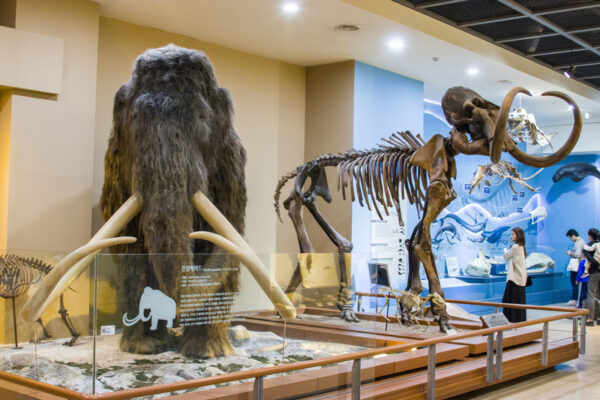
Colossal is focusing on a post-Ice Age species, the Woolly Mammoth. Mammoths were relatives of modern elephants. They died out on mainland North America approximately 10,000 years ago. An island-isolated population remained lingering on in Canada’s North until between 4,000 and 4.300 years ago.
Remains of Woolly Mammoth have been found frozen in permafrost, making it possible to extract their ancient DNA. Using modern elephants as hosts, Colossal intends to insert Mammoth DNA segments into the genome of Asian Elephant using pluripotent stem cells. The embryos created would be implanted and carried to term. The result would be an engineered modern Asian Elephant bearing Woolly Mammoth traits, not the actual Mammoth of the past, but rather, a hybrid.
Why bring back the Woolly Mammoth? When mammoths roamed the Arctic, they served as Ice Age grazers, clearing the snow pack to allow tundra grasslands to flourish, and spreading seeds in their dung to expand the range of Arctic plants. Their trampling of snow kept the permafrost from thawing. Their activities supported increased Arctic biodiversity. So, there may be a good argument to bring back the Mammoth.
De-extinction of the Moa
The Moa, a giant flightless bird from New Zealand, is a more recent extinction that occurred shortly after the arrival of the Māori, the first humans to reach the archipelago over 600 years ago.
Moas didn’t last long after humans arrived and were soon extinct. Mainly herbivores, Moas served a useful role in maintaining New Zealand’s forest ecosystems. Once gone, forest biodiversity declined.
Unlike Woolly Mammoths, Moas were not creatures that lived in cold environments. To extract surviving DNA, scientists turned to bones, feathers, eggshells and beaks found in remains. From these, the scientists could sequence many DNA fragments. They compared these fragments to similar ones found in related bird species. Emus, Australia’s large flightless bird, come to mind.
To incubate an Emu with Moa characteristics requires inserting the DNA into Emu eggs at an early stage. Colossal has considered a different strategy, 3D-printed eggs, which I expound on below.
De-extinction of the Tasmanian Tiger
The Tasmanian Tiger, also known as the Tasmanian Wolf or Thylacine, was a carnivorous marsupial native to Tasmania. When European colonizers arrived there, the Tasmanian Tiger was a threat to sheep and other domesticated species brought to the island. The result was that the government put a bounty on the Tiger, with the last one dying in captivity in 1936.
Finding DNA from museum-preserved Tigers isn’t a big challenge. Scientists have sequenced 99.9% of the Tiger’s genome. Its closest living relative is the Dunnart, a tiny, mouselike marsupial. Using CRISPR gene-editing tools, Colossal hopes to edit the DNA of the Fat-tailed Dunnart.
A tiny Dunnart, however, could never carry a baby Tiger to term. That’s why Colossal is developing an artificial womb. The hoped-for result will be a hybrid Tiger breeding population in captivity with the potential of reintroduction into the Tasmanian wilds. Will that just create the same conditions that led to a bounty on every Tiger’s head?
3D-Printed Eggs and Artificial Wombs
Moas and Dodos from Printed Eggshells
Colossal recently started producing 3D-printed eggshells and successfully used them to incubate baby chickens. This technology could conceivably be used to revive the Moa, as well as other extinct species like the Dodo.
To develop a 3D egg to incubate Moas would require a shell 80 times larger because Moas could stand 3.6 to 3.7 metres (11.8 to 12.1 feet) in height, and weigh 230 kilograms (approximately 500 pounds).
The artificial eggshell contains a permeable membrane that allows oxygen to penetrate just like real eggshells. To compensate for the lack of calcium, which normally gets absorbed from the shell, Colossal added calcium to aid chicken embryo growth and development.
Moa resurrection, even with this latest innovation, remains a long way off. More than likely, Colossal will end up inventing a hybrid bird species with Moa genetic traits. That conclusion is easy to reach since all efforts by the company to date to revive species have used living species of animals as hosts and produced hybrids displaying a mix of genetic characteristics.
Dinosaurs from Printed Eggshells
The likelihood of this Jurassic Park scenario happening is zero. We might be able to modify a bird’s genes to create something that looks like a dinosaur, but it won’t be because we have reconstructed the latter’s DNA.
Sixty-six-million-year-old molecules no longer exist, so we wouldn’t know where to start in trying to recreate a dinosaur’s genome. The only living dinosaur relatives are birds, with no current way for us to determine what, if anything, in their DNA is still dinosaur.