I don’t know why I am motivated these days to look at how the words written here will be shared with readers long after I am gone. Maybe it is because my wife and I are in the process of updating our wills, and I am sorting through the digital legacy I will leave, or not, after I die.
Downsizing gets you thinking about your physical legacy. What do you leave to your child? What burden do you place on him or her after you pass? My wife and I have gone through three downsizing and decluttering exercises in the last 13 years. First, it was selling our home after our daughter’s engagement. Moving from a 4-bedroom house with a finished basement to a midtown Toronto, 2-storey, 2-bedroom apartment meant parting with excess furniture, crockery, books and stuff that we no longer needed that filled our garage and basement. The apartment had problems, so we decided to move 2 years later to a smaller space. That meant more decluttering. A good chunk of my book collection was now history, although we still had my vinyl record collection, a packed CD tower, and old VHS tapes and players. When we had to move again to Oakville, where we live today, there was more downsizing. The stereo, records, CDs, VHS tapes and player, and more had to go. I even packed up more books to give away. Before leaving Toronto, I transferred most of the CD library and some videos to my computer’s hard drive. We were going to travel light.
As our physical footprint has contracted, our digital one has grown. Now, the archive of my life is more digital than physical, and I am more invested in the Cloud. It has been a truly strange evolution.
What does leaving a physical or digital footprint mean after you die? Is it a message sent to the future, or is it just an untidy statement that sums up and closes the books on a life? A Scientific American article published this month, written by Adam Rogers, How to Send a Message to Future Civilizations, addresses the question of sending messages to the future. In other words, leaving a digital record for those to ponder living centuries ahead.
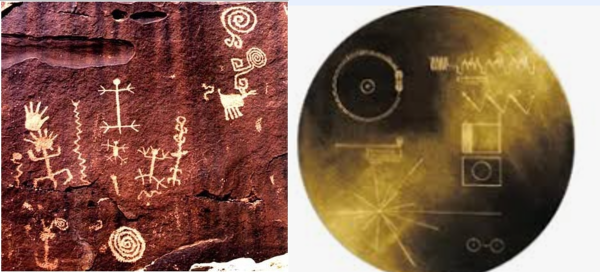
Rogers describes the human tendency to create visual archives, something we have been doing for tens of thousands of years. We can see these painted on the walls of caves and on today’s Internet Cloud. What is interesting is how the messaging from representational symbols painted on rock walls to today’s content-rich, multimedia world has changed. How quickly we invent and discard new forms of media preservation, just think of the short life of the CD, or remember MP3 players, Palm Pilots, and digital cameras. A smartphone today carries the entire load of these previous media platforms. Computer hard drives, thumb drives, and the Cloud contain the rest.
But nothing in the digital world seems permanent. I have been learning this in the creation and maintenance of this blog site. How quickly things break in the Internet Age. An illustration: I periodically do searches on my site to cite past articles in support of current postings. Invariably, I find broken hyperlinks in older articles. Why? Digital source material can be easily deleted, moved, or placed behind paywalls. This is a symptom of rapid technological change decade by decade. It isn’t only my site that suffers from this.
A Pew Research report entitled When Online Content Disappears, published in 2023, sampled over half a million of the more than one trillion webpages on the Internet at that time. It reported: 38% of webpages that existed in 2013 were no longer accessible; 23% of news pages and 21% of government websites contained at least one broken hyperlink; Wikipedia contained 11% inaccessible reference links. The Pew sampling looked at social media and at X, formerly Twitter, noting that 18% of tweets were no longer visible.
Our digitizing of the past has an ephemeral future. Magnetic media, the technology we rely on today to store our collective past and present, only has a short shelf life, amounting to a decade or two. The Long Now Foundation is a site dedicated to addressing a 10,000-year time scale, recording humanity’s presence. Long Now recognizes the ephemeral nature of magnetic media and has taken inspiration from the first record keepers who drew pictures and symbols on rock. It is exploring storing humanity’s digital legacy on silica glass and pure metals. Others in pursuit of messaging to stand the test of time are experimenting with DNA for data storage.
Zander Rose is a futurist at the Long Now Foundation. He sums up the challenge of keeping a record of our past to share with the future, stating:
“You can either write things in plaintext on giant stone tablets that last for thousands of years, and as long as someone can decode the language, they can read them, or you can go with a method that assumes you rewrite the data onto a new medium, whatever that new medium is, every day or every year or every 10 years.”
We visited this problem before two Voyager spacecraft left Earth on grand tours of the Outer Solar System and beyond, beginning in 1977. Coming up with media that could endure a billion years led to the production of two 30-centimetre (12-inch) Golden Records, copper disks plated with nickel, gold, aluminum and Uranium-238. Etched into the disks were instructions to create a player, along with symbology depicting the location of Earth, images of us, and more. If an alien, technologically advanced civilization were to encounter either Voyager and build the player by following the provided instructions, they would access the onboard content and see photographs of us, life on Earth, the sounds of music, footsteps, laughter, the wind, and messages from U.S. President Jimmy Carter and the Secretary General of the United Nations Kurt Waldheim. The disks both Voyagers have been carrying will share our message a billion years into the future.