
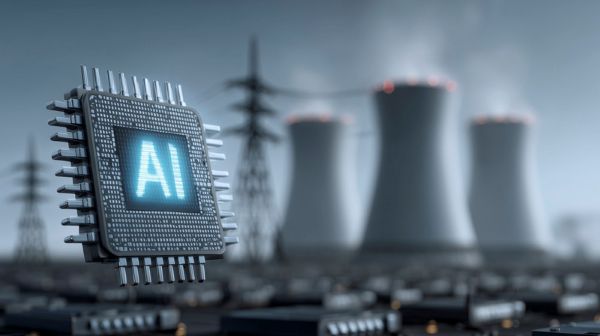
The arrival of generalized artificial intelligence (AI) couldn’t be coming at a worse time, say some environmentalists. Why? Because the AI being created by Silicon Valley billionaires is an energy hog, requiring massive data centres. That means expanding energy production to meet demand, which is turning into a carbon emissions problem as burning coal and natural gas in thermal power plants becomes the fastest short-term solution.
Others argue that the widespread adoption of AI globally will help humanity adapt to climate change and even mitigate its causes.
So, will AI exacerbate climate change, or will it be our saviour?
Data Centres and AI
The growing demand for data centres containing thousands of energy-hungry computers is at the crux of this debate. Data centres need energy to run and to stay cool. Where do they get the power? If it comes from coal and natural-gas-fired power plants, then AI in data centres represents a significant carbon emission contributor. Even if the energy comes from renewables, data centres still contribute carbon emissions, just not in the same volume. That’s because generative AI, Large Language Models, AI training, and AI use by big companies and people like me who ask AI questions and receive answers require lots of computing power.
GPUs, TPUs and CPUs
AI developers, when calculating energy requirements, count the number of GPUs, TPUs and CPUs needed to do the job. What are these?
The International Energy Agency (IEA), in quantifying the current environmental carbon footprint for data centres, estimates a present-day contribution of about 0.5% to total carbon emissions from the energy they use today. It sees that number rising to 1.4% by 2030.
With more AI, does that mean faster climate change, or can more AI help mitigate global warming? Can we use its artificial brain power to design solutions to climate change while allowing us to energize it?
Some AI enthusiasts in Silicon Valley think that the technology is our answer to climate change. They see AI data centre operations producing insights that humans cannot discern. For example:
-
AI can discern patterns in its own usage to forecast energy requirements from wind, solar and other renewable sources, and balance supply and demand.
-
AI can look at the energy grid and help us improve grid transmission performance.
- AI can optimize data centres to reduce overall energy usage and address embodied emissions.
AI and Global Climate Change Externalities
Where AI can prove useful in mitigating or adapting to climate change is by focusing on important economic sectors such as agriculture, energy, healthcare, mining, transportation, manufacturing and service industries. AI can help to optimize food production, improve land use, address wildfire threats to global forests, identify new carbon sinks, improve weather forecasting and more.
AI as a technology accelerator can help us make how we produce the energy it and we need less negatively impactful on the environment. It can help us find new types of battery materials or invent new emission reduction technologies.
Widespread deployment of AI, through technological innovations, could reduce worldwide carbon emissions in 2035 by up to 1.4 gigatons states the IEA. The caveat for this prediction is that added data centres are powered only by renewable or net-zero energy sources.
Data centres generating AI could be a force for mitigating climate change. Yet currently, AI contributes to climate change through a proliferation of data centres and growing demand.
AI data centres can help save us from ourselves. As a technology accelerator that focuses on climate change challenges, AI operating from data centres can generate novel mitigation and adaptation solutions. Even though it may be obvious to AI, the one solution it cannot be programmed to consider is getting rid of us.