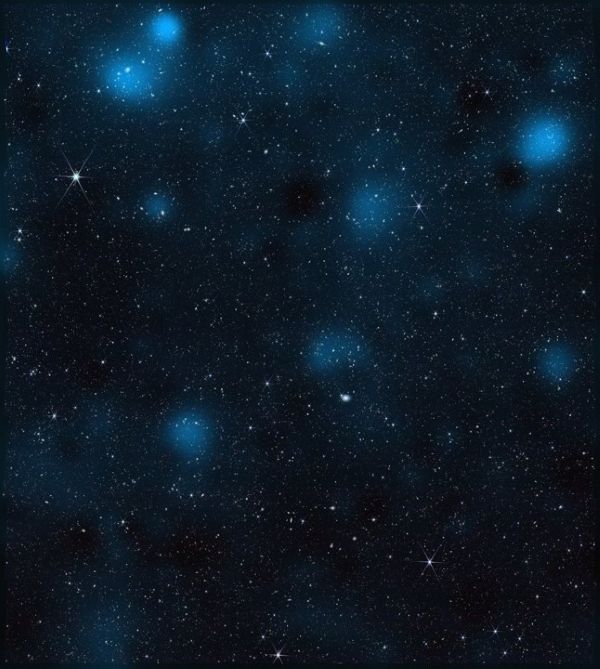
The latest map of where to find dark matter in the Universe has appeared online on January 26, 2026, in an article published in Nature Astronomy. The map has been produced from 255 hours of images taken by the James Webb Space Telescope (JWST) covering a patch of sky 2.5 times bigger than the full Moon and recorded using the telescope’s Near-Infrared Camera (NIRCam). Statistical analysis of this very large sample has allowed researchers to plot the presence of dark matter and produce the image appearing at the top of this posting.
Facts About Dark Matter
We cannot see dark matter. Hence, its name. It, however, is abundant, constituting approximately 27% of the Universe’s mass. It doesn’t emit, reflect, absorb, or block light. The referenced image, therefore, isn’t a visual depiction of dark matter but rather a rendering produced through a statistical reconstruction based on gravitational distortions caused by dark matter’s presence. Where there are large concentrations, the rendering shows lighter patches of blue. Where there is less, the blue is diffused and darker.
What we don’t know about dark matter is a lot. We haven’t identified dark matter particles. We suspect these particles could be WIMPs, axions, sterile neutrinos, or primordial tiny black holes. We don’t know how dark matter came into existence. Was it present from the Big Bang, or formed during the initial rapid expansion? We don’t know if dark matter reacts to any other force other than gravity.
How Dark Matter Becomes Visible
When light is emitted by a galaxy or star and travels towards us, as it passes close to large objects, gravity causes the light to bend. Both normal (luminous) and dark matter can exert a detectable gravitational force, causing passing light to bend. Called gravitational lensing, it was first predicted by Einstein in 1907, and later observed during a 1919 scientific expedition to a solar eclipse. The phenomenon can be strong, weak or micro.
- Strong lensing happens when light coming from a distant star or galaxy passes close to a galaxy cluster or an individual large galaxy. As the light gets bent, it can produce twin images of the source. It can produce arcs of light or Einstein rings, the latter being halos that encircle objects lying between the original light sources and viewers.
- Weak lensing happens when light from a distance is bent by more diffuse objects such as dark matter. It produces more subtle arcing of light emitted from a source. Often, the lensing is so faint that it is only perceived through large sample statistical analysis.
- Micro lensing happens when light is bent when passing individual stars, black holes and large exoplanets. It produces shifts in the brightness of the light coming from the source.
The Cosmic Evolution Survey (COSMOS)
The JWST is contributing to a project called the Cosmic Evolution Survey or COSMOS. It involves 15 telescopes, of which the Hubble Space Telescope and the JWST are included. It has been studying 2 square degrees of the sky, or an area about 10 times the size of the full Moon. The Hubble first mapped this space in 2007. The JWST revisit produced twice the number of observed galaxies as Hubble and 10 times more than any ground-based observatories.
The map JWST has produced reveals how dark and luminous matter co-evolve. It shows how dark matter shapes the formation of galaxies and galaxy clusters. In the image, there are 129 galaxies per square arcminute. An arcminute is 1/60th of a degree when plotted on a map. For a visual comparison, consider either the Sun or Moon, each having a diameter of 30 arcminutes. The spatial resolution of the dark matter structures is at least 1 arcminute. Only the JWST and Hubble data have been used to show the locations of the dark matter.
This map is the most detailed produced to date of both dark and luminous matter. It shows enhanced lensing sensitivity to red-shifted light emitted from more distant structures. The Doppler redshift occurs the farther away the light source is from the observer. It is possible, therefore, for us to observe weak lensing shear fields induced by the dark matter as light from more distant galaxies passes by.

 images a patch of sky 2.5 times bigger than the full Moon to produce a map that includes dark matter.)