The beginning of the Atomic Age happened before I was born. By the time I reached age 12, my junior high school had us ducking under desks during air raid drills. I grew up in an age when the threat of nuclear war was conceivable. I even remember a conversation my parents had about building a backyard fallout shelter. It didn’t happen with the closest I remember coming during the Cuban Missile Crisis. In a war between the United States and the Soviet Union, the missiles and bombers would be flying over the North Pole with Canada between the nuclear adversaries.
Why a Doomsday Clock
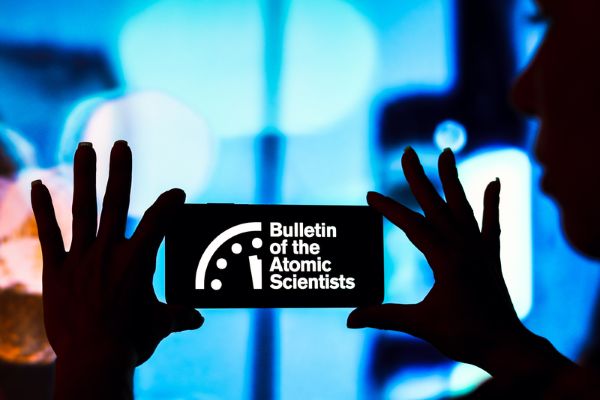
The World War II Manhattan Project built the atomic bombs dropped on Hiroshima and Nagasaki. J. Robert Oppenheimer, Albert Einstein and others who were instrumental in bringing about the Atomic Age and the bomb, formed the Bulletin of the Atomic Scientists, and in the first June 1947 publication, hatched the Doomsday Clock and set it at 7 minutes to midnight. Midnight represented global Armageddon. At the time, only the United States had the bomb, and the scientists set the clock at 7 minutes before midnight to represent concerns about unwarranted use of the technology by its sole possessor.
That didn’t last very long because in 1949, the Soviet Union dropped its first atomic bomb, with the Doomsday Clock’s minute hand moving to 3 minutes. An arms race around thermonuclear weapons soon saw both countries test their first hydrogen bombs in 1953, and a 2 minutes to midnight reset.
The clock’s minute hand, since then, has moved back and forth through the remainder of the 20th century and into the 21st. With the latest announcement this week, the minute hand stands at 85 seconds to midnight.
The clock is no longer solely measuring the nuclear threat. Now, climate change, artificial intelligence (AI), cyber, biotechnology, terrorism, and pandemics have been factored into the minute hand setting.
Military Risks
The current clock setting reflects a world that the Bulletin states is “perilously close to global disaster.” It notes that Russia, China, the United States, and many other countries are becoming increasingly aggressive, adversarial, and nationalistic. It notes that global undertakings are being reversed and that “a winner-takes-all great power competition” is underway, raising the risk of nuclear war, while undermining collective efforts to address climate change. It cites AI, biotechnology misuse, complacency, and indifference to all of the above as posing an existential threat.
The Bulletin’s announcement cites America’s plan to deploy the Golden Dome defence as igniting a future war in space, fueling a new arms race. It also notes the expiry of arms limitation agreements between Russia and the United States and recent announcements by President Trump to renew nuclear weapons testing, something not done by anyone other than North Korea.
Climate Doomsday Risks
On climate change, the announcement noted that greenhouse gasses from human activity were now 150% above preindustrial levels, with global mean temperatures the warmest on record. Sea level rise, extreme weather events, droughts, and other climate change evidence appeared to no longer resonate with many governments, and in particular, the United States. The Trump administration appeared to have declared war on sensible climate change strategies, calling it all a big Chinese-inspired hoax.
Biotechnology and Biological Risks
The Bulletin pointed to one biotechnology threat that I have previously described, the laboratory creation of “mirror life,” biologically synthesized mirror-image cells that would be unrecognizable to the immune systems of all life on Earth and represent another potential existential threat. Without any international agreement or guardrails, it is hard not to distinguish its level of threat from that posed by natural pathogens causing pandemics. We are still living through COVID at this time, and dealing with an American government that is increasingly exhibiting anti-science behaviours while not constraining what some would consider the mad science of mirror life research.
AI Risks
On the subject of AI, the Bulletin sees it as a biological, social and technological threat. AI-aided design is impacting medical research, including the study of new pathogens that could lead to potential biological weapons.
Then there is the rapid emergence of AI Large Language Models (LLMs) and an arms race among technology giants, with no guardrails beyond those established by the companies themselves.
This AI revolution, the Bulletin states, “has the potential to accelerate the existing chaos and dysfunction in the world’s information ecosystem, supercharging mis- and disinformation campaigns and undermining the fact-based public discussions required to address urgent major threats like nuclear war, pandemics, and climate change.”
Great Power Competition Risks
The final reason given for setting the minute hand to 85 seconds is the rise of nationalistic autocracy led by Russia, China and the United States, creating an “us-versus-them mentality” in the leadership and decision-making of the three superpowers, increasing the “risk of global catastrophe.”
The Doomsday Clock announcement concludes with these words:
“Our current trajectory is unsustainable. National leaders—particularly those in the United States, Russia, and China—must take the lead in finding a path away from the brink. Citizens must insist they do so. It is 85 seconds to midnight.”