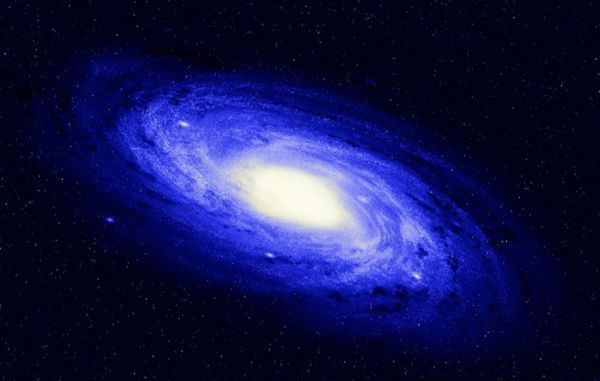
The reason we have given dark matter its name is simple. We can’t see it with our eyes or make it visible using imaging technology. Does dark matter react to parts of the light spectrum? Can we see evidence of it through electromagnetism?
Some question its existence at all. The consensus among physicists, astronomers and cosmologists today, however, is that dark matter very much is real and that it accounts for approximately 85% of the Universe’s total mass. Can it be detected? Indirectly observable using gravitational wave detectors, and a phenomenon called lensing, when light from distant galaxies is distorted as it passes close to objects between our view of them and Earth. Dark matter could explain the appearance of halos that have been observed surrounding spiral galaxies.
The skeptics, however, believe that dark matter and its unrelated companion, dark energy, are illusions. A recent study from the University of Ottawa, argues that dark matter and dark energy are illusions and can be explained the distortions and inferred detection of dark matter can be explained by changes to gravity and other forces in the Universe as it ages and continues to expand.
Professor Rajendra Gupta, in the Department of Physics at the University, has published his experimental results in the journal Galaxies in September of this year. Gupta argues that everything we have observed doesn’t require dark matter. He states, “You don’t need to assume any exotic particles or break the rules of physics.” Instead, “the timeline of the universe simply stretches out, almost doubling the universe’s age, and making room for everything we observe.” Everything observed can be explained by “flat rotation curves,” referring to the orbital speed of the stars and nebula in spiral galaxies that remains constant even at increasing distances from the galactic centre. This counters Newtonian physics’ predictions of declining speeds the further away from the centre.
If Gupta is right, then the latest efforts to detect dark matter may come up empty. One such experiment is a project called QROCODILE, led by physicists at the University of Zurich, Hebrew University of Jerusalem, Cornell, the Karlsruhe Institute and MIT. They are using superconducting detectors at near-absolute-zero temperatures to find dark matter particles. QROCODILE stands for Quantum Resolution-Optimized Cryogenic Observatory for Dark Matter Incident at Low Energy. It is designed to capture evidence of dark matter particles, thousands of times smaller than any previous detector technology. So far, in over 400 hours of operation, a small number of anomalous phenomena have been detected.
Are these dark matter? Can they be explained by the Universe’s natural background radiation and cosmic rays? Possibly. That’s why the project in its next phase will become NILE QROCODILE, even more sensitive and equipped with improved shielding to detect particles even smaller. NILE stands for Next Incremental Low-threshold Exposure, using tungsten silicide microwires cooled to near absolute zero and installed underground to eliminate cosmic rays and background radiation from the detector’s equation.
What’s so important about detecting dark matter particles? By finding them, scientists can explain how the missing unobserved content of the Universe contributes to its formation. It can explain dark matter halos seen around galaxies. It can confirm the inflationary theory of the post-Big Bang Universe. It could explain observed discrepancies in the Hubble Constant, which measures the rate of expansion in the Universe. It could even discover new symmetries and matter-antimatter asymmetry. That’s a subject for another posting.
The latest lexicon of potential dark matter particles includes WIMPS, Weakly Interacting Massive Particles, Sterile Neutrinos, Dark Photons, and millicharged particles. The NILE QROCODILE hopes to add to this list by capturing sub-MeV (Sub-million-electron volt) particles.
Of course, if Professor Gupta is correct, all these efforts to build a case for dark matter will go for naught.