
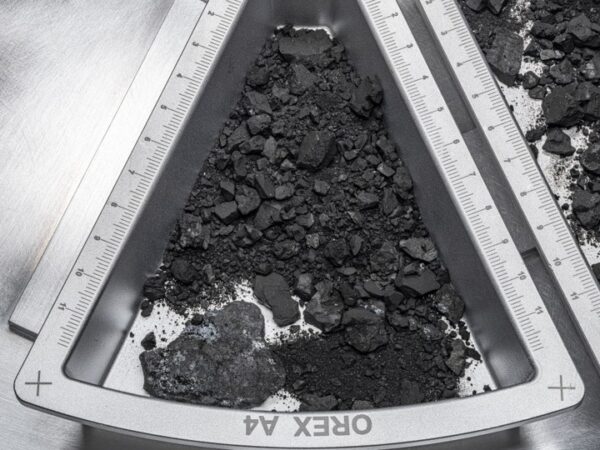
What if life on Earth arrived here from space? The asteroid sample return missions to Ryugu and Bennu have brought back evidence of the chemical ingredients we associate with RNA and DNA being abundant in this corner of the Universe, and have reignited the panspermia debate.
What is panspermia? It is a theory that states life didn’t originate on Earth but came from elsewhere. For some, the theory supports the idea that the ingredients for life arrived from elsewhere and that favourable conditions on Earth led to life.
What the two branches of panspermia believers have in common is that life precursors and life in all its forms are abundant throughout our Universe.
Asteroid Samples Reinforce the Panspermia Hypothesis
Visits to Ryugu and Bennu, both carbon-rich asteroids, returned samples containing the nucleobases that make up the base pairs found in RNA and DNA. We are talking about finding adenine, guanine, cytosine, thymine and uracil, the nucleobase organic compounds associated with the beginning of life on Earth. In addition, the samples contained concentrations of dissolved salts similar to what we find on Earth as well as ammonia and nitrogen-rich soluble organic matter.
All of the above chemistry is essential to life here on Earth. So, its existence off-world suggests it may be equally essential to life elsewhere and that our existence owes itself to a common source.
Last month I posted an article describing Lee Smolin’s Goldilocks Enigma: the Universe we live in appears predisposed to the emergence of life. Does that mean RNA and DNA could have self-organized in areas of space where conditions were hospitable?
It Started with RNA
Today, the notion of DNA and RNA from space is not considered scientifically plausible. Of course, we don’t know exactly what the conditions could have been like throughout the early Universe and its subsequent evolution.
Growing scientific consensus, however, considering the content of asteroid samples, sees the nucleobases and chemical precursors to RNA and DNA appear to have been cosmically derived.
In other words, conditions in parts of our Universe were ripe to create a chemistry lab starter kit for the emergence of base pairs, sugars, fatty-acid molecules and other chemical compounds that, through mutual attraction, created self-replicating complex molecules like RNA, DNA, protocells, and then the first living cells.
It started with RNA and other complex molecules in competition for the chemical resources produced by nebulae and stars. Scientists don’t believe RNA was the sole self-replicating molecule in the early Universe. Sugar-based molecules also formed, as well as other organized molecular structures, some appearing exotic to us if we were to encounter them today.
Why did RNA replicators win out in this corner of the Universe? I ask this because the Universe is huge, and we don’t know about competing self-replicators existing elsewhere that could have led to living things we might not even recognize as such. The best answer for RNA winning has to do with the RNA template’s ability to exploit the abundance of raw materials within the vicinity.
What led to the first protocells? The best candidates are lipids, the technology we use today to deliver mRNA vaccines. Lipids are fatty acids that form small vesicles with membranes. Imagine RNA strands safely replicating inside, away from competitors and able to split apart and replicate.
Without competition, however, self-replication would likely have been a dead end. So, multiple different RNA-containing protocells would likely have competed for the resources and evolved parasitic and cooperative strategies to continue to harvest the essential chemicals needed for replication.
Did RNA and DNA Compete?
They would likely have competed if they had both arisen at the same time. A mixed RNA-DNA world competing for nucleobases and other chemicals may have favoured DNA in the end because it was a bigger and more stable molecule. DNA nucleobase chains are much longer than RNA strands. The former lends itself to replication and contains more nucleobases, a path to faster evolution.
The general scientific consensus, however, suggests RNA came first, and DNA followed, so less competition and more cooperation. That’s why when DNA appeared, RNA continued to thrive as a cooperative partner in the evolution of the first living cells.
The Final Missing Ingredients
You probably are thinking energy and water were the missing ingredients needed for self-replicating cells to form. The Universe had energy in abundance. Hydrogen preceded the first stars. Oxygen was one of many elements that emerged from fusion within stars. Hydrogen-oxygen bonding produced water.
But the key remaining missing ingredients were planets, the products of nebulae and stars. For cells to emerge, planetary environments that provided constituent materials, chemistry, and energy were needed. We used to think pools of water forming on Earth’s surface when warmed by our young Sun, and fed by an atmosphere predominantly containing carbon dioxide, were the ideal for life to spontaneously emerge or provide the conditions for life from elsewhere to thrive.
Today, however, it is the hydrothermal vents found deep inside Earth’s oceans where conditions are cradles for life to establish itself. Similar conditions in our local Solar System can be found deep inside the oceans that lie under the icy surfaces of the moons of neighbouring planets.
Europa and Enceladus today contain all the essentials. They have rocky cores, liquid saltwater oceans, the chemistry of life found here on Earth, and the energy created by the gravitational forces exerted on them by Jupiter and Saturn that heat the moons’ interiors.
Even at a significant distance from the Sun, a prime energy source for Earth, the strangest of Goldilocks conditions could be present. Far from the Goldilocks Zones we traditionally think of as favourable to life’s emergence, life may be present.