
Today is Earth Day 2026. First proposed in the late 1960s, before the majority of us were less aware of global warming and increasing extreme weather events, Earth Day focuses on acting in the best interests of our environment on this planet. Doing business as usual has changed because of this annual event that is acknowledged in more than 190 countries today.
Governments have created cabinet-level representation to acknowledge that clean air and clean water are essential human rights. Many businesses have integrated sustainability into their best practices, including some in the fossil fuel industry.
Fossil Fuel and Donald Trump Problems
Until Donald Trump won the presidency of the United States in 2016, and again in 2024, the agenda of the second-largest contributor of greenhouse gas emissions (GHGs), China, being the largest, took a leadership role in addressing environmental issues. The American participation in the Paris Climate Agreement of 2015 wouldn’t have happened without President Barack Obama’s support.
Obama was president when British Petroleum’s Deepwater Horizon disaster occurred off the coast of Louisiana in the Gulf of Mexico. The year was 2010. The explosion killed 11. The rig caught fire and sank; 4.9 million barrels of oil escaped into the Gulf; 2,080 kilometres (1,300 miles) of the coastline were fouled; 800,000 birds and 65,000 turtles died; 36% of the Gulf fishery closed.
The cleanup used controlled burns, skimmers, and dispersants, further contaminating the environment. The Gulf ecosystems have never returned to normal.
BP paid US$ 65 billion for the cleanup, lawsuit settlements and fines. Supposedly, having learned a lesson, the company changed its practices. The company projected a new green image. Its website featured solar and wind projects. Then Donald Trump happened, and BP, like many other fossil fuel companies, went right back to their old ways.
President Donald Trump calls climate change a Chinese hoax. He says coal is clean. He has turned the US Environmental Protection Agency into a joke that no longer protects the environment. NOAA, America’s primary agency for tracking weather and forecasting extreme weather events, has seen dramatic budget cuts. Meanwhile, the US Department of the Interior is following Trump’s “drill-baby-drill” agenda, opening up protected lands and waters to fossil fuel prospectors.
Fossil Fuel Perspectives
The fossil fuel companies tell a story. It states that the planet’s future faces a trivial threat from climate change. It’s nothing the industry cannot handle. These industry points to events like the latest war in the Middle East as evidence that humanity cannot do without oil and gas to address our energy needs. Energy is what is driving the future, and fossil fuels are king.
This is the message fossil fuel producers want you to hear. They don’t want you to notice what they have known for more than 50 years: that their products represent an existential threat to the planet’s current climate. That is a story they continue to bury.
They want to profit from the reality of humanity’s growing energy needs, fuelled by the Global South countries that aspire to achieve better conditions for their citizens. The fossil fuel companies support the Global South’s ambitions to have what the Global North already has. At the same time, the fossil fuel companies expect that the source of new oil and gas will likely come from the countries of the Global South. All the more reason to support Global South aspirations.
Environmental Facts and Perspectives
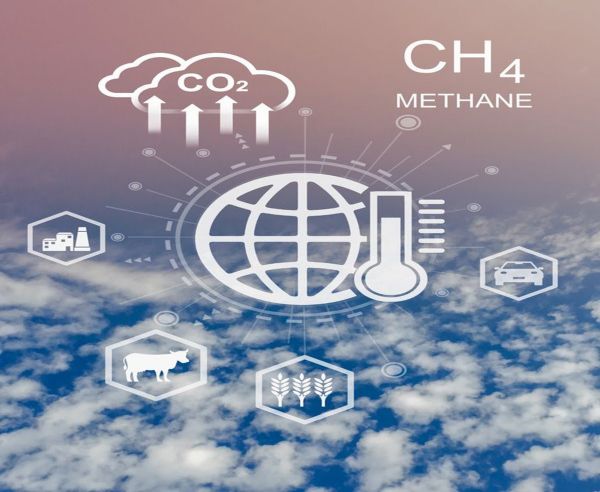
From nature’s perspective, it is human activities like business, manufacturing, mining, transportation and consumption that are the agents responsible for surplus GHGs in the atmosphere. What GHGs are we talking about? Predominantly, CO2 and CH4.
CO2 – in 2024, this GHG made up 0.043% (430 parts per million) of the atmosphere. That doesn’t sound like much, but before the Industrial Revolution, CO2 levels were 0.028% (280 parts per million). Human activities in less than two centuries have annually added gigatons of CO2 that, unfortunately, will persist in the air for centuries.
We should all be familiar with CO2. We breathe in oxygen (O2) and expel CO2. So do all the animals on Earth. Where does the rest of the atmospheric CO2 come from? Mostly from human activities like the burning of fossil fuels (wood, coal, oil, natural gas, and wildfires).
The natural world has abundant carbon sinks to capture atmospheric CO2 from our and others’ exhalations. Plants take in CO2, whether we are talking about temperate and tropical forests, grasslands, peat bogs, or algae (ocean kelp forests). Soil traps CO2 as well. Mineralization processes turn CO2, combined with rain falling on basalt and sandstone, into calcium carbonate (limestone).
The biggest CO2 absorber is the ocean, taking up more than a quarter of the excess. The CO2 absorbed by the ocean turns into a weak carbonic acid. This lowers seawater pH (a measure of acidity or basicity with 7.0 neutral on the logarithmic scale that goes from 0 to 14). Before the Industrial Revolution, ocean surface water pH levels were 8.2. In 2024, the pH level was 8.05. Lowering pH levels threatens shell-forming marine animals.
CH4 – In 20245, this GHG made up 0.000194% (1,940 parts per billion) of the atmosphere. Before the Industrial Revolution, CH4 levels were approximately 700 parts per billion (ppb). By 1983, CH4 levels were 1,645 ppb by 1983, and over 1,900 ppb by 2021.
CH4 doesn’t persist in the air as long as CO2. Over 12 years, hydroxyl radicals in the atmosphere remove 90% of the gas. Its global warming potential (GWP), however, while still present, is 25 to 84 times greater than that of CO2.
Sources of CH4 include us, ruminant animals like cows, pigs and other livestock. Other natural contributors include wetlands, microbes, termites and the ocean. Human activity contributors include natural gas and oil industry wellhead leaks, abandoned fossil fuel sites, and landfills.
Natural CH4 sinks include forests, soils, oceans, wetlands and permafrost. Atmospheric chemistry takes care of much of the rest. CH4 emissions, however, are accelerating. The greatest threat CH4 represents is the possibility of rapid warming spikes and consequent accelerated permafrost melt, releasing the trapped gas.
Identifying and Solving CO2 and CH4
We know the two GHGs we are producing in excessive amounts that represent a significant challenge to the planet and our way of life. So, what are we doing about it?
We have several questions that need answers now, if not soon, to help make collective decisions to determine the world in which our children and their children will live. These include:
- Can we ignore the distractions of politics and the sidebar issues of today and stay focused on the existential threat that climate change presents?
- Can we collectively and willingly change the way we live to leave a less negative environmental footprint on the planet?
- Do we have the collective will to end our fossil fuel reliance that currently powers our society and replace it with sustainable energy-producing alternatives?
- Do we have the technological know-how and will to spend the money and develop the solutions to help remove GHGs from the atmosphere and ocean?
- Are we prepared to help communities and nations already impacted by our fossil fuel addiction and help with compensation and adaptation?
Stay tuned to the next posting on this topic as we work through strategies and answers to all of the above.