James Hansen, a former NASA director of the Goddard Institute for Space Studies, has developed the climate models that revealed the scientific reality of global warming. Back in 1988, he spoke to the U.S. Senate about the certainty that atmospheric and ocean warming were underway. The reason, he stated, was rising carbon dioxide (CO2) and other greenhouse gases (GHGs) in the atmosphere. He described this phenomenon as human-induced climate forcing.
Today, Hansen and his colleagues, Pushker Kharecha, Dylan Morgan and Jasen Vest, published their latest findings and predictions, noting that we are heading for another El Niño, three years after the last one, describing it as a faster cycling than normal. They predict, as a result, a new record global high mean temperature in 2026 and a higher one in 2027. They believe the trend points to a 2°C (3.6°F) mean temperature rise by the 2030s, faster than previous mid-century predictions. The following graph plots global surface temperature data from 1950 to the present, showing how El Niño highs recently have surpassed the Paris Climate Agreement lower target of 1.5°C (2.7°F).
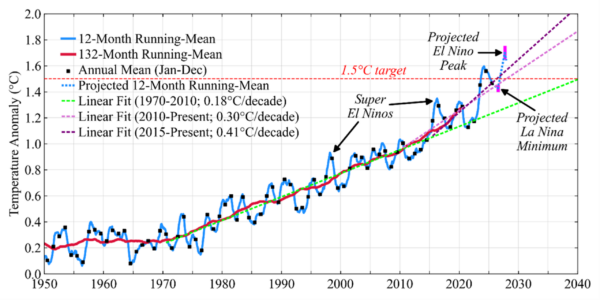
Currently, we are at the back end of an El Niño/La Niña (ENSO) cycle with the trade winds of the equatorial Pacific Ocean pushing warm surface waters west and causing upwellings of cold water from deep in the ocean to surface off the coast of South America. As plotted in the graph above, the normal cycle in atmospheric temperatures is directly related to this recurring ocean phenomenon.
Being at the bottom end of the ENSO cycle puts us in the cool La Niña phase. Latest climate modelling suggests an end to this phase of the ENSO cycle by early summer with the return of another El Niño. Why? Because upper ocean heat is rising faster than in the past, with peaking near the end of this year.
The current scientific consensus has yet to determine with certainty whether the rate of ENSO cycles is speeding up. A 2022 paper in Nature Communications projected faster onsets and slower decays for El Niño events this century. A 2023 paper in the journal Nature concluded that ENSO cycle rate change remained uncertain.
ENSO Cycles Determine Global Weather
Why would a shift in warm surface water in the equatorial Pacific Ocean change the weather here in Toronto, or elsewhere in North America, Europe, and Africa? Considering the locale of this phenomenon, it makes sense that the ENSO cycle should affect East Asia, Australia, Pacific island nations and South America. But in fact, this recurring warm El Niño phase followed by the cooler La Niña profoundly influences the Americas, Asia-Pacific, Africa and Europe.
- In the Americas, the El Niño phase causes floods in Peru and droughts in the southwestern U.S., while the La Niña phase causes droughts in the Amazon and floods in the southeastern U.S.
- In the Asia-Pacific region, the El Niño causes droughts in Indonesia and floods in India and Pakistan, while the La Niña phase spawns Indian Ocean typhoons and floods in Australia.
- In Africa, the El Niño phase causes drought in East Africa, while the La Niña phase produces abnormally high rainfall in South Africa.
- In Europe, the El Niño phase causes warmer-than-normal winters while the La Niña phase causes colder temperatures and more rain in the south and west.
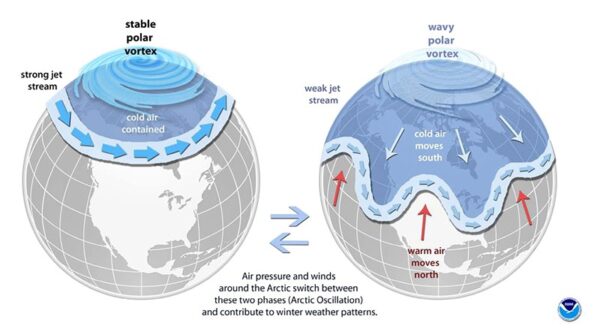
In Canada, where I live, El Niños typically cause warmer, drier winters while La Niñas cause cooler temperatures, rain and more snow for the eastern half of the country. The recent polar vortex that settled over much of Eastern Canada and the U.S. vausing iguanas in Florida to fall out of trees, has its roots in the current La Niña. A cooler Eastern Pacific Ocean destabilizes southern air masses, which makes winter Arctic air creep south and causes dramatic oscillations in the Jet Stream. The two pictures below show the stable El Niño phase on the left, and the pattern that comes during La Niñas on the right.
What’s In The Future?
Climate models projecting to 2100 are in line with what Hansen and his associates are gleaning. The aforementioned 2022 paper predicts a 33% increase in La Niña events and a 20% increase in El Niños by 2100 from climate forcing feedback caused by GHGs in the atmosphere. If emission levels begin to drop, the ENSO cycles will continue to rise, but at a slower pace.
Warming implications aren’t limited to the atmosphere. The warmth in the atmosphere will increasingly be absorbed by the ocean, leading to deep ocean warming, which in turn will amplify the heat in the air and El Niño frequency. Unlike ocean surface warming, deep ocean heat will last for centuries, contributing to future climate extremes.

 cycles are speeding up, accelerating global warming.)
