
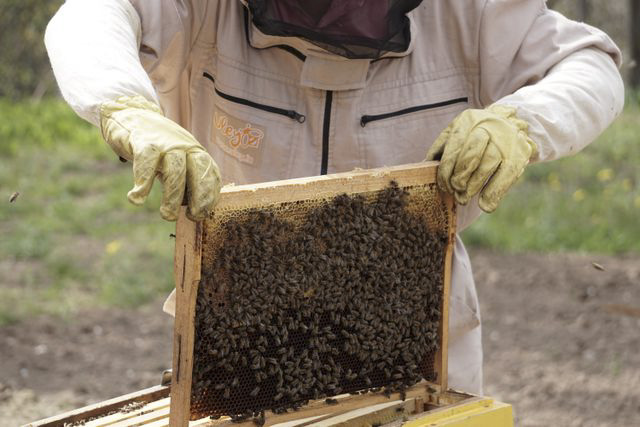
Paige Linton sent in an article that looked at the challenges bee populations face today from habitat loss, pesticide exposure, climate change and parasites. She noted that concerns about threats to pollinators have brought farmers, conservationists, biologists, and technology companies together to tackle the challenges bees face in the 21st century.
Her article coincided with new research I was looking into about hybrid California bees that appear to have developed natural resistance to what is causing Colony Collapse Disorder (CCD), an observable phenomenon first reported in 2006 in North America and elsewhere.
Paige also mentions the popularity of urban beekeeping. As I look from our balcony to the neighbouring rooftop terrace in our home here in Bronte, Ontario, there sits a beehive. When the beekeeper shows up, we are invited to listen and learn more about bees and beekeeping. When we moved in three-and-a-half years ago, our welcome package included a jar of honey harvested from our Bronte beehive.
What follows is mostly Paige’s prose. I have added a section describing the California hybrid honeybee discovery.
Enjoy the read, and please send comments.
Research into what is causing CCD in honeybees around the world remains in high gear as conservationists, farmers and scientists rush to protect one of the world’s most important pollinators. Some scientists question the original CCD studies, arguing that hive endangerment may be exaggerated. That doesn’t, however, change human interest in caring for our bee populations. Applying the latest in 21st-century technology to protect current and future food security, therefore, remains a priority.
21st Century Bee Management
1. Artificial Intelligence and Drone Monitoring Systems
Artificial intelligence (AI) is being weaponized to help beekeepers monitor bee populations. Advanced drones, not drone bees, are being equipped with high-resolution cameras and AI software to observe bee activity, helping to identify behaviour patterns and detect signs of hive stress and CCD.
AI systems are good at processing large amounts of data in real time, which is advantageous when studying bee activities such as foraging, habitat degradation, and signs of pest infestations. Some of these tools can detect the presence of the Varroa mite, the bee parasite most associated with CCD.
Using AI tools helps to provide an early warning system to help improve colony health with far less potentially disruptive manual inspections.
2. Precision Agriculture and Reduced Pesticide Use
Modern precision agriculture technologies are helping reduce unnecessary chemical exposure for pollinators. Instead of applying pesticides uniformly across entire fields, farmers now use sensors, GPS mapping, drones, and data analytics to target specific field problem areas.
This approach offers several benefits:
- Reduced pesticide use,
- Lower environmental impact,
- Better protection for pollinators,
- Improved farm efficiency,
- Lower operating costs.
Treating only the affected areas rather than an entire field means farmers can better protect flowering plants and pollinator habitats while still managing crop pests effectively.
Precision agriculture also helps optimize irrigation, planting schedules, and crop rotation plans, creating more diverse landscapes that provide food sources for bees throughout the growing season.
3. Smart Urban Beekeeping Technology
Urban beekeeping is increasingly popular, and 21st-century technology is making it easier than ever to maintain healthy hives in cities and suburbs. Smart systems equipped with sensors continuously monitor temperature, humidity, hive weight, and bee activity, sending data directly to mobile devices. This allows beekeepers to identify potential problems quickly.
For example, sudden weight changes may indicate dwindling nectar supplies, while unusual temperature shifts can indicate colony stress or equipment issues.
By reducing guesswork and improving hive management, smart technology helps both experienced and beginner beekeepers support healthier bee populations in urban environments.
4. Renewable Energy and Sustainable Beekeeping Operations
Sustainability extends beyond protecting bees themselves. Many beekeeping operations are adopting solar-powered systems to produce the energy needed for:
- Hive monitoring equipment,
- Facility lighting,
- Honey processing equipment,
- Climate-controlled storage areas.
Sustainable hive construction has become more common, with manufacturers using responsibly sourced wood and recycled materials.
During honey harvesting, many beekeepers rely on a honey extractor to efficiently remove honey while preserving honeycombs for future use. This process conserves hive resources, reduces waste, and allows the bee colonies to use their energy to gather nectar rather than rebuild comb structures.
5. Habitat Restoration and Plant Identification Technology
Creating pollinator-friendly habitats supports bee populations. New technologies help conservation organizations identify, restore, and monitor these ideal areas more effectively.
Mobile applications allow users to identify native flowering plants and track pollinator-friendly species within their localities. At the same time, satellite imagery and geographic information systems (GIS) help conservation groups locate new areas suitable for habitat restoration projects.
Emerging technologies include the ability to:
- Map pollinator migration routes,
- Evaluate habitat health,
- Monitor restoration success,
- Identify regions lacking floral resources.
Some organizations have even experimented with drone-assisted seed dispersal systems to distribute native wildflower seeds, accelerating habitat recovery efforts.
6. Water Quality Monitoring and Environmental Protection
Access to clean water is essential for bee health. New monitoring technologies help detect contaminants that may threaten bees and other pollinators. Automated sensors can identify pesticide residues, heavy metals, and other pollutants in water sources near agricultural or urban environments.
Sensors can send real-time data to researchers, environmental agencies, and farmers to respond quickly to detected contamination. Better water management is helping create healthier ecosystems to support both honeybee colonies and native pollinator species. Some are implementing rainwater collection systems and pollinator-specific water stations to provide safer and more reliable water sources for bees throughout a growing season.
7. Letting Nature Do Its Thing
In Southern California, a hybrid honeybee population has emerged that appears resilient to Varroa mites. The presence of large populations of mites in hives is associated with CCD. The mites feed on the bees’ body fat and spread viruses that cause deformed wings and paralysis.
One of the primary causes of CCD points to an industry issue. The widespread transportation of hives to farms where they are needed for pollination has created a path for the Varroa mite to spread.
In California, it appears that nature, not human intervention, is doing its Darwinian thing, winnowing out bee populations that cannot withstand the mites, and through natural selection creating a California hybrid capable of surviving the onslaught. These bees are not commercial breeds. Their genetic origins point to a mixing of African, Eastern European, Middle Eastern and Western European strains.
The mites appear to be less attracted to the hybrid bees from the larval to adult stage, indicating natural selection has evolved bee defences. The implications for honeybees far beyond California cannot be underestimated.
Studies of the California bees point out that mites continue to cohabit hives, but their population levels are lower and therefore much more manageable to eradicate using current bee-friendly pesticides. To learn more about California hybrid bees and their resistance to Varroa, an article recently appeared in the journal Nature Scientific Reports.
For pollinators, taking advantage of nature’s gift may prove to be a compelling strategy to support global bee populations.