
On March 3rd, I described a reality check for the Artemis Program under NASA’s new director, Jared Isaacman. Would Lunar Gateway be cancelled to meet new timelines to get NASA back to the Moon before the end of the decade?
With Artemis II delayed and the next departure date tentatively set for April Fool’s Day, the program desperately needed a success story.
Was Isaacman the person to pull Artemis out of the fire?
Could America’s human space program, except for the ISS, be salvaged from the Congressional pork-barreling and constant political interference from past presidents?
Could NASA continue to exist in the face of a burgeoning commercial space economy led by companies like SpaceX? NASA today has become reliant on SpaceX to ferry its crews to the ISS. Joining SpaceX are other commercial operators, like Blue Origin, Sierra Space and Rocket Lab. All are chomping at the bit to get into the space game. The triumph of the NASA Apollo Program is a distant memory.
Isaacman’s Plan to Rescue Artemis
Enter Isaacman, a billionaire astronaut who commanded and privately funded two missions to space, the first in 2021, and the second in 2024, using the services and technology from SpaceX. He is a human in space enthusiast and appears well-suited to get NASA’s Artemis Program back on the rails.
Following Isaacman’s reshuffling of upcoming missions beyond Artemis II, Isaacman announced on March 24, 2026, a $20 billion change in plans. No surprise: Lunar Gateway cancelled.
Affected NASA Artemis Program Partners
There will be fallout from Gateway’s death. Artemis partners and contractors have been working on components for the project. Some of these are close to completion or already delivered. A partial list follows:
- ESA (The European Space Agency) has its subcontractor, Thales Alenia Space, working on the communication links for HALO, the Habitation and Logistics Outpost for Gateway, being built by Northrop Grumman. The completed HALO module was delivered to NASA in April 2025.
- JAXA (The Japan Aerospace Exploration Agency) has been working on 1-Hab, the crew habitation module, providing battery, life support and thermal control systems. The project is not finished.
- CSA (The Canadian Space Agency) has been developing its next-generation robotic arm, the Canadarm3. Manufactured by Canada’s MDA Space, the developer of the Canadarms that have served NASA’s Shuttle and are currently in use on the ISS, Canadarm3 will incorporate AI. It is still in development.
- MBRC (The Mohammed Bin Rashid Space Centre) has been building the Emirates Airlock and docking port. It was to be attached to the HALO module.
- Non-government contributors to Gateway include companies like Maxar Space Solutions, the aforementioned Northrop Grumman and Thales, as well as Blue Origin, Draper, Redwire and, of course, SpaceX. SpaceX was to use the Falcon Heavy to deliver Gateway to lunar orbit.
The above suppliers list is far from complete. There are many more subcontractors contributing components to these projects, creating a substantial supply chain.
Is Gateway Money Spent Unrecoverable?
Gateway was a $5.3 billion project. Is the money gone, or can work be repurposed? In the March 24, 2026 announcement, it states that the Gateway supply chain partners will see their contracts adjusted to repurpose the hardware and software to meet a new objective, the building and support of a permanent lunar base near the South Pole.
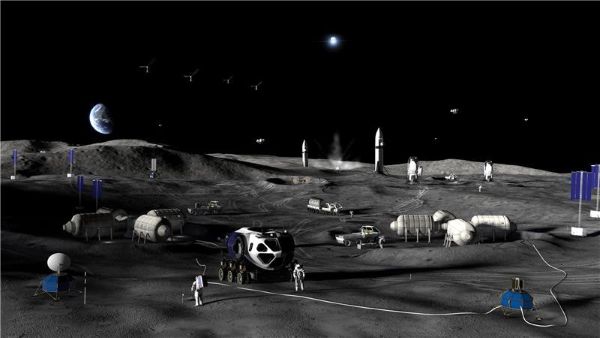
Isaacman’s announcement of this new Artemis twist, the Ignition Project. It allocates $20 billion over seven years to construct the lunar base and involves dozens of missions to the Moon.
The Ignition announcement didn’t just discuss the lunar project. I will save the rest for another posting. But for now, what follows describes NASA’s new plan for Artemis.
Reigniting Artemis
Ignition is the name Isaacman has chosen to establish the first permanent lunar base by 2030. Ignition includes habitats, lunar transportation, a nuclear power station, communications and other infrastructure. Ignition is to be a testbed for a future mission to Mars and involves three phases:
- Phase One: Build, Test, Learn – It involves repeat missions to the Moon using CLPS (Commercial Lunar Payload Services) to deliver materials and equipment to build a lunar base infrastructure. It includes rovers, power generation, communications, navigation, surface operations, and scientific payloads.
- Phase Two: Establish Early Infrastructure – It involves missions that include astronauts. JAXA will provide the LTV (Lunar Terrain Vehicle). In addition, there will be robotic rovers, scientific payloads, and additional infrastructure deliverables to support short stays by crews on the lunar surface.
- Phase Three: Enable Long‑Duration Human Presence – As cargo‑capable HLS (Human Landing Systems) become available, this phase will include heavier infrastructure deliverables to support the permanent lunar base. In describing this phase, NASA lists contributions from ASI’s (The Italian Space Agency) Multi-purpose Habitats (MPH), CSA’s (Canadian Space Agency) Lunar Utility Vehicle, and other Artemis partners who will provide infrastructure for habitation, surface mobility and logistics.
Is Gateway Never to be Revived?
A recent Politico article labelled the Lunar Gateway a “moondoggle.” I questioned the need from the early stages of the Artemis Program. That, however, doesn’t mean that Gateway has no merit. It could be a model for future waystations between Earth, Mars and other destinations in the Solar System. Future versions of Gateway could become space service centres to support a growing transportation network similar to how gas stations support terrestrial road networks.
Another potential use for a future version of Gateway in cislunar space could serve as an Earth observation platform, providing a bird’s-eye view of the Earth and the satellites that orbit around it.
Gateway could serve to identify any space rocks that might, in future, threaten Earth. And finally, it could provide a template for building future space cities in cislunar space and beyond.
But for now, may Lunar Gateway rest in peace.