Please welcome Shanzaib Haider to the 21st Century Tech Blog. Shanzaib is a thoughtful writer who explores how to bring intention and balance into everyday life. His reflections on digital wellness and personal growth often find a home at MindfulBrowsing.com. Away from the screen, he’s drawn to writing, getting lost in books, and deep conversations about mindfulness and meaningful connections.
In this, his first contribution, he describes how rapidly the world has changed from the 20th to the 21st century. This theme is often described on this site. When I was born in 1949, my grandmother, who lived next door to us in Montreal, had ice delivered for her icebox to keep perishables cold. In 1952, my parents were the first family on our street to have a black-and-white television with a cable connection to bring in network stations from Burlington, Vermont, along with Canada’s first national broadcasting network, the CBC. Having witnessed the dramatic changes in my lifetime, I find it interesting to read a perspective on technological change coming from a younger person. Thank you, Shanzaib. I look forward to reading comments from our readers and to future postings from you.
For anyone born into the world of smartphones and constant Internet connectivity, it’s natural to wonder when the world changed so much. Many of our 21st-century digital habits have their roots in technologies and social shifts that began in the late 1900s. While we now carry the equivalent of supercomputers in our pockets, the journey here didn’t leap from darkness to daylight. Instead, the 1990s experienced a rapid digital revolution, from landlines, fax machines, and dial-up telephony to the digital world of today.
For those who lived through it, the last decades of the 20th century were a time of profound transition. In North America, Western Europe, Australia, and Japan, innovation was a matter of fact. But in many other places, people remained dependent on older technologies and practices. The two worlds existed side by side and in some parts of the planet, still do.
Let’s take a deeper look.
What Daily Life Looked Like Before the 21st Century
Long before social media, smartphones, and instant access to everything through the Internet, life was far more offline and hands-on. People established practices that worked fine for them. The Mindful Browsing website, referred to earlier, describes some of what life was like before social media, noting how people spent more time connecting face-to-face and enjoying uninterrupted moments rather than being glued to screens.
Communication
Back before smartphones, people leaned on old-school ways to stay in touch. Letters were the most common mode of communication for everyday updates, mailed through the post. When you had big news or emergencies, not everyday stuff, people sent telegrams.
Fax machines, invented early in the 20th century, didn’t catch on until the late 1970s. When the Internet was born, e-mail took over.
Telephones were largely for having conversations. Landlines and rotary dials were predominant. There was a thing called dial tone.
Banking and Bills
Bills were sent through the mail. People paid them either by visiting their bank or by sending cheques through the mail. At the bank, tellers stamped paper bills indicating paid in full. Visiting the bank could be time-consuming as well as social.
Today, banking is digital and online, with no more waiting in lines and deposit and withdrawal slips to fill in. Signatures have gone digital, and banking happens with a click.
Grocery & Shopping
Grocery stores have been around in cities for a long time. Before stores, people could purchase fresh food from local farms and growers. Before the shift from rural to urban living, most of humanity depended on proximity to the land. By the end of the 20th century, humanity for most of the planet was disconnected from where food came from.
As for non-food items, department stores, small shops, markets, and home-based businesses were the places where humans shopped. Before the Internet and Amazon, there were mail-order catalogues. In rural communities, mail-order catalogues were where most of us shopped.
Work and Scheduling
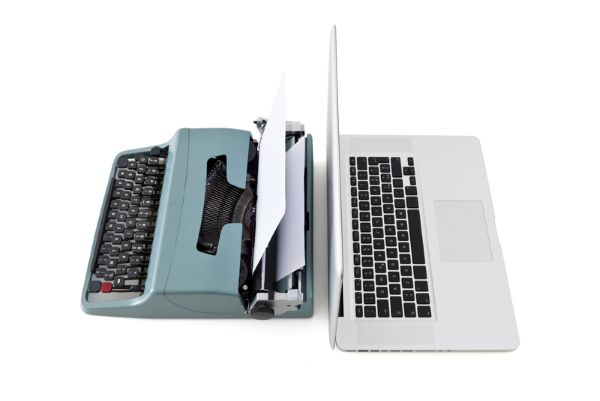
Before computers and WiFi, there were manual and electric typewriters and landlines. Then the first dedicated word processors showed up. Telex machines were replaced by fax machines. Before Xerox, there was the Mimeograph, invented in 1879, and later on, Gestetner rotary devices to make multiple copies of documents. Before e-files, there were paper systems and filing cabinets. People used the telephone to make appointments. They kept track using paper calendars and planners. A refrigerator door was often the communication centre of a home, with magnets holding up paper reminders and notices.
Today, everything has gotten faster, and digital devices have mostly replaced what is described above. The lines between work and personal life have become blurred. We live in an age of always being connected and digital distractions.
Travelling
The automobile was a late 19th-century invention. In the 20th century, it became dominant. Before GPS technology, people relied on paper maps. Car ownership and learning to drive were rights of passage.
Trains, another 19th-century invention, along with rail networks, served to transport people and materials. In the 20th century, the airplane appeared, and by the late 1950s, commercial jets became the way for people to travel for work and leisure. For work and personal travel, travel agents provided bookings, itineraries, and travel advice. Expedia and TripAdvisor weren’t a thing.
When you travelled for work or pleasure, you stayed in motels and hotels. There was no Airbnb.
Entertainment and Social Life
These days, everything’s just a tap away. Video games, movies, e-books, social media, the list goes on. But, back before screens took over, people were more hands-on and found others in social settings to have fun. The first voice radio transmissions date back to 1906. The first television transmissions occurred in 1928. The first tape recorder appeared in 1935. The first cassette tape player arrived in 1963. The first digital audio files showed up in 1971. The first MP3 players showed up in 1997. Today, smartphone apps have replaced all.
Before the invention of photography in the 19th century, images were rendered by drawing them. Today, smartphones and selfies record every aspect of our visual life for sharing on social media.
Children spent a great deal of time doing outdoor activities before the 21st century. They ran around, played hopscotch, dodgeball, hide-and-seek, skipped, and more. These games weren’t just about burning energy. They weren’t organized sports. Instead, they brought kids together, helped to form lifelong bonds of friendship, and developed interpersonal skills for work and life.
Much of what was the norm in our 20th-century entertainment and social life has been lost to small-screen dependency and addiction. We are less physically active in the 21st century, where digital technology predominates. As these technological changes spread everywhere, humanity is losing the advantages that were part of our pre-21st-century existence.
Before the 21st century, our lives followed very different rhythms. The arrival of modern digital technology has changed humanity. Most of us in the 20th century didn’t feel like something was missing. Our world was filled with conveniences, with each year bringing something a little newer and a bit more modern.
When we look back, it is hard not to see how the world of the 21st century is very different, and how much our daily lives have changed.

