
In university, I studied history, notably the medieval kind, with a focus on Eurasia and North Africa. I chose this geography because I wanted to walk a mile in others’ shoes and appreciate, through a larger lens, different historical perspectives and their relationship to the views and ideas of those of us living in the Western World.
After graduating, I hoped to teach history in ways that would make reluctant high school students appreciate the past while striding into the future. At the time, I was unable to get that teaching job, and instead was hired by a publishing company to sell textbooks to universities and colleges. Eventually, I got good at that and was promoted to acquisitions editor. Then, when the personal computer showed up, I transferred those skills to becoming a software publisher.
The world of computing became my focus. The first local area networks (LANs) showed up. My interest graduated to the world of connectivity and how networks could stream data, voice, video or even energy across our planet.
Networks became avenues for convergence. So, when I was asked to be a keynote speaker for a Toronto technology conference in 2000, I went on stage, taking a pager, cellphone, CD player, digital camera and personal electronic organizer and wrapping them in tape. I told my audience that within the decade all of these would be packed into a single handheld device small enough to put in my pocket. When the iPhone launched a few years later, my prediction became reality. I had become a futurist.
I am convinced that to be a futurist, you need a foundation in history. Analyzing historical data helps you to understand current events and trends. It can help you to make well-informed decisions and even predictions by seeing patterns in the data.
Studying data patterns is how artificial intelligence (AI) works. Today’s large-language-model (LLM) AIs get fed immense quantities of data to make them proficient in predicting word associations. This has led to a proliferation of tools similar to ChatGPT that are being used by people in businesses and students in schools as shortcuts for writing reports, emails, essays, presentations and more.
From recent conversations, I have talked to people in business who use ChatGPT to write emails and reports, and students who are handing in assignments created by AI bots, with teachers scrambling to determine whether what is being submitted is human or AI-generated.
Machine learning (ML) and neural network-based artificial general intelligence (AGI) use their pattern recognition capacity on unstructured and structured data fed to them. How good are they at predicting the future?
I asked the AI called Monica to answer that question. This is what it wrote:
Would an AI have predicted the iPhone? I am not certain because there wasn’t a great deal of published data on multi-stream technological convergence back then when I first made my onstage prediction.
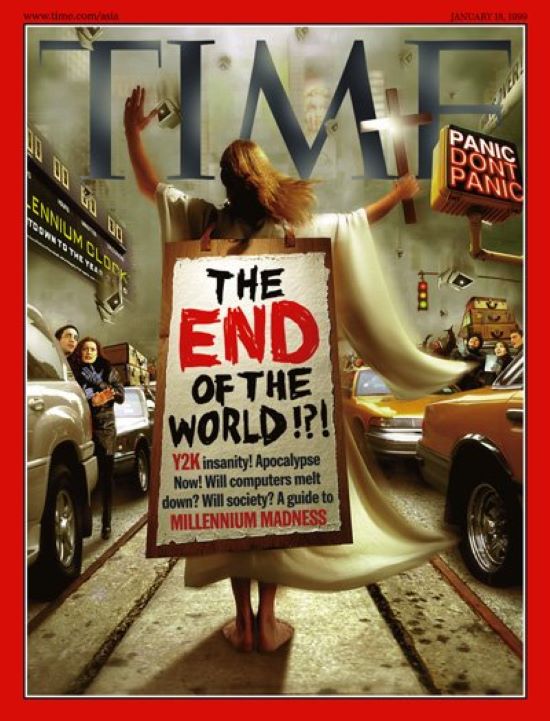
Would an AI have gotten Y2K wrong? If not familiar with Y2K, it had to do with mainframe software being written with a two-digit year code. Businesses, financial institutions and governments using mainframes were told they would stop working at midnight on December 31, 1999, as the year code changed to 00. Airplanes were going to drop out of the skies. Trains would stop running, and elevators would plunge to the ground. These were the scenarios sold to the public by the computer industry at the time, generating hundreds of millions of dollars to rewrite old software to change the year field. Y2K turned out to be a highly exaggerated scare perpetuated by the futurists of the time.
Would an AI have predicted the Russian Revolution or the eventual fall of the U.S.S.R.? If the AI had access to the historical, economic and demographic data of the time (remember, there wasn’t an Internet back then or a digitized version of the Encyclopedia Britannica for it to study), I think it would have predicted both results.
The future isn’t written. It will always be uncertain. The psychohistory of Isaac Asimov’s “Foundation” is not science, but rather science fiction.
Delving into history, however, does provide context for future possibilities. We are amassing vast amounts of data, doubling every few months today. Historical context and collective experience equip us to better tackle current challenges and predict what lies ahead, whether it is human futurists making prognostications or AIs acting as oracles.
When we study the cyclical nature of history and thoughtfully examine and interpret our past, we are more informed and better prepared to be futurists.