
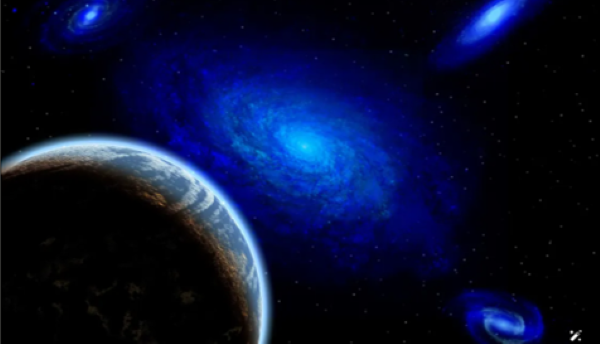
A 1933 science fiction novel written by Philip Wylie and Edwin Balmer told the story of two wandering planets entering the Solar System, one the size of Earth and the other Neptune-like, with the latter colliding with Earth. Called “When Worlds Collide,” there was little to suggest that the galaxy was populated with planets roaming through deep space.
We Get the Word Planets from Ancient Greece
Ancient Greek observations of wandering pinpoints of light observed in the night sky named them πλανήτης (planḗtēs). The name means wanderers. Except for the Moon, Sun, comets and shooting stars, everything the ancient Greeks observed in the night sky didn’t move. The fixed points of light were called ἀστήρ (astḗr), meaning star. Astḗr gave us the words astronomy, asterisk (star-shaped) and astronaut.
To the Greeks, other than the Moon, planḗtēs were the most obvious visible objects in the night sky. They cyclically changed position throughout the year. From planḗtēs we got the word planet.
Nothing the Greeks described, however, was a wanderer like the rogue planets of Wylie and Balmer’s novel. In fact, planets beyond the Solar System remained unknown until 1992. The first two were observed orbiting a distant star. In 2011, the first untethered rogue planet was found wandering through the Galaxy. A year later, a rogue super-Jupiter was imaged. By 2020, an Earth-sized rogue planet was discovered. Then in 2023, the James Webb Space Telescope discovered the first pair of companion rogues, à la Wylie and Balmer.
Rogue Planets Everywhere
A paper appearing in the American Astronomical Society journal in 2023 described a nine-year sky survey that concluded rogue planets were far more abundant than previously thought. The study was conducted at the Mount John University Observatory in New Zealand. There, scientists used gravitational microlensing to discover 3,500 events over a short period. The paper they wrote stated that the number of unbound rogue planets was likely far greater than the number of stars populating the Milky Way.
How much greater? The calculated ratio indicated 21 rogue planets to every one orbiting a star. The results showed a range of planetary masses from one-third the size of Earth to more than 6,660 times bigger than our planet.
Microlensing the Key to Finding Rogue Planets
How does gravitational microlensing work? It is used to indirectly observe celestial objects invisible to the eye by looking at distant stars and noting when an object passes between the observer and the light. When an object crosses between the light source and the observer, it bends space and time. These bends are key to uncloaking formerly invisible objects.
Microlensing is a bit more complicated than just observing light coming from another star. To be effective, it involves viewing a part of the night sky at just the right time, and doing it in fast sequence to catch subtle space-time bends. When the light bends, and no star or other object is observed nearby, the bending of the light is deemed to be caused by a rogue planet.
Not everything microlensing observations yield are rogue planets. A planet orbiting at a far distance from its parent star could be mistaken as a rogue because it passes in front of a distant light source. For example, a remote observer looking at us might mistake the yet-unfound Planet X for a rogue if using microlensing, because, being so far beyond our local Oort Cloud, it might pass in front of a remote star and bend its light without being recognized as a companion to our Sun.
So, how did so many rogue planets come to exist? The paper describes that during the formation of the Solar System and other star systems, planet scattering was very common. Planets regularly were booted from their parent star, explaining the existence of so many rogues today.
New Telescope Will Confirm an Abundance of Rogues
At the end of this month, if all goes well, NASA plans to launch the Nancy Grace Roman Space Telescope. Among its many objectives is the study of exoplanets using gravitational microlensing. NASA expects to discover thousands of these rogues as well as orbiting planets. The hope is to image some of these planḗtēs directly.