
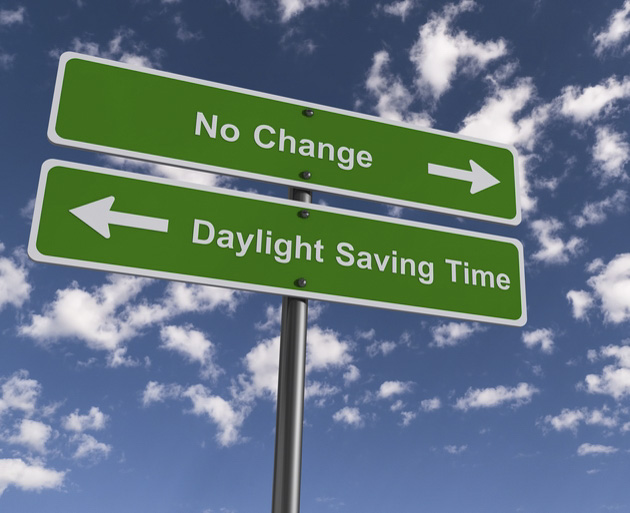
Canadians are adding to their stress levels this November, not just because the U.S. mid-term elections are this week, but also because the first Sunday in the month traditionally involves turning the clocks back one hour to Standard Time from Daylight Saving Time.
The U.S. election could calm the trade waters between our two countries roiled by Donald Trump’s escalating tariff war, or it may not if the votes favour the Republican Party in the House and Senate. But several Canadian provinces changing to permanent Daylight Saving Time could upset families and businesses.
Why Canadian Provinces Want Permanent Daylight Saving
Daylight Saving Time (DST) was introduced as a concept in the late 19th century and legislated by countries fighting in World War I. Rolling clocks back one hour in the fall conceivably created an extra hour of light late in the day. It meant energy savings. The public benefits meant children could walk home from school while there was still light. It meant those coming home from work could drop in on stores before the light failed.
For a country like Canada, lying mostly north of the 49th parallel of latitude, extra light in the afternoon during the shortest and darkest winter days was appreciated even if the changing of the clocks caused short-term disruptions to our circadian rhythm.
The energy-saving and light-saving time switch twice a year soon caught on to be adopted across the globe until recently. Now, the two halves of Canada are heading in different directions on clock management. Most of Eastern Canada is continuing to make the fall-back switch to Standard Time at 2 a.m. this Sunday, November 1st. What’s happening in Western Canada, however, is a change to keep DST year-round.
Canada’s Time Changes Will Take Getting Used To
Canada has six time zones: Pacific, Mountain, Central, Eastern, Atlantic and Newfoundland. From the Pacific to Newfoundland, there has been a 4-hour and 30-minute difference from west to east.
The westernmost province in Canada, British Columbia, is in the Pacific Time Zone. On Sunday, it will no longer switch to Standard Time. Instead, it will stay permanently on Pacific Daylight Saving Time while its neighbour to the south, the State of Washington, will continue to make the spring and fall switch.
Going east, we enter Mountain Time, which will now officially become Alberta Time. The province is permanently adopting Daylight Time year-round. It will mean an hour difference between Alberta and the U.S. states currently on Mountain Time. So Denver and Calgary will be an hour apart through the late fall and winter, and in the same time zone in the spring through summer and early fall. The Northwest Territories (NWT) will follow Alberta’s lead.
Nunavut in the eastern and central Arctic spans three time zones and will switch times twice a year, with one exception: Southampton Island, which stays on Eastern Standard Time (EST) year-round.
Saskatchewan stays on Standard Time, as does the Yukon, year-round. For these two parts of Canada, it means having to adjust to the neighbours’ time changes.
Further east, we enter Central Time. The province of Manitoba and the northwestern corner of Ontario are adopting permanent DST.
The bulk of Ontario and all of Quebec will fall back one hour to EST and return to DST in the spring.
The Atlantic provinces: New Brunswick, Nova Scotia and Prince Edward Island will return to Atlantic Standard Time. In Newfoundland and Labrador, the western portions of the latter share Atlantic time and will fall back. Coastal Labrador joins Newfoundland, being 30 minutes ahead of Atlantic time.
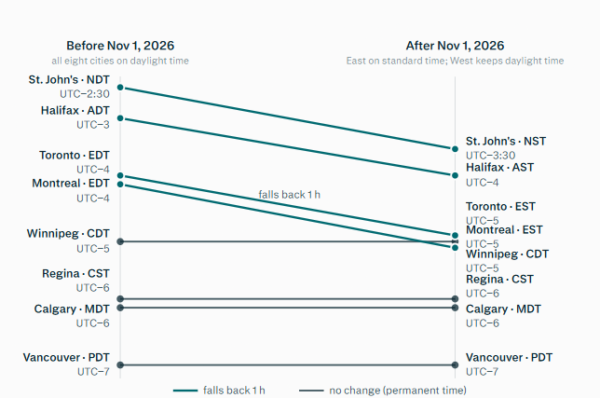
That means for me living here in Oakville, just west of Toronto, instead of three hours behind in the winter, Vancouver will be two hours back, Calgary and Edmonton will be an hour back, and Winnipeg will be on the same time until Toronto leaps to DST in the spring. For points east, nothing will change.
Quebec like Ontario, returns to EST on Sunday, but the province is still determining whether to return to DST next year or adopt EST year-round.
If all of the above seems confusing, maybe the following chart can help clarify what this mishmash of time changes will do to major cities across the country:
The United States has yet to make the moves being done in Canada, but the House of Representatives have passed the Sunshine Protection Act legislation for the country to adopt DST year-round. Should the Senate approve the switch, then the U.S. will eliminate some of the biological impact issues of twice-annual time switches as described below.
Biological Impacts of Time Jet Lag
Ask for medical advice on whether to adopt DST or Standard Time year round, and the vast majority of those who study sleep argue in favour of permanent standard time.
Twice-yearly clock changes impact our circadian clock, which temporarily becomes misaligned. This negatively impacts sleep-wake times, meal times, blood pressure, and even natural immune system function. The fall back to create more evening light affects melatonin release, which promotes sleep. The impact of spring forward and fall back is asymmetric.
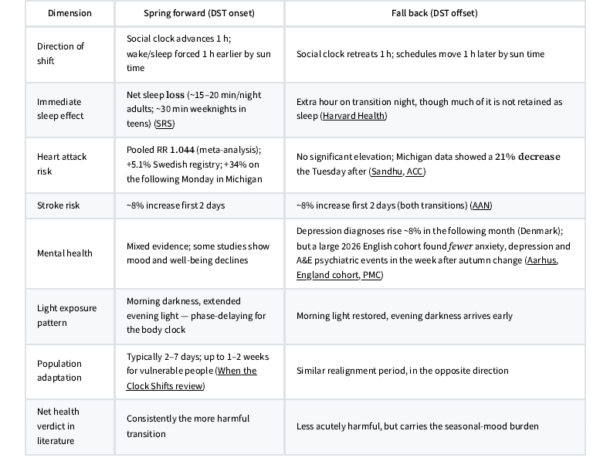
Asymmetric in what way? The coming fall back is seen as less harmful than the spring forward. Studies show that fall back is associated with an 8% increase in depression with less usable evening daylight. Spring forward studies indicate an increased risk of heart attack. A Michigan study noted a 34% increase in cardiac arrest events on the Monday after the time change. Other studies show an 8% increase in ischemic stroke events in the first two days.
Who is most affected? People with sleep disorders, for one. Studies show that adults sleep 15 to 20 minutes less for the week following the spring time change. Diabetics and those with cardiovascular disease are also at greater risk. School-age children often struggle with the change in sleep-wake times. Shift workers can also be negatively impacted.
The following chart shows a comparison between the impacts of spring and fall semiannual time changes:
It will be interesting to see what further research shows, beginning with the changes happening in Western Canada tomorrow. I suspect this national experiment in time change management will be closely followed.